




01. Edit your form online
Type text, add images, blackout confidential details, add comments, highlights and more.

Type text, add images, blackout confidential details, add comments, highlights and more.

Draw your signature, type it, upload its image, or use your mobile device as a signature pad.

Send it via email, link, or fax. You can also download it, export it or print it out.
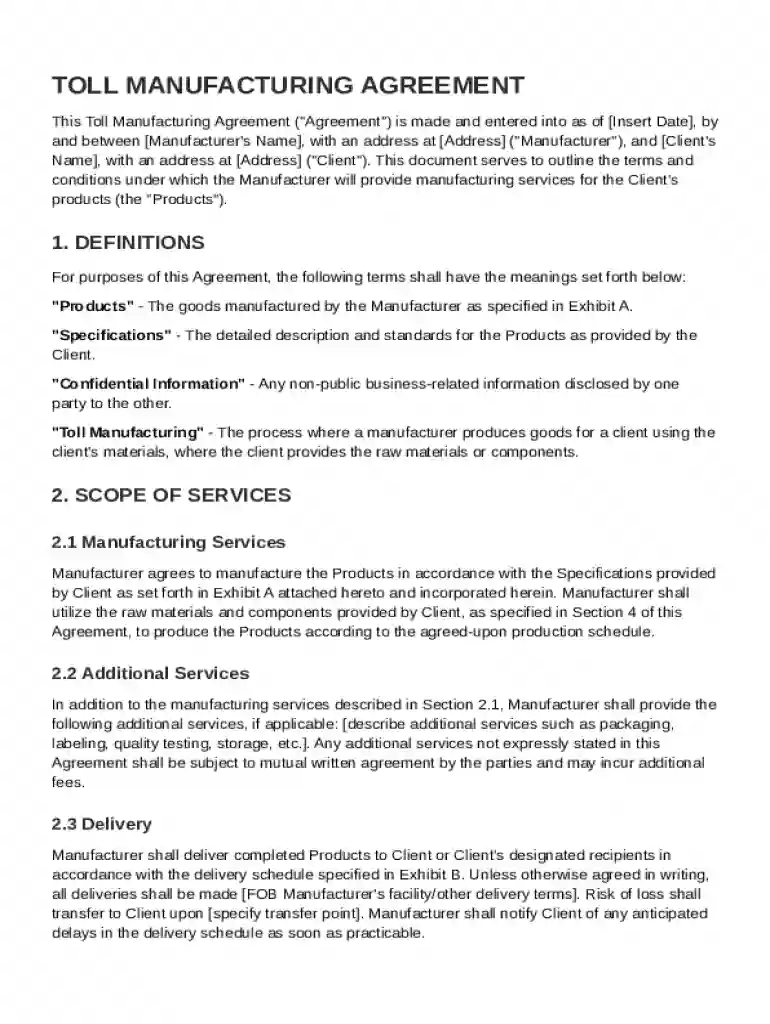
A Toll Manufacturing Agreement Template is a legal document that outlines the contractual terms between a manufacturer and a client for the production of the client's products using the client's materials. This agreement sets forth the responsibilities of both parties in detail, encompassing areas such as product specifications, quality standards, pricing, and confidentiality. It serves to protect both parties by clarifying obligations and rights concerning raw material usage, product manufacturing, and intellectual property. The term "Toll Manufacturing" refers to the process where a company, the client, outsources the manufacturing of its products to another company, the manufacturer, while retaining ownership of the raw materials.
To utilize the Toll Manufacturing Agreement Template effectively, parties should first review the standard terms and customize them to fit specific needs. Begin by identifying particular clauses that may require tailoring to address business-specific concerns, such as unique raw materials or production processes. Parties should carefully draft sections related to confidentiality and intellectual property to ensure adequate protection.
Understanding the language used in a Toll Manufacturing Agreement is crucial for both parties. Common terms include:
Completing a Toll Manufacturing Agreement requires careful attention to detail and a step-by-step approach to ensure all components are accurately filled in.
The Toll Manufacturing Agreement must be employed in compliance with U.S. contract law to ensure its enforceability. Parties should be aware of the legal guidelines surrounding such agreements, especially concerning intellectual property protection and confidentiality provisions. Both parties must sign the agreement to formalize the contractual relationship, and each should retain a signed copy.
Several elements are fundamental to formulating a robust Toll Manufacturing Agreement. These components work collectively to create a clear, comprehensive outline of the parties' rights and obligations.
Typically, businesses involved in product manufacturing from diverse sectors utilize Toll Manufacturing Agreements. Companies that lack the facilities or resources to produce their goods might engage with specialized manufacturers for these services. Common industries include pharmaceutical companies, cosmetics manufacturers, and food and beverage industries.


Although the general framework of a Toll Manufacturing Agreement remains consistent across the United States, certain states may impose specific legal requirements. These can include regulations regarding environmental compliance, safety standards, and employment laws affecting on-site labor.
At DocHub, your data security is our priority. We follow HIPAA, SOC2, GDPR, and other standards, so you can work on your documents with confidence.


Jan 1, 2011 Toll manufacturing. In practice, a manufacturing agreement (joint product or production process improvement with emphasis on IP.
Part 80 covers definitions, exemptions, licenses, safeguarding, manufacturers, distributors, research, prescribing, and dispensing controlled substances in NYS.


