




01. Edit your sc form sc1120 instructions 2022 online
Type text, add images, blackout confidential details, add comments, highlights and more.

Type text, add images, blackout confidential details, add comments, highlights and more.

Draw your signature, type it, upload its image, or use your mobile device as a signature pad.

Send taxation topics via email, link, or fax. You can also download it, export it or print it out.
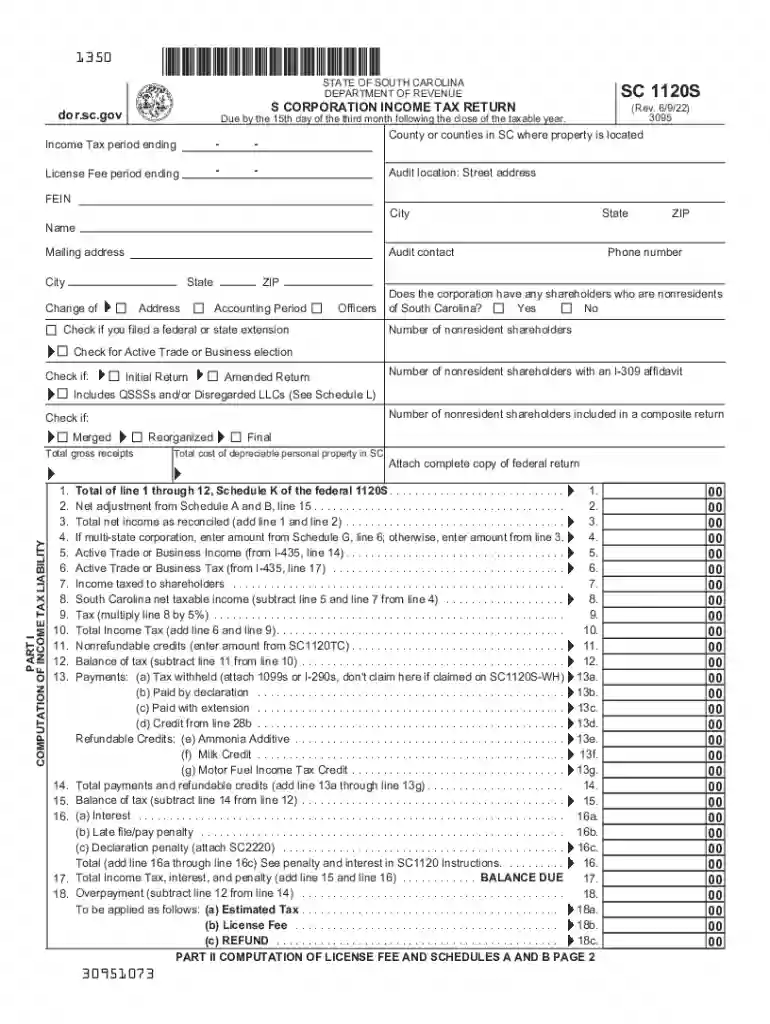
The SC 1120S form, issued by the South Carolina Department of Revenue, is the South Carolina Income Tax Return specifically for S corporations. This form is integral for businesses classified as S corporations in South Carolina to report their financial details, ensuring tax obligations are met correctly and in compliance with state regulations. It includes sections detailing the reporting of gross receipts, calculating taxable income, and license fees. The SC 1120S is pivotal in aligning a corporation’s financial activities with state tax laws.
This form is predominantly used by businesses classified as S corporations operating within South Carolina. S corporations, known for their pass-through taxation, utilize the SC 1120S to ensure that their income, deductions, and credits are appropriately documented and reported to the state. Both new and established businesses structured as S corporations are required to file this return. The form is vital for business owners to communicate financial standings and fiscal activities to state authorities.


The SC 1120S form must be filed by the 15th day of the third month following the close of the taxable year, typically March 15 for calendar-year taxpayers. Timely filing is crucial to avoid penalties and ensure compliance with state requirements. Businesses should mark this date and prepare well in advance to meet the necessary obligations.
Legally, S corporations in South Carolina are required to file the SC 1120S to report state income taxes appropriately. This form ensures that the state receives accurate information on corporate earnings and tax liabilities, maintaining a lawful standing with regard to state taxation policies. Non-compliance can result in fines, penalties, and other legal ramifications.
Failing to file the SC 1120S by the deadline can lead to significant penalties. These may include financial fines based on the unpaid tax amount and additional charges for each month the return is late. Accurate and timely filing is essential to avoid costly repercussions that can impact a business's financial health and operational reputation.
South Carolina has particular requirements for S corporations that must be considered:
Understanding these rules helps S corporations align their operations and tax obligations with state expectations, ensuring compliance and minimizing potential legal issues.
We've got more versions of the sc form sc1120 instructions 2022 form. Select the right sc form sc1120 instructions 2022 version from the list and start editing it straight away!
| Versions | Form popularity | Fillable & printable |
|---|---|---|
| 2025 | 4.8 Satisfied (24 Votes) | |
| 2024 | 4.9 Satisfied (36 Votes) | |
| 2023 | 4.3 Satisfied (59 Votes) | |
| 2022 | 4.6 Satisfied (22 Votes) | |
| 2021 | 4.8 Satisfied (57 Votes) | |
| 2020 | 4.3 Satisfied (83 Votes) | |
| 2019 | 4.4 Satisfied (73 Votes) | |
| 2018 | 4 Satisfied (40 Votes) | |
| 2017 | 4.3 Satisfied (144 Votes) | |
| 2016 | 4.3 Satisfied (96 Votes) | |
| 2015 | 4 Satisfied (32 Votes) | |
| 2014 | 4 Satisfied (57 Votes) | |
| 2010 | 4.2 Satisfied (67 Votes) | |
| 2008 | 4.6 Satisfied (59 Votes) | |
| 2007 | 4 Satisfied (43 Votes) |
At DocHub, your data security is our priority. We follow HIPAA, SOC2, GDPR, and other standards, so you can work on your documents with confidence.
Sep 3, 2008 Checks must be made payable to: SC DEPARTMENT OF REVENUE. 2. Verify the dollar and written amount of the check. 3. Indicate type of tax andRead more
SC 1120S. (Rev. 6/17/25). 3095. Due by the 15th day of the third month following the close of the taxable year. STATE OF SOUTH CAROLINA. DEPARTMENT OF REVENUE.Read more


