
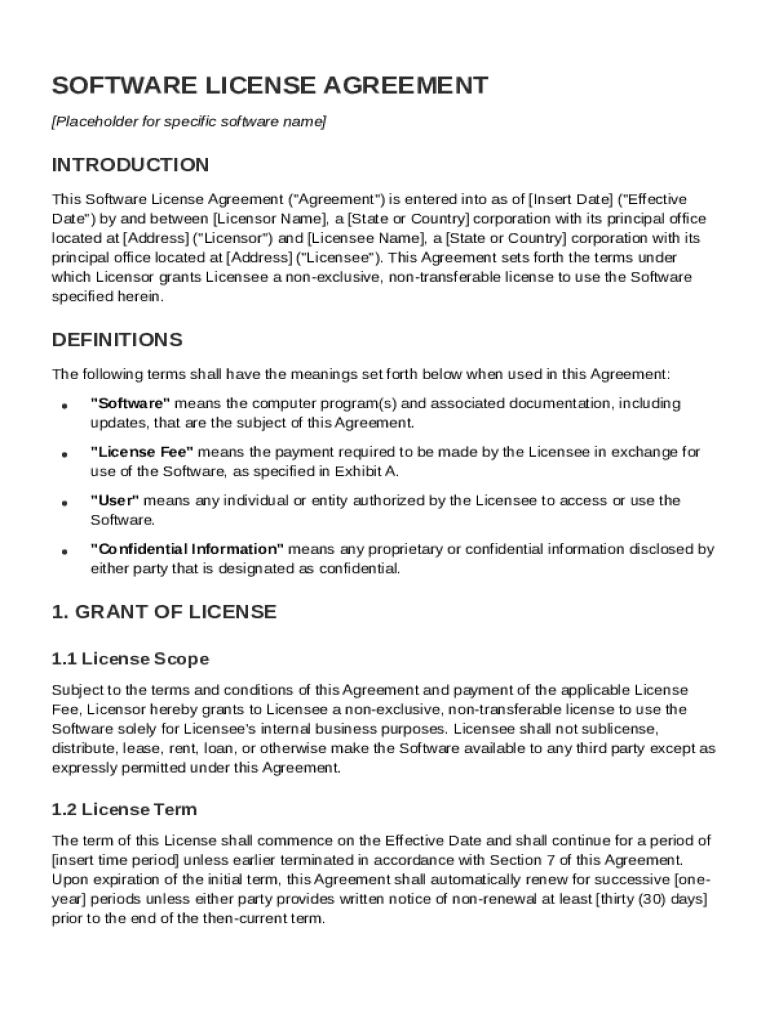







Definition & Meaning
A Software License Agreement Template is a pre-drafted document that outlines the legal framework under which a licensor provides a licensee access to use specific software. It is a non-exclusive, non-transferable license, indicating that while the licensee can use the software, they do not own it and cannot distribute it. This template establishes guidelines for internal business purposes, ensuring both parties have a clear understanding of rights, responsibilities, and limitations.
Key Elements of the Agreement
- Definitions: Clear explanations of terms such as "Licensor", "Licensee", and "Software."
- License Scope: Specifies what the license covers, including usage rights and limitations.
- Payment Obligations: Details associated fees and payment schedules.
- Restrictions: Provides boundaries on how the software can and cannot be used.
How to Use the Software License Agreement Template
Using this template involves tailoring it to fit the specific needs of the software being licensed. Start by reviewing each section of the template to understand its purpose and relevance.
- Customization: Modify terms to suit the agreement specifics, such as license duration and scope.
- Consultation: Engage with legal advisors to ensure compliance with applicable laws.
- Review Cycle: Have both parties review for accuracy and clarity before finalizing.
Common Scenarios of Use
- Startups: Crafting agreements when licensing software for internal use.
- Software Developers: Providing access to users under controlled conditions.
- Enterprises: Licensing third-party applications for corporate environments.
Steps to Complete the Software License Agreement Template
Completing the template requires a systematic approach to ensure all relevant elements are addressed.
- Identify Participants: Clarify the roles of the licensor and licensee.
- Define Software Details: Include name, version, and description of the software.
- Set Terms: Input specific terms such as license period and renewal options.
- Detail Restrictions: Specify any usage, distribution, or modification limitations.
- Outline Support Parameters: Define what support and maintenance, if any, will be provided.
Important Considerations
- Intellectual Property: Reaffirm who maintains ownership of the software.
- Security Measures: Address data protection and confidentiality requirements.
- Termination Clauses: Outline scenarios where the agreement may be revoked.
Important Terms Related to Software License Agreement Template
Understanding the terminology used within a software license agreement is crucial for clarity and effectiveness.
- Non-Exclusive License: A license that does not prevent the licensor from offering the same license to others.
- Non-Transferable License: Restricts the licensee from transferring rights to another party.
- Indemnification Clause: Protects parties from breaches caused by the other party.
- Governing Law: Specifies which state or nation’s laws will apply to the agreement.
Legal Use of the Software License Agreement Template
These agreements are enforceable under the ESIGN Act, which validates electronic signatures. Compliance with this Act ensures signatures collected digitally are legally binding.
Compliance Requirements
- Electronic Signature Usage: Both parties must agree to use electronic signatures.
- Confidentiality Agreement: Obligation to keep sensitive information private and secure.
Risk Mitigation Strategies
- Regular Reviews: Periodically review terms to ensure continued relevance.
- Audit Trails: Maintain records of signature and document access to provide accountability.
Examples of Using the Software License Agreement Template
Here are some real-world scenarios illustrating the use of this template:
- Small Businesses: Implementing third-party CRM software with specific usage limitations.
- Developers: Licensing development tools to freelance software engineers.
- Corporate IT Departments: Establishing guidelines for employees using specialized internal applications.
Case Studies
- Tech Startup: A new company uses the template to secure middleware for development purposes.
- Enterprise Software Provider: Establishes a multi-user license for a data analytics platform.
Key Elements of the Software License Agreement Template
These elements ensure the document serves its legal purpose effectively:
- Intellectual Property Rights: Confirm ownership remains with the vendor.
- Support Provisions: Specify what technical assistance is available.
- Warranty and Liability: Limit liability to control risk exposure.
- Termination Rights: Conditions that allow either party to exit the agreement.
Nuances and Variations
- Custom Software: May require tailored terms for unique software capabilities.
- International Agreements: Adaptations for different jurisdictions and laws.
Business Types That Benefit Most from the Software License Agreement Template
Understanding which businesses benefit can guide effective use of the template.
Benefiting Business Models
- SaaS Providers: Offer subscription-based access managed through licenses.
- IT Consulting Firms: Utilize licensed tools for client deliverables.
- Educational Institutions: License educational software to enhance learning experiences.
Practical Applications
- Retail Chains: Using POS software licensed through clear agreements.
- Healthcare Providers: Licensing EHR systems with confidentiality clauses.
Digital vs. Paper Version
Both versions of the agreement have specific considerations that may influence the decision to use one over the other.
Digital Version
- Advantages: Quick distribution and updates; easy integration with digital signature solutions.
- Considerations: Requires electronic signature compliance; suitable for remote transactions.
Paper Version
- Advantages: Tangible document for in-office or in-person agreements.
- Considerations: Requires physical signature collection; harder to amend once completed.
By following these structured steps and detailed insights, businesses can effectively utilize a Software License Agreement Template to manage software use, protect intellectual property, and maintain clear terms with minimal risk.




