






Definition and Meaning
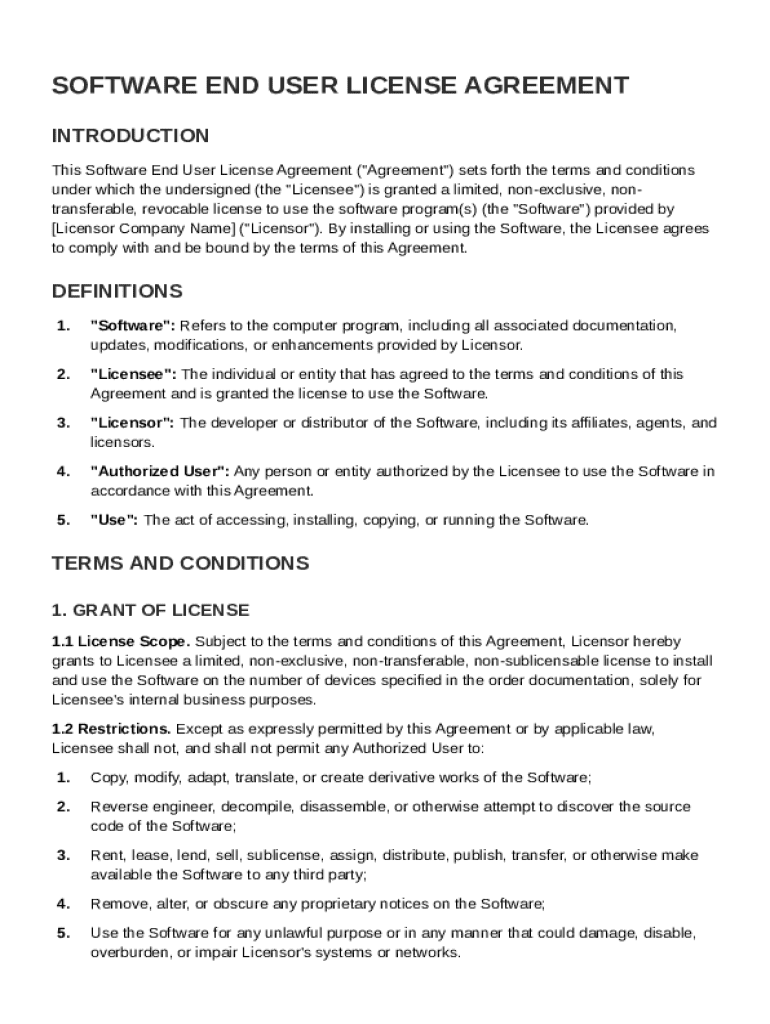
A Software End User License Agreement (EULA) is a legal contract between a software licensor (the creator or rights holder of the software) and the licensee (the user of the software). It outlines the terms and conditions under which the Licensee is granted a limited, non-exclusive right to use the software. The EULA includes important details such as the scope of the license, usage restrictions, ownership rights, payment obligations, warranty limitations, and confidentiality requirements. Its primary purpose is to protect the licensor's intellectual property rights while providing the user with the necessary permissions to use the software.
Key Elements of the Software End User License Agreement Template
A comprehensive Software End User License Agreement Template should contain several critical elements:
- Grant of License: Specifies the rights given to the licensee, defining the extent to which the software can be used.
- Restrictions: Details any limitations on use, such as prohibiting reverse engineering or duplicating the software for distribution.
- Intellectual Property Rights: Affirms that ownership of the software and all related intellectual property remains with the licensor.
- Payment Terms: Outlines the payment obligations of the licensee, including any fees for additional features or services.
- Warranty and Liability: Addresses any software warranties and limits the licensor's liability in case of software malfunctions or issues.
- Confidentiality Obligations: Protects any proprietary information that may be exchanged between parties.
- Termination Conditions: Defines the circumstances under which the agreement can be terminated by either party.
- Governing Law: Indicates which jurisdiction's laws will govern the agreement in case of disputes.
Steps to Complete the Software End User License Agreement Template
- Review the Template: Carefully read each section of the agreement to understand the terms and conditions.
- Customizing the Document: Modify the template to reflect specific terms relevant to the software and the parties involved.
- Input Parties' Information: Include full names and contact details of both the licensor and the licensee.
- Specify License Details: Clearly define the type and scope of the license, including any usage limitations.
- Negotiate Terms: Discuss any negotiable terms with the other party to reach a mutual understanding.
- Seek Legal Advice: Consider consulting with a legal professional to ensure compliance with applicable laws and regulations.
- Finalizing the Agreement: Have both parties sign the document to make it legally binding.
Important Terms Related to Software End User License Agreement Template
- Licensor: The party that owns the software and grants the license to the user.
- Licensee: The user or entity that is granted rights to use the software under the agreement.
- Non-Exclusive License: Allows the licensor to grant multiple licenses to different users simultaneously.
- Intellectual Property: Refers to the legal rights over creations of the mind, including the software and its code.
- Confidential Information: Information that is not publicly known and is protected under the agreement.
Legal Use of the Software End User License Agreement Template
The EULA template is used to create a legally binding agreement that governs the use of software. Legal use implies full adherence to the terms set out in the agreement, ensuring both parties understand their rights and obligations. It's essential to ensure:
- Compliance with Copyright Laws: Protects intellectual property and limits unauthorized use.
- Adherence to Data Protection Regulations: Especially if the software processes personal data.
- Fulfilling License Conditions: Avoiding any unapproved uses which could void the agreement.
Who Typically Uses the Software End User License Agreement Template
Various parties can benefit from a Software End User License Agreement Template, including:
- Software Developers and Companies: To protect their software products and intellectual property rights.
- Entrepreneurs: When developing new software products and platforms.
- Corporate IT Departments: For internal software development and licensing agreements.
- Independent Software Vendors (ISVs): For commercializing software and dealing with end-users.


Examples of Using the Software End User License Agreement Template
- Commercial Software Release: Setting up agreements with customers upon purchasing software licenses.
- Custom Software Development: Creating agreements for bespoke software solutions provided to clients.
- SaaS Platforms: Licensing agreements for subscription-based software services, stipulating the terms for ongoing use.
Versions or Alternatives to the Software End User License Agreement Template
Different versions of the EULA template may be adapted for various types of software, including:
- Open Source EULAs: Allow users to modify and distribute the software under certain conditions.
- Proprietary Software EULAs: Designed for software that users can't modify.
- Enterprise EULAs: Catered to corporate environments with multiple users and devices.
Using these templates effectively helps ensure the legal and operational integrity of software distribution and use agreements.