
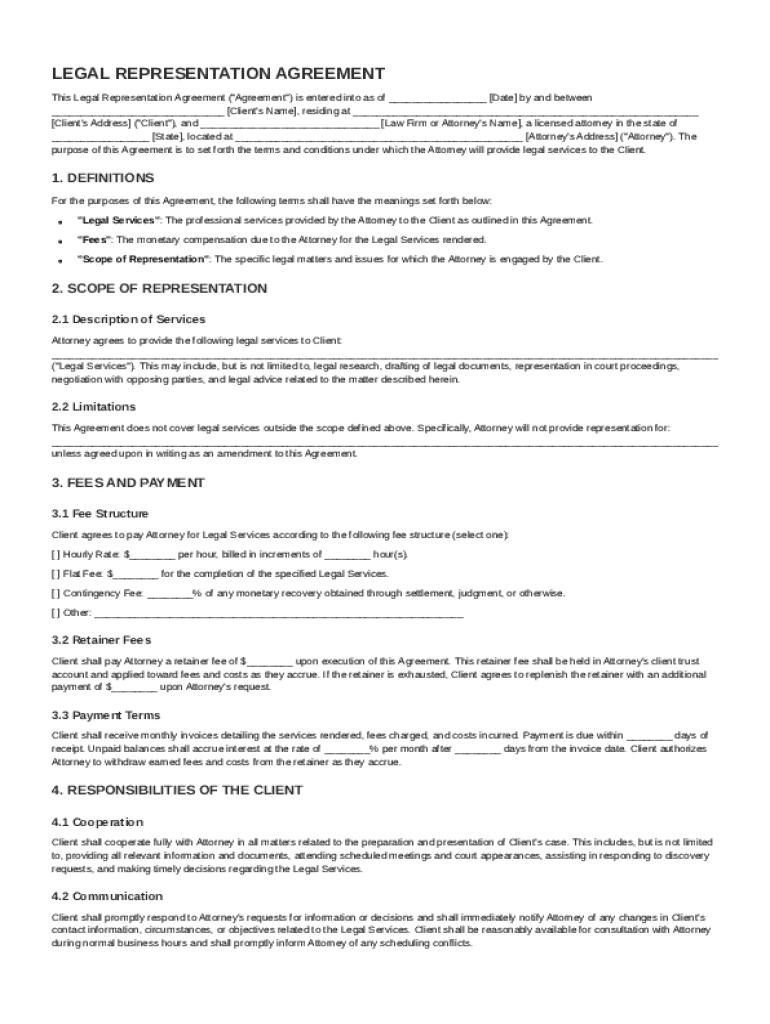







Definition & Meaning
The Legal Representation Agreement Template is a vital document that establishes the relationship between a client and an attorney. This agreement outlines the essential terms and conditions under which legal services will be provided. It includes key aspects such as the scope of representation, fee structures, client responsibilities, and termination conditions. The primary purpose of this template is to ensure a clear understanding between both parties regarding their professional engagement. By defining these terms, both the attorney and the client are protected, and potential conflicts can be minimized.
Key Elements of the Legal Representation Agreement Template
The template is composed of several critical sections that define the attorney-client relationship:
- Scope of Representation: This section specifies what legal services the attorney will provide, ensuring that both parties have a unified understanding of the tasks included.
- Fee Structures: Details the financial terms, including retainer fees, hourly rates, or fixed fees, and any payment schedules or conditions.
- Client Responsibilities: Outlines obligations the client must fulfill, such as providing accurate information and timely communication.
- Termination Conditions: Offers conditions under which the agreement can be terminated, either by the client or the attorney.
- Confidentiality Obligations: Ensures that client information is kept confidential, respecting legal and ethical standards.
Each element aims to protect both the client and attorney by ensuring that expectations are clearly outlined and agreed upon.
Steps to Complete the Legal Representation Agreement Template
To successfully fill out the Legal Representation Agreement Template, several steps should be followed:
- Identify Both Parties: Clearly state the names and contact details of the client and the attorney.
- Define the Legal Services: Specify the areas of law and the specific services the attorney will provide.
- Establish Financial Terms: Document fee structures, including advance payments, billing cycles, and methods of payment.
- Clarify Responsibilities: Ensure that client obligations are clearly listed, including necessary documentation and information.
- Outline Conditions for Termination: Define how either party may end the agreement and any necessary notice period.
- Sign the Agreement: Both parties should sign and date the document to acknowledge their understanding and acceptance of the terms.
Each step is crucial to ensure that the agreement is comprehensive and legally binding.
Important Terms Related to Legal Representation Agreement Template
Understanding specific terms within the Legal Representation Agreement Template is essential:
- Retainer Fee: An upfront cost paid to secure legal services, often credited against future work.
- Billable Time: Any time spent by the attorney working on the client's behalf that will be charged.
- Client's Disclosure: The obligation to provide truthful and complete information relevant to the case.
- Attorney-Client Privilege: A legal privilege that maintains the confidentiality of communications between the lawyer and client.
Familiarity with these terms helps clients to better understand their rights and obligations.
State-Specific Rules for the Legal Representation Agreement Template
While the template provides a general framework, it may need adjustments based on local laws:
- Fee Arrangements: Some states have specific rules about contingent fees or require written fee agreements above certain amounts.
- Client's Rights: Regulations may mandate that certain client rights are explicitly stated, including the right to terminate the agreement at any time.
- Dispute Resolution: States may have preferred methods for resolving conflicts, such as arbitration.
For accurate and compliant use, it's crucial to consider these state-specific legal requirements when completing the agreement.
Who Typically Uses the Legal Representation Agreement Template
This template is primarily used by:
- Clients seeking legal services: Individuals or businesses in need of legal advice or representation in various matters, including family law, business disputes, or real estate transactions.
- Attorneys and law firms: Legal professionals who wish to formalize their engagement with clients and protect their professional interests through a robust contractual framework.
- Corporate legal departments: Companies that need to frequently engage external legal counsel and standardize their legal processes.
Understanding who uses this template can guide clients and attorneys in tailoring the document to their specific needs.


Legal Use of the Legal Representation Agreement Template
Using this template within the boundaries of the law ensures that it remains valid and enforceable:
- Contractual Law Compliance: The agreement must adhere to principles of contract law, including offer, acceptance, and consideration.
- Ethical Obligations: Attorneys must comply with ethical standards, ensuring that the agreement does not contain unethical or illegal terms.
- Consumer Protection Laws: Certain provisions may be influenced by laws designed to protect clients from exploitation or unfair practices.
These legal aspects underscore the importance of ensuring that the agreement is drafted accurately and legally.
Versions or Alternatives to the Legal Representation Agreement Template
While the traditional template provides broad coverage, there may be variations or alternatives tailored to specific needs:
- Limited Scope Representation Agreements: Used when a client requires targeted assistance in a specific legal domain.
- Contingency Fee Agreements: Typically applicable in personal injury cases where attorney fees are a percentage of the settlement.
- Flat Fee Agreements: Suitable for routine legal services where the scope and duration are well-defined.
Understanding these alternatives helps clients and attorneys choose the document format that best suits their unique circumstances.




