




01. Edit your form online
Type text, add images, blackout confidential details, add comments, highlights and more.

Type text, add images, blackout confidential details, add comments, highlights and more.

Draw your signature, type it, upload its image, or use your mobile device as a signature pad.

Send it via email, link, or fax. You can also download it, export it or print it out.
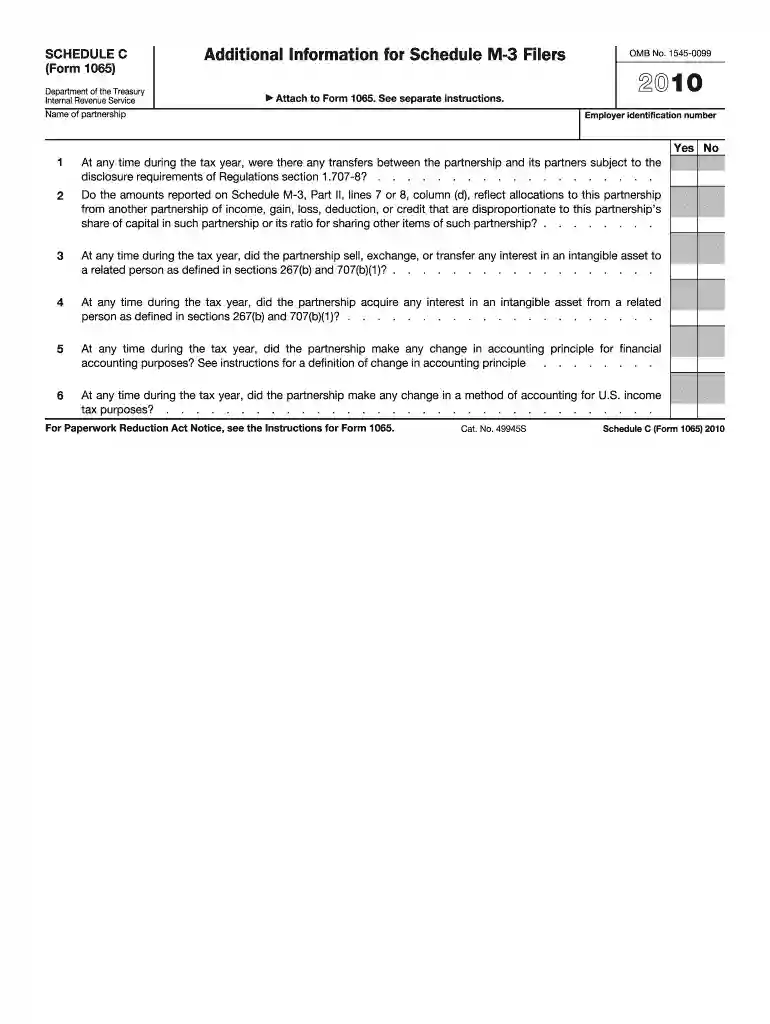
The 2010 Schedule C (Form 1065) is an integral part of the Internal Revenue Service (IRS) forms utilized by partnerships to provide additional financial details. Specifically, it accompanies the Schedule M-3, helping partnerships disclose information about financial and accounting shifts pertaining to their operations. This information includes transactions between partners, allocations from other partnerships, and changes in accounting principles or methods during the fiscal year.
Understanding how to effectively utilize the 2010 Schedule C is crucial for accurate tax reporting. This form requires precise data entry regarding partnership activities and is generally filled out by the partnership’s accountant or tax advisor.
Filing the Schedule C involves several meticulous steps to ensure comprehensive reporting.
Understanding specific terminology associated with the Schedule C is vital for effective handling.
Partnership Allocations: Distribution of income or loss among partners.
Capital Contributions: The assets or resources contributed by a partner to the partnership.
Operational Method Changes: Adjustments in accounting practices within the partnership entity.
Familiarity with these terms aids in accurately filling out financial sections that detail complex transactions.
The proper legal application of this form is mandatory to abide by federal taxation laws.
The Schedule C ensures that partnerships report operational data transparently, minimizing potential legal consequences.
Non-compliance or misreporting can lead to audits, fines, or legal action by the IRS.
Each entry on the form must be justifiable with underlying financial records.
Partnerships should engage legal or tax professionals to ensure all data included meets IRS standards and legal requisites.
Submitting the Schedule C on time is crucial to avoid penalties.
Standard Submission: Typically due by March 15th for calendar year partnerships.
Extensions: Filing for an extension is possible but should be done before the regular due date to avoid interest on any taxes owed.
Compliance with these deadlines is necessary to avoid late fees and ensure that the partnership’s tax filings are processed without delay.
Completing the Schedule C necessitates several supporting documents.
Failure to accurately complete and file the Schedule C can result in significant consequences for the partnership.
Monetary fines can accrue daily until compliance is achieved.
Continued non-compliance may trigger audits and further financial scrutiny.
Partnerships are encouraged to maintain diligent records and seek professional advice to avoid these repercussions.
By adhering to these guidelines, partnerships can ensure compliance with IRS regulations and avoid unnecessary legal or financial penalties. Understanding the 2010 Schedule C (Form 1065) promotes transparency and accuracy in financial reporting, a cornerstone of sound fiscal management in partnerships.
We've got more versions of the 2010 Schedule C (Form 1065) - Internal Revenue Service - irs form. Select the right 2010 Schedule C (Form 1065) - Internal Revenue Service - irs version from the list and start editing it straight away!
If you regularly deal with documents kept in your Google Drive, DocHub is an excellent solution for you to easily and quickly complete, adjust, and sign them. This editor integrates properly with Google apps, so you can export your 2010 Schedule C (Form 1065) - Internal Revenue Service - irs from your Google Drive to the editor without the need of downloading and re-uploading it. Right-click on your document, choose Open With → DocHub PDF Sign and Edit. In our editor, add and assign Signature Fields for all parties involved, then click on the Menu button above → Send → choose how you want to share your paperwork.
You can get and edit your 2010 Schedule C (Form 1065) - Internal Revenue Service - irs online by using DocHub. Its straightforward yet feature-rich design allows you to begin productive work right after you register your account. Create your profile and add your document, then our user interface will guide you through our stress-free form completion experience.
At DocHub, your data security is our priority. We follow HIPAA, SOC2, GDPR, and other standards, so you can work on your documents with confidence.
Partnerships file an information return to report their income, gains, losses, deductions, credits, etc. A partnership does not pay tax on its income.Read more
Apr 15, 1976 Increased section 179 deduction dollar limits. The maximum amount you can elect to deduct for most sec- tion 179 property you placedRead more
Attach to Form 1040, Form 1040NR, Form 1041, Form 1065, or Form 1065-B. See Instructions for Schedule F (Form 1040). If a profit, stop here and see instructionsRead more


