
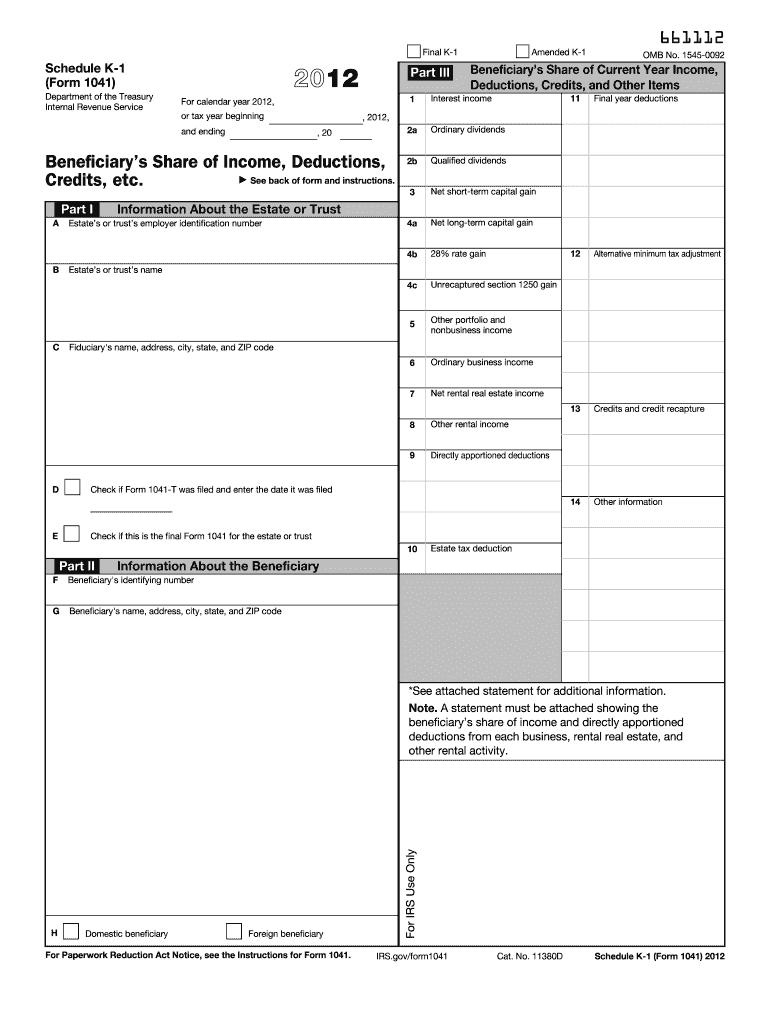







Definition and Purpose of Schedule K-1 (Form 1041)
Schedule K-1 (Form 1041) for the year 2012 is a document used by the Internal Revenue Service (IRS) to report the income, deductions, credits, and other financial distributions that beneficiaries receive from an estate or trust. This form is crucial for reflecting the financial activities of the trust or estate and ensuring transparency in reporting individual shares for tax purposes.
Role in Tax Filing
- Beneficiaries of estates and trusts use Schedule K-1 to accurately complete their individual tax returns.
- It details various income types, including dividends, capital gains, and rental income, which affect personal tax liabilities.
- Understanding how each category impacts tax calculations is vital for compliance with IRS regulations.
Steps to Complete the Schedule K-1 (Form 1041) for 2012
Completing Schedule K-1 (Form 1041) involves several essential steps to ensure accuracy and completeness. Below is a step-by-step guide to filling out this form:
-
Gather Required Information: Collect all relevant financial documents, including previous tax returns, estate or trust financials, and distribution records.
-
Identify Income Distribution: Clearly outline all categories of income distributed to beneficiaries, such as interest, dividends, capital gains, and business income.
-
Deductions and Credits: Calculate any applicable deductions or credits that apply to the beneficiary's share from the estate or trust.
-
Allocate Shares: Divide the income, deductions, and credits among beneficiaries according to the terms set forth in the estate or trust agreement.
-
Complete Identifying Information: Ensure all information, like names, addresses, and Taxpayer Identification Numbers (TINs), is correctly reported.
-
Review and Submit: Double-check the form for accuracy, ensure it conforms with IRS guidelines, and attach the form to the beneficiary’s personal tax return.
How to Obtain the Schedule K-1 (Form 1041)
Available Sources
- IRS Website: Download directly from the official IRS website.
- Tax Software: Many tax preparation software packages, such as TurboTax and QuickBooks, include fillable forms for ease of use.
- Professional Tax Preparers: Accountants or CPAs may provide this form as part of their tax preparation services.
Digital vs. Paper Version
- Digital Forms: Fillable online forms are available, providing quick access and easy completion.
- Paper Forms: Hard copies can still be obtained through traditional channels if preferred by the user.
Key Elements of Schedule K-1 (Form 1041)
Understanding the main components of Schedule K-1 is crucial for correct completion. Significant elements include:
- Partnership Percentages: Detailed breakdowns of each beneficiary’s percentage of distributed income.
- Income Categories: Sections specifying ordinary dividends, interest, and capital gains.
- Deductions and Credits: Areas to record relevant deductions and tax credits directly linked to estate or trust activities.
- Adjustments and Allocations: Includes methods to allocate shared expenses or capital losses.
IRS Guidelines for Schedule K-1 (Form 1041)
The IRS provides specific guidelines to ensure each Schedule K-1 is filled out correctly and efficiently. Key guidelines include:
- Accuracy and Completeness: Complete each section with precision, ensuring full transparency in all financial distributions.
- Timeliness: Meet all filing deadlines to avoid penalties.
- Consistent Reporting: Verify all reported information is consistent with other documents submitted to the IRS.
Filing Deadlines and Important Dates
Understanding critical deadlines is essential for avoiding penalties:
- Tax Year Alignment: Schedule K-1 must align with the fiscal year of the associated estate or trust.
- Extended Deadlines: If necessary, extensions for filing may be available, though this often requires additional documentation.
Penalties for Non-Compliance
Failure to comply with IRS requirements can result in penalties:
- Late Filing Penalties: Incurred if the form is not submitted by the deadline.
- Incorrect Information Penalties: If inaccuracies lead to underreporting of income or misrepresented tax obligations.
Software Compatibility and Integration
Popular Tax Software
Schedule K-1 (Form 1041) is compatible with several popular tax software solutions:
- TurboTax: Provides guided assistance and accuracy checks.
- QuickBooks: Integrates business financials for streamlined reporting.
- H&R Block: Offers additional auditor support for complex filings.
Benefits of Software Use
- Error Reduction: Automated calculations help prevent human errors.
- Efficient Data Management: Simplifies the data entry process and facilitates easy updates.
Business Types Benefiting from Schedule K-1 (Form 1041)
Common Types
Business entities that typically utilize this form include:
- Trusts: Taxable trusts must distribute income details to beneficiaries.
- Estates: Executors need to report distributions post-mortem to beneficiaries.
Why Schedule K-1 is Essential
- Accurate Reporting: Ensures all stakeholders are informed of their tax liabilities and benefits.
- Facilitates Better Planning: Enables long-term financial strategizing for trusts and estates.
Practical Examples of Using Schedule K-1 (Form 1041)
Real-World Scenarios
-
Family Trust Distributions: A trust set up to distribute income from invested assets among family members each year.
-
Inherited Rental Properties: Estates that include rental properties where income derived is divided among heirs.
-
Charitable Trusts: Trusts that distribute to charities where beneficiaries receive tax deductions.
By comprehensively understanding and applying this information, users can ensure compliance and optimize their tax planning by effectively utilizing Schedule K-1 (Form 1041) for estates and trusts.




