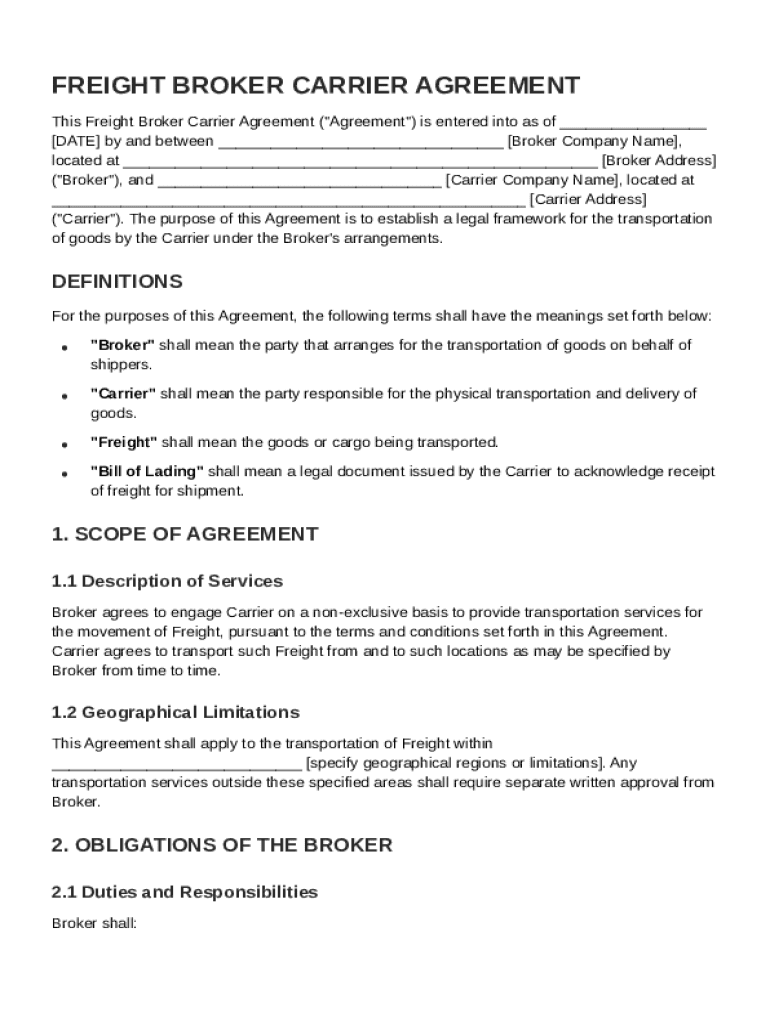







Definition & Meaning
A Freight Broker Carrier Agreement Template is a comprehensive legal document used to outline the contractual obligations between a freight broker and a carrier. This agreement serves as a foundational framework for the transportation of goods, specifying responsibilities, compensation terms, insurance requirements, and more. It establishes the role of the broker in arranging shipments and ensuring payment to the carrier, while the carrier is tasked with safely transporting goods according to specified regulations. Key aspects also include termination clauses, confidentiality agreements, and procedures for dispute resolution.
How to Use the Freight Broker Carrier Agreement Template
To effectively utilize the Freight Broker Carrier Agreement Template, users should follow these steps:
- Download the Template: Access the template through a reliable online platform like DocHub.
- Customize Details: Input specific information such as names of the parties involved, shipment details, and compensation terms.
- Review Obligations: Ensure that both broker and carrier responsibilities are clearly defined to avoid future disputes.
- Add Legal Provisions: Include any additional legal clauses necessary for compliance and risk management.
- Collect Signatures: Use an electronic signature option to finalize the agreement, making sure both parties sign the document.
Practical Example
A regional freight broker and a local trucking company form an agreement to transport goods from Los Angeles to San Francisco. The broker uses the template to outline the scheduled pickup and delivery times, payment terms, and equipment specifications required for the load. This ensures transparency and sets clear expectations for both parties.
Key Elements of the Freight Broker Carrier Agreement Template
The template encompasses several critical elements necessary for a binding contract:
- Identification of Parties: Names and contact information of both broker and carrier.
- Definitions: Clear definitions of terms used within the document to avoid ambiguities.
- Description of Services: The specific services the carrier is expected to provide, including loading, transportation, and delivery.
- Compensation: Details on how and when the carrier will be paid for their services.
- Insurance Requirements: Mandatory insurance coverage the carrier must maintain.
Additional Clauses
- Force Majeure: Provisions for scenarios where either party is unable to fulfill obligations due to unforeseen circumstances.
- Termination Terms: Conditions under which the agreement can be terminated by either party.
Important Terms Related to Freight Broker Carrier Agreement Template
Several key terms are essential for understanding and creating a valid Freight Broker Carrier Agreement:
- Broker: The entity arranging the transportation of goods on behalf of a shipper.
- Carrier: The entity responsible for physically transporting the goods.
- Shipper: The party requesting the shipment of goods.
- Consignee: The receiver of the freight at the delivery destination.
Legal and Logistical Terms
- Liability: The legal responsibility of the carrier during transit.
- Bill of Lading: A detailed list of goods being shipped, serving as a receipt.
Steps to Complete the Freight Broker Carrier Agreement Template
Completing the template involves several key steps:
- Initial Preparation: Gather all necessary business and shipment information.
- Introduction Section: Fill in basic details, including names and addresses of involved parties.
- Service and Compensation Details: Specify the type of freight, route, and payment terms.
- Legal Clauses: Incorporate legal requirements and ensure compliance with industry standards.
- Review and Finalize: Conduct a thorough review to ensure all details are correctly captured before signing.
Tips for Completion
- Use digital tools like DocHub for ease of input, amendment, and electronic signature.
- Consult legal advisors to customize the template if special clauses are required.
Legal Use of the Freight Broker Carrier Agreement Template
The template's legality hinges on compliance with both federal and state regulations, ensuring all activities align with the standards set by the U.S. Department of Transportation and other regulatory bodies. This agreement is essential for establishing a legal understanding, preventing fraud, and ensuring proper compensation.
Compliance Considerations
- FSMA Compliance: Ensures adherence to the Food Safety Modernization Act when transporting food products.
- DOT Regulations: Adherence to U.S. Department of Transportation's rules for goods transportation.
State-Specific Rules for the Freight Broker Carrier Agreement Template
State laws can affect the content and enforcement of the Freight Broker Carrier Agreement. Different states may have unique requirements for transportation insurance, liability limits, and dispute resolution processes.
Examples
- California: May require additional environmental compliance disclosures.
- Texas: Could necessitate specific insurance liability minimums.
Why Should You Use the Freight Broker Carrier Agreement Template?
Having an agreement in place mitigates risks associated with the transportation of goods. It provides clarity on roles, responsibilities, and expectations, minimizing disputes and fostering a productive business relationship between brokers and carriers.
Benefits
- Risk Mitigation: Clearly defined terms help in managing liability and financial exposure.
- Efficiency: Streamlined process enhances operational efficiency and helps in managing logistics smoothly.
Who Typically Uses the Freight Broker Carrier Agreement Template?
The template is widely used by various business entities such as:
- Freight Brokers: Facilitators of goods movement.
- Carriers: Trucking companies or individual owner-operators.
- Logistics Companies: Businesses managing supply chain logistics.

Business Types
- Small Enterprises: Those needing flexible shipment solutions.
- Large Corporations: Managing multiple carriers and high volume shipments.