






Definition and Meaning of a Framework Agreement Template
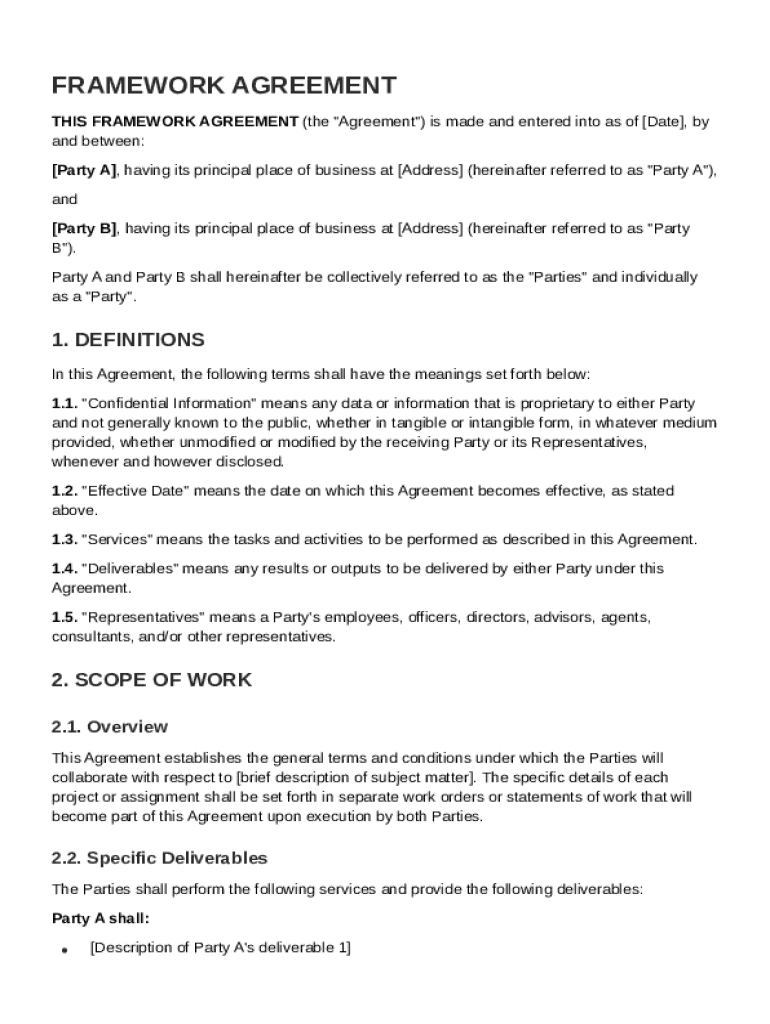
A Framework Agreement Template serves as a foundational document that establishes general terms and conditions for future transactions or collaborations between two or more parties, commonly referred to as Party A and Party B. This document is especially significant in business environments where ongoing interactions or multiple projects are expected. It outlines overarching themes such as the scope of work, payment terms, confidentiality obligations, intellectual property rights, governing law, and dispute resolution procedures. By setting these parameters, a framework agreement aids in defining roles and expectations, allowing individual projects to be executed efficiently under separate work orders, without the need for renegotiating basic terms each time.
How to Use the Framework Agreement Template
Using a Framework Agreement Template involves several steps to ensure that it suits the specific needs of the parties involved. Initially, each party must review the template to identify sections that require customization based on their unique requirements. Customization might include inserting specific payment terms, defining the scope of work more clearly, or adding clauses unique to the industry or relationship. Once customized, the parties should consult legal professionals to ensure the agreement aligns with legal standards and obligations. After revisions are completed, both parties must review the document thoroughly before signing, ensuring that it accurately reflects their understanding and intentions. For effective use, it's crucial to revisit and potentially update the framework agreement as business needs or legal standards evolve over time.
Key Elements of the Framework Agreement Template
A typical Framework Agreement Template includes several critical elements that provide a comprehensive reference for future collaboration:
- Terms and Definitions: Clearly define the key terms used throughout the agreement to avoid ambiguity.
- Scope of Work: Detail the nature and limitations of the projects expected under the agreement.
- Payment Terms: Specify how and when payments will be made, including any conditions or milestones.
- Confidentiality Obligations: Outline the responsibilities related to protecting sensitive information.
- Intellectual Property Rights: Address ownership and usage rights of creative works or proprietary information.
- Dispute Resolution Procedures: Establish methods for resolving disagreements, such as arbitration or mediation.
- Governing Law: Identify which legal jurisdiction's laws will apply to the agreement.
Including these elements ensures clarity and provides a solid foundation for operational efficiency and legal protection.
Legal Use of the Framework Agreement Template
The Framework Agreement Template is designed to facilitate legal compliance and clarity in business relationships. In the United States, it's essential for the agreement to align with federal and state laws, including contract law and intellectual property regulations. Parties must ensure the agreement is drafted in clear, concise language and doesn't involve any clauses that could be deemed unfair or unenforceable. Moreover, since the template includes legally binding terms, legal counsel should review it to guarantee that its provisions are enforceable and don't conflict with existing legal obligations or rights. By doing so, parties mitigate the risk of legal disputes and ensure smooth operational transactions.
Steps to Complete the Framework Agreement Template
To effectively complete a Framework Agreement Template, parties should follow these steps:
- Initial Review: Assess the template to understand its structure and key sections.
- Customization: Modify the template to reflect the specific terms and conditions pertinent to the relationship.
- Legal Consultation: Engage with legal advisors to ensure that the customized terms are legally sound.
- Internal Approval: Obtain necessary approvals from organizational stakeholders.
- Final Review: Conduct a thorough final review to confirm accuracy and completeness.
- Signing: Have both parties sign and date the agreement to formalize it.
- Ongoing Review: Periodically review and update the agreement as needed to reflect changes in business operations or legislation.
Following these steps helps in ensuring the agreement is comprehensive and accurately reflects the intentions of all involved parties.
Important Terms Related to the Framework Agreement Template
Understanding specific terms within a Framework Agreement Template is crucial for proper interpretation and usage:
- Party A and Party B: The entities involved in the agreement.
- Confidentiality Obligations: Guidelines on information protection between parties.
- Intellectual Property Rights: Defines how creations, inventions, etc., are handled.
- Dispute Resolution: The procedures for resolving conflicts, which may include court proceedings or alternative methods like arbitration.
- Governing Law: The jurisdiction whose laws govern the agreement.
Familiarity with these terms enables parties to navigate the agreement effectively and prevents misunderstandings.
Examples of Using the Framework Agreement Template
Framework Agreement Templates are utilized in various industries to streamline processes:
- Technology Companies: Establish long-term partnerships for software development projects.
- Construction Firms: Set terms for multiple projects with the same contractor to ensure consistency.
- Marketing Agencies: Agree on baseline terms for ongoing campaigns with clients.
- Educational Institutions: Create partnerships with external providers for student resources and programs.
These examples demonstrate the versatility of framework agreements in setting consistent expectations across diverse contexts.
Business Types that Benefit Most from Framework Agreement Template
Different business types leverage Framework Agreement Templates to enhance operational efficiencies:
- Startups: To ensure clear expectations with partners during rapid growth cycles.
- Multinational Corporations: For coordination across different locations and jurisdictions.
- Nonprofit Organizations: To manage collaborations with multiple service providers.
- Consulting Firms: To formalize engagements that involve varied projects over time.
These entities benefit from the template's ability to establish reliable and lasting partnerships under defined terms.