
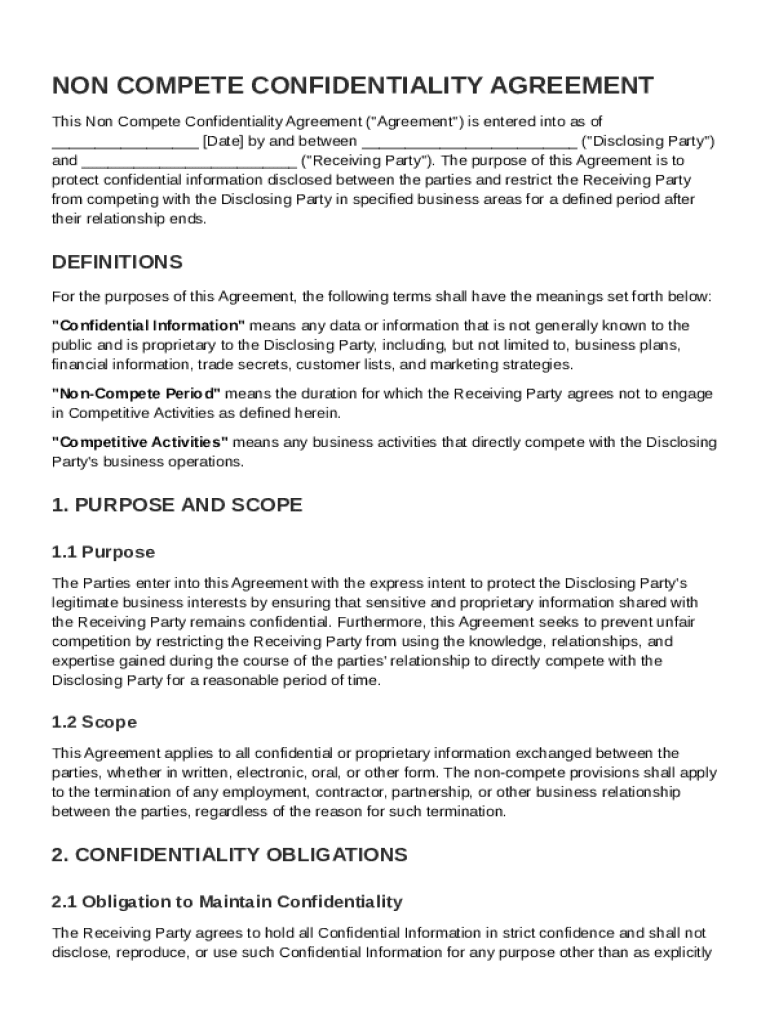







Definition and Purpose of a Non Compete Confidentiality Agreement
A Non Compete Confidentiality Agreement is a legal document designed to safeguard sensitive information shared between two parties, known as the Disclosing Party and the Receiving Party. This agreement is crucial in preventing the Receiving Party from participating in competitive activities for a defined period after their relationship ends, thus ensuring that confidential business information remains protected. Key elements typically covered include definitions, confidentiality obligations, non-compete terms, remedies for breaches, and processes for dispute resolution.
How to Use the Non Compete Confidentiality Agreement Template
To utilize the Non Compete Confidentiality Agreement Template effectively, follow these steps:
-
Identify the Parties: Clearly define both the Disclosing Party and the Receiving Party. This is essential for specifying who is expected to maintain confidentiality and what information is protected.
-
Define Confidential Information: Clearly outline what constitutes confidential information to avoid ambiguity. This section should detail what is considered sensitive and proprietary.
-
Non-Compete Clause: Specify the duration and scope of the non-compete restrictions. This includes outlining the geographical limits and the nature of the competitive activities prohibited.
-
Agreement Customization: Use DocHub's editing tools to tailor the template to the specific needs of your business, such as adding additional clauses or modifying existing ones to fit specific requirements.
-
Review and Sign: Before finalizing, both parties should thoroughly review the agreement. Utilize DocHub’s electronic signature feature to collect legally binding signatures from all involved parties.
Steps to Complete the Non Compete Confidentiality Agreement Template
-
Open the Template: Access the Non Compete Confidentiality Agreement Template on DocHub. Ensure compatibility with your file format for a smooth editing process.
-
Edit the Content: Use DocHub’s comprehensive editing tools to insert relevant details, such as party names, confidential information descriptions, and termination conditions.
-
Set Permissions: If multiple users are involved in reviewing the document, set specific permissions for viewing or editing sections to maintain control over sensitive information.
-
Add Annotations: Utilize annotation tools to highlight crucial sections or add comments for clarification.
-
Final Review: Conduct a thorough final review with legal counsel if necessary, to ensure compliance with relevant state laws and business needs.
-
Collect Signatures: Use DocHub's feature to collect electronic signatures, maintaining legally binding status under the ESIGN Act.
Key Elements of the Non Compete Confidentiality Agreement Template
The Non Compete Confidentiality Agreement Template contains several critical components:
-
Confidentiality Obligations: Outlines the responsibilities of the Receiving Party to maintain the secrecy of specific information shared during and after the duration of the agreement.
-
Non-Compete Terms: Specifies restrictions on engaging in similar business activities that may compete with the Disclosing Party for a designated period and location.
-
Remedies for Breach: Details potential consequences and legal recourse available to the Disclosing Party if the Receiving Party violates terms of the agreement.
-
Dispute Resolution: Provides guidance on handling disputes that may arise from the agreement, often recommending mediation or arbitration.
-
Termination Conditions: Explains scenarios under which the agreement may be terminated, along with any applicable notice periods.
Legal Use of the Non Compete Confidentiality Agreement Template
The Non Compete Confidentiality Agreement Template must be used within the legal framework established by U.S. laws. Key considerations include:
-
State Laws: Ensure that the agreement complies with the specific legal requirements of the state where it will be enforced, as states may have differing restrictions on non-compete clauses.
-
Enforceability: Verify that the non-compete terms are reasonable in scope, duration, and geographic area to be considered enforceable in court.
-
Governing Law: Specify the state laws that will govern the agreement to prevent jurisdictional disputes.
State-Specific Rules for Non Compete Confidentiality Agreements
Each state in the U.S. may have unique guidelines and restrictions regarding non-compete agreements:
-
California: Notoriously restrictive, often rendering non-compete clauses unenforceable except in specific scenarios.
-
Texas and Florida: Generally allow non-compete agreements, provided they are reasonable in duration and scope.
-
New York: Often requires that non-compete clauses be limited to what is necessary to protect legitimate business interests.
Businesses must strive to adapt their agreements in compliance with their state's rules to ensure enforceability.
Examples of Using the Non Compete Confidentiality Agreement Template
The Non Compete Confidentiality Agreement Template can be applied in various business scenarios:
-
Startup Collaboration: When two startups collaborate on a project, the agreement protects proprietary technologies and business strategies from being used competitively.
-
Employee Exit: Ensures an employee who is leaving and starting their own business does not exploit sensitive information acquired during their tenure.
-
Vendor Relationships: Protects shared marketing plans or product designs when working with external vendors to prevent misuse of confidential data.
Digital vs. Paper Version
Using a digital version of the Non Compete Confidentiality Agreement Template offers several advantages:
-
Flexibility and Convenience: Digital forms can be edited, signed, and shared easily using platforms like DocHub, without the need for physical copies.
-
Real-Time Collaboration: Enables multiple stakeholders to review and amend the document simultaneously, streamlining the workflow.
-
Secure Access: Digital templates provide enhanced security measures such as encryption and password protection to safeguard sensitive information.
Businesses should consider these benefits when selecting a format for their agreements.
Business Types that Benefit Most from Non Compete Confidentiality Agreement Templates
Certain business types frequently employ these agreements to protect their interests:
-
Technology Firms: To shield proprietary codes and algorithms from being shared with competitors.
-
Healthcare Organizations: Protects client data and specialized medical procedures from misuse or fraudulent applications.
-
Financial Services: Ensures customer data and investment strategies remain confidential to maintain competitive advantages.
These businesses, among others, rely heavily on non-compete confidentiality agreements as a foundational component of their operational strategy.




