




01. Edit your form online
Type text, add images, blackout confidential details, add comments, highlights and more.

Type text, add images, blackout confidential details, add comments, highlights and more.

Draw your signature, type it, upload its image, or use your mobile device as a signature pad.

Send it via email, link, or fax. You can also download it, export it or print it out.
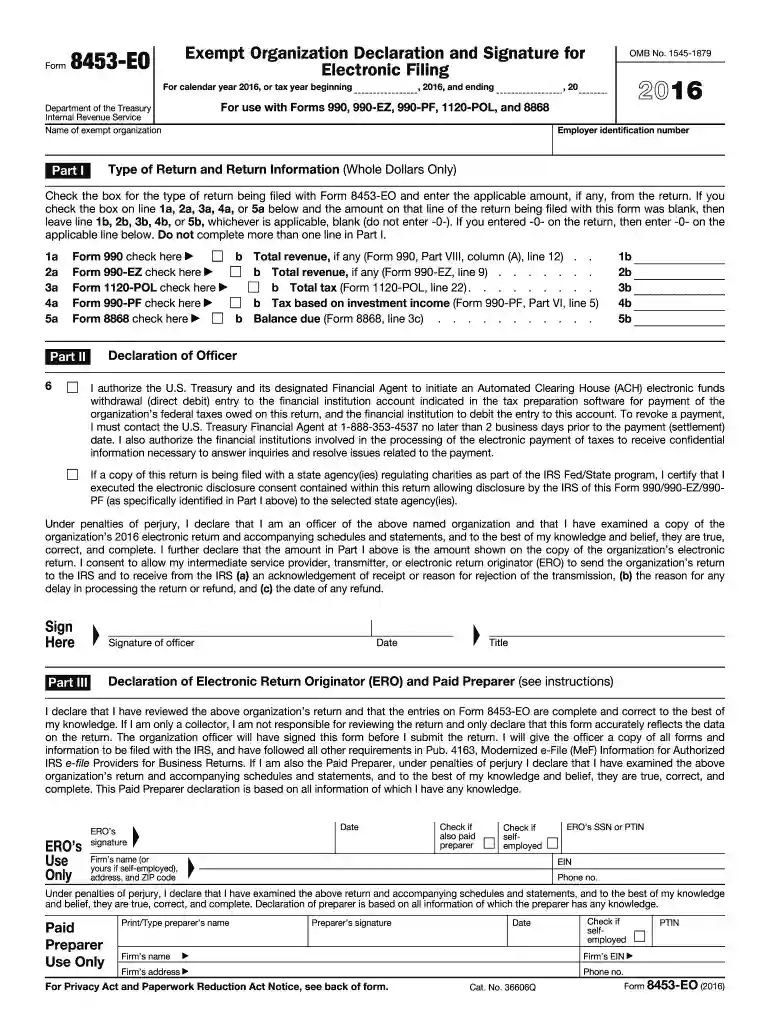
Form 8453-EO is officially known as the Exempt Organization Declaration and Signature for Electronic Filing. It is required for exempt organizations to validate their electronic tax returns, including Form 990, 990-EZ, 990-PF, 1120-POL, and 8868, for the tax year 2016. The form serves to authenticate electronic submissions by providing necessary declarations from organizational officers and electronic return originators (EROs).
Completing Form 8453-EO involves detailed procedures to ensure accurate submission. Here is a simplified sequence of how the form is typically used:
Understanding each section of the form is crucial for timely and accurate filing:
This form is primarily used by various exempt organizations within the U.S. Examples include:
Several critical components make up the form:
Supporting documentation varies based on the specific return form:
The general deadline adheres to IRS-standard tax filing dates:
Understanding legal requirements associated with Form 8453-EO ensures compliance:
Options for submitting the completed form include:
These structured sections provide comprehensive guidance for users of Form 8453-EO, offering clarity on procedures, compliance, and applicable scenarios.
We've got more versions of the 2016 Form 8453-EO. Exempt Organization Declaration and Signature for Electronic Filing form. Select the right 2016 Form 8453-EO. Exempt Organization Declaration and Signature for Electronic Filing version from the list and start editing it straight away!
| Versions | Form popularity | Fillable & printable |
|---|---|---|
| 2020 | 4.8 Satisfied (72 Votes) | |
| 2019 | 4.4 Satisfied (138 Votes) | |
| 2018 | 4.3 Satisfied (140 Votes) | |
| 2017 | 4 Satisfied (45 Votes) | |
| 2016 | 4.3 Satisfied (185 Votes) | |
| 2015 | 4 Satisfied (27 Votes) | |
| 2014 | 4 Satisfied (43 Votes) | |
| 2013 | 4.3 Satisfied (61 Votes) | |
| 2012 | 4.3 Satisfied (36 Votes) | |
| 2011 | 4 Satisfied (59 Votes) |
At DocHub, your data security is our priority. We follow HIPAA, SOC2, GDPR, and other standards, so you can work on your documents with confidence.


