




01. Edit your form online
Type text, add images, blackout confidential details, add comments, highlights and more.

Type text, add images, blackout confidential details, add comments, highlights and more.

Draw your signature, type it, upload its image, or use your mobile device as a signature pad.

Send it via email, link, or fax. You can also download it, export it or print it out.
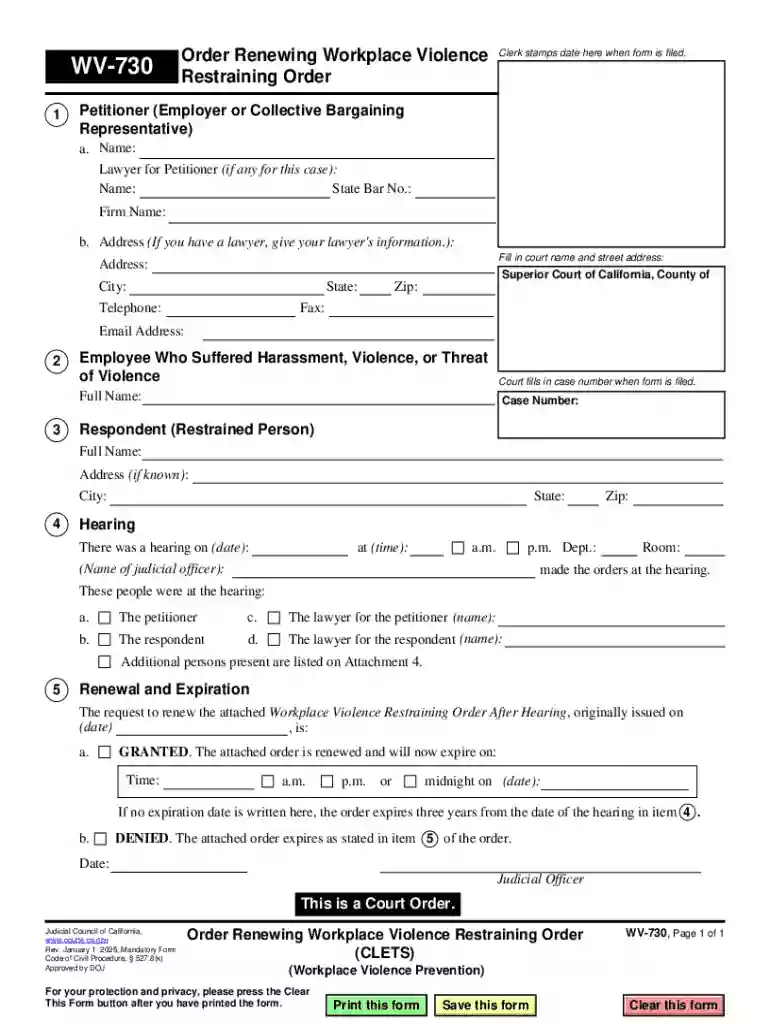
The WV-730 form, known as the Order Renewing Workplace Violence Restraining Order, is utilized within California. It serves the specific purpose of renewing an existing restraining order that pertains to instances of workplace violence. This form is crucial in maintaining protection for individuals against potential threats within a professional environment. The renewal process involves detailing components such as the petitioner, employee affected, respondent, hearing specifics, and the duration of the renewed order. Understanding the formal structure of the WV-730 is essential for accurately extending protective measures related to workplace safety.
When using the WV-730 form, it's important to follow a structured approach to ensure comprehensive and accurate completion. First, identify the existing restraining order that requires renewal. Start by filling in the sections applicable to the petitioner, the employee involved, and the respondent. Make sure to include any additional necessary documentation that supports your need for a renewal. Once the form is completed, submit it to the appropriate legal authority in California. The process may involve participating in a hearing to decide the terms of the order's renewal. Ensure all parts of the WV-730 are filled out as per the legal requirements to avoid delays or complications in the renewal process.
Understanding the terminology associated with the WV-730 form is vital for correct and lawful application. Each term plays a significant role in the legal process:
Each of these terms should be thoroughly understood and correctly used when dealing with the WV-730 form.
Completing the WV-730 form involves a series of defined steps to ensure that all necessary details are captured accurately:
Adhering to these steps will help facilitate a smoother process and minimize the risk of omissions or errors.
The WV-730 form is exclusively used within the legal framework of California to address matters involving workplace violence. Its primary legal function is to continue protection for individuals under threat without having to issue a completely new restraining order. Such legal instruments ensure workplace safety by preventing further instances of harassment or violence. Utilizing the WV-730 requires strict adherence to state-specific regulations and requirements, underscoring the importance of proper completion and submission.
The primary users of the WV-730 form are individuals or entities involved in securing workplace safety through legal protection orders. Employers, legal representatives, and employees themselves may engage with the WV-730 to renew necessary protective measures. The overarching goal is the safety of employees from potential workplace violence, making the form an important tool within occupational settings where there have been past incidents of violence or credible threats.


As the WV-730 is a California-specific form, several state regulations govern its usage. California law provides the legal basis for workplace violence restraining orders, and thus the WV-730 must be completed in accordance with these statutes. Familiarity with California’s legal landscape regarding restraining orders ensures that the form is completed accurately and submitted timely. It is crucial to comply with all procedural requirements to avoid potential legal challenges or delays.
Consider a situation where an employee was initially granted a restraining order due to a threat from a co-worker. As the expiration date for the original order approaches, the employee or their employer might file a WV-730 to extend the protection. Another scenario might involve an employer renewing an order to protect a group of employees from a former staff member who exhibits threatening behavior. Both cases demonstrate the practical application of the WV-730 in promoting workplace safety and addressing ongoing threats effectively.
We've got more versions of the Wv-730 form. Select the right Wv-730 version from the list and start editing it straight away!
At DocHub, your data security is our priority. We follow HIPAA, SOC2, GDPR, and other standards, so you can work on your documents with confidence.


730, North Bethesda, MD 20852, Phone (301) 291-7550. West Virginia Junior College is authorized to offer associate degrees and permitted to offer postRead more
WV-730 Order Renewing Workplace Violence Restraining Order (CLETS) Approved by DOJ. Who Suffered Harassment, Violence, or Threat of Violence. This is a Court
The U.S. Department of Energy (DOE) is tasked with the mission to advance the national, economic, and energy security of the United States;


