




01. Edit your form online
Type text, add images, blackout confidential details, add comments, highlights and more.

Type text, add images, blackout confidential details, add comments, highlights and more.

Draw your signature, type it, upload its image, or use your mobile device as a signature pad.

Send it via email, link, or fax. You can also download it, export it or print it out.
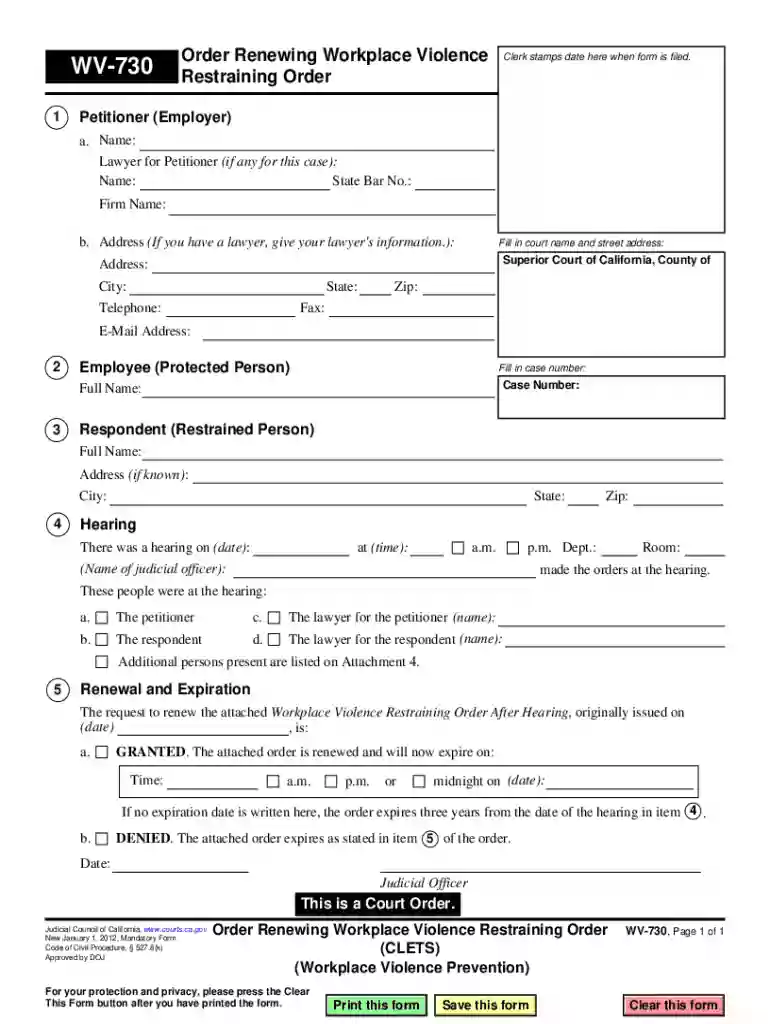
The WV-730 form, titled "Order Renewing Workplace Violence Restraining Order," is a legal document used in the Superior Court of California. Its primary purpose is to renew an existing restraining order intended to protect an employee from workplace violence. This form is particularly vital in ensuring that the safety measures originally put in place continue to be effective for an extended period. Designed to outline the process for renewal, the WV-730 includes specific sections for different parties involved, such as the petitioner (typically the employer), the protected person (employee), and the restrained person.
Using the WV-730 form requires careful attention to detail, as it involves legal procedures. Here's how it's generally used:
Understand Eligibility: Confirm that the existing restraining order qualifies for renewal under Californian law.
Gather Required Information: This includes details about the original order, such as the case number and the court where it was issued.
Complete the Form: Fill out all necessary sections, including information about the petitioner, the protected individual, and the restrained person.
File with the Court: Submit the form to the relevant California Superior Court. Be sure to adhere to any specific filing guidelines or deadlines.
Attend the Hearing: Be prepared to attend a court hearing if required, where a judge will decide on the renewal based on the information provided.
Completing the WV-730 requires a methodical approach to ensure all necessary information is accurately captured:
Section for Petitioner Information: Include details such as name, address, and relationship to the protected individual.
Protected Person Details: Provide information about the person requiring protection, ensuring accuracy as this is crucial for legal identification.
Restrained Person Information: Enter details of the person from whom protection is sought, including any previous incidents justifying the restraining order.
Order Details: Outline the specifics of the order being renewed, including its original expiry date and any modifications needed.
Signatures: Ensure that all parties, where applicable, sign the form to validate the request for renewal.
Attachments: Include any supporting documents that validate the need for renewal, such as incident reports or previous court orders.
The legal implications of the WV-730 form are significant as it affects the safety and rights of both the protected and restrained individuals. The renewal of a restraining order must comply with California's legal standards. The form ensures that the workplace maintains a safe environment for employees, which aligns with broader employment laws mandating employee safety. Non-compliance or failure to renew may lead to legal repercussions and potential risk for the protected individual.
Several critical elements must be addressed when processing the WV-730 form:
These components ensure the form's completeness and facilitate a smooth judicial process.
While the WV-730 is specific to California, various state-specific rules govern its use:
Understanding these state-specific nuances is crucial for legal compliance and ensuring the form's effectiveness.
Practical scenarios where the WV-730 form is utilized include:
These examples illustrate the form's application in real-world situations, ensuring the safety and peace of mind of those under protection.
Several terms associated with the WV-730 form are vital for comprehension:
Understanding these terms aids in accurately interpreting the form and ensuring proper execution of its intended legal outcomes.
We've got more versions of the Wv-730 form. Select the right Wv-730 version from the list and start editing it straight away!
At DocHub, your data security is our priority. We follow HIPAA, SOC2, GDPR, and other standards, so you can work on your documents with confidence.




WV-730 Order Renewing Workplace Violence Restraining Order (CLETS) Approved by DOJ. Who Suffered Harassment, Violence, or Threat of Violence. This is a Court
The U.S. Department of Energy (DOE) is tasked with the mission to advance the national, economic, and energy security of the United States;
730, North Bethesda, MD 20852, Phone (301) 291-7550. West Virginia Junior College is authorized to offer associate degrees and permitted to offer postRead more


