




01. Edit your form online
Type text, add images, blackout confidential details, add comments, highlights and more.

Type text, add images, blackout confidential details, add comments, highlights and more.

Draw your signature, type it, upload its image, or use your mobile device as a signature pad.

Send it via email, link, or fax. You can also download it, export it or print it out.
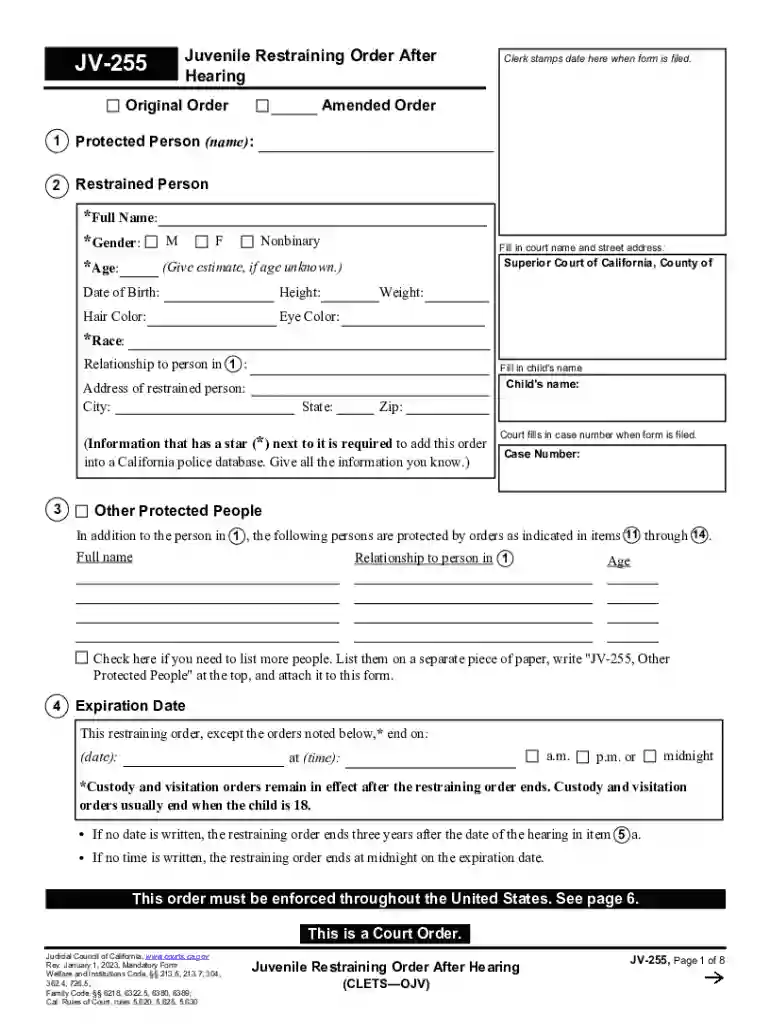
The Jv-255 is a Juvenile Restraining Order issued by the Superior Court of California. This legal document specifies the terms imposed on a restrained individual following a court hearing. It serves to protect certain individuals and includes clear prohibitions. The Jv-255 is enforceable throughout the United States, ensuring that the protections it provides are not limited to California alone. The content of the order underscores the court's authority to ensure compliance and enforce consequences for any violations.
Understanding the components of the Jv-255 is crucial. The order delineates the names and details of the protected person and the restrained individual. It specifies the court's jurisdiction details and provides comprehensive instructions on the activities that the restrained person must avoid, such as contacting the protected person or possessing firearms. These elements contribute to the intended safety and security offered by the document, establishing clear guidelines for compliance.
Proper utilization of the Jv-255 involves understanding how it functions in a legal context. Once issued, the order must be followed explicitly by the restrained person. The processes within the Jv-255 are designed to facilitate understanding of the legal obligations and the repercussions of non-compliance. It is essential for both the protected and the restrained individuals to clearly understand their rights and responsibilities, ensuring that the terms set by the court are maintained without deviation.
Completing the Jv-255 involves several steps to ensure that it is filed correctly and is enforceable. Initially, a detailed petition is filled out, outlining the necessity for such an order. Supporting documentation may be required to validate claims of protection. Once the petition is submitted, a court hearing is scheduled where evidence is presented. Following the court's decision, the Jv-255 is formalized and issued, which includes provisions that the restrained individual must adhere to.
The primary users of the Jv-255 are individuals seeking legal protection in situations involving juveniles. Typically deployed in scenarios where there is a need to legally prevent contact or communication between individuals, the Jv-255 is often used in cases concerning domestic situations, school environments, or any instance where a minor's safety is potentially threatened. Legal professionals, guardians, or social services may initiate these orders on behalf of juveniles to establish legal boundaries.


The legal framework supporting the Jv-255 ensures that the orders are valid and enforceable. In practice, this means that the terms outlined within the order must be strictly adhered to by the restrained person. The Jv-255 acts as a legally binding document, carrying the authority to impose penalties for non-compliance, such as fines or imprisonment. Adhering to the legal prerequisites when filing and enforcing the Jv-255 is crucial, ensuring its integrity and protection under the law.
Real-world scenarios illustrate the application of the Jv-255. For instance, a school may seek a Jv-255 to prevent a known bully from contacting a victim, ensuring the victim's safety. In another case, a guardian might secure a Jv-255 against an individual with a history of threatening behavior towards a minor under their care. These practical examples highlight the form's utility in ensuring safe and legally protected environments for minors.
Ignoring the restrictions set in a Jv-255 brings serious repercussions. Legal violation of the order can result in arrest, fines, or imprisonment, depending on the severity of the non-compliance. The court may extend the duration of the order or impose further restrictions. These penalties emphasize the importance of adhering to the order's terms, reinforcing the document's protective intent and the legal system's commitment to enforcing it strictly.
Familiarity with specific terms related to the Jv-255 can enhance comprehension and facilitate compliance. Key terms include "restrained person," "protected person," and "no-contact order," each defining the roles and boundaries within the order. Understanding legal jargon such as "jurisdiction" and "enforceable" is vital for utilizing the Jv-255 to its full potential, ensuring effective communication and action within legal and protective settings.
While the Jv-255 is enforceable throughout the United States, different states may have specific procedural nuances or additional legal requirements. Some states might require supplementary forms or a different level of proof before issuance. Understanding these variations is integral for parties involved to ensure that their actions meet the legal criteria required in the specific jurisdiction where the order is entered and enforced.
Filing a Jv-255 involves preparing several documents to support the issuance of the order. These typically include a completed petition form detailing the need for protection and any evidence substantiating claims of risk or abuse. Additional documents might include police reports or medical records. Having a comprehensive documentation package enhances the likelihood of obtaining a favorable and enforceable order.
We've got more versions of the Jv-255 form. Select the right Jv-255 version from the list and start editing it straight away!
At DocHub, your data security is our priority. We follow HIPAA, SOC2, GDPR, and other standards, so you can work on your documents with confidence.



gamma-Aminobutyrate, alpha-carboxy-2-nitrobenzyl ester (cGABA) is a stable photoactivatable probe used to study gamma-aminobutyrate (GABA) receptors.
Mar 13, 2026 Contaminated sediments in rivers and streams, lakes, coastal harbors, and estuaries have the potential to pose ecological and human healthRead more
Juvenile Restraining Order After Hearing (CLETSOJV) (JV-255) Tells you that a judge has made a long-term restraining order. Effective: January 1, 2026


