




01. Edit your form online
Type text, add images, blackout confidential details, add comments, highlights and more.

Type text, add images, blackout confidential details, add comments, highlights and more.

Draw your signature, type it, upload its image, or use your mobile device as a signature pad.

Send it via email, link, or fax. You can also download it, export it or print it out.
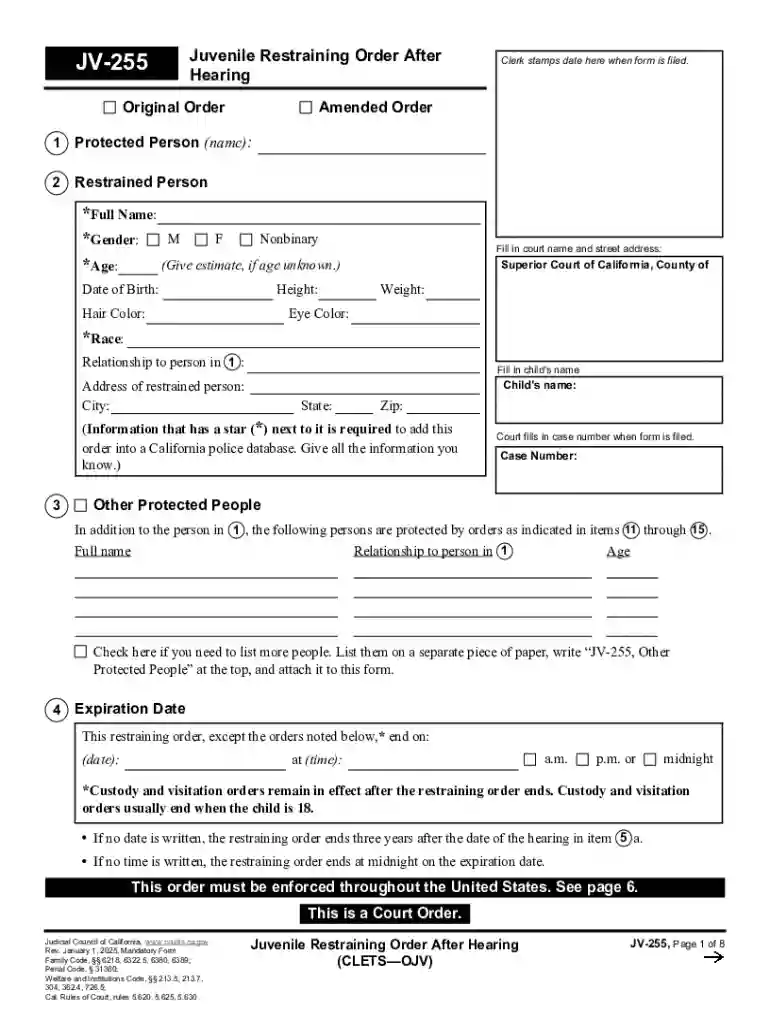
The JV-255 form, known as the Juvenile Restraining Order, is a legal document issued by the Superior Court of California. It outlines conditions imposed on an individual, referred to as the restrained person, following a legal hearing. The form's primary purpose is to ensure the safety of a protected party by restricting contacts and movements of the restrained person. The form details specific prohibitions, including but not limited to, no-contact orders and stay-away provisions. In cases of non-compliance, the form provides legal consequences, ensuring adherence to the stipulated conditions.
To effectively utilize the JV-255 form, ensure you understand each section's requirements. This form is generally completed by a protected party seeking legal protection or their legal representative. Once issued, the conditions must be followed by the restrained person. For court officials and legal representatives, this form serves as a critical document for proceedings in juvenile court cases, ensuring all parties understand the restrictions and guidelines imposed. Its usage is often accompanied by legal counsel to clarify each condition's scope.
Personal Information Entry: Begin by accurately filling out the personal details of both the protected and restrained individuals. This includes names, addresses, and contact details.
Detail Specific Restrictions: Clearly outline the restrictions being placed on the restrained individual, such as no-contact orders or restriction from specific locations.
Prohibited Items and Actions: Enumerate any items or actions from which the restrained person is prohibited, such as possession of firearms.
Compliance Requirements: Describe any required actions the restrained person must undertake to comply with the order, including attending hearings or counseling sessions.
Review and Sign: After completing the form, it is essential to review all sections for accuracy before signing. Legal representatives or court officials, if involved, must also review the completed form.
Restrictions on Contact: Lists explicit no-contact orders to protect the safety of the protected party.
Stay-Away Provisions: Details requirements for the restrained person to maintain a specific distance from particular locations or individuals.
Compliance Conditions: Mandates for counseling or other corrective measures the restrained person must follow.
Legal Consequences: Outlines potential legal penalties if the restrained person violates the terms of the order.
Protected Person: The individual for whom the restraining order seeks to provide safety.
Restrained Person: The individual subject to the conditions and restrictions imposed by the order.
No-Contact Order: A stipulation preventing the restrained person from contacting the protected person through any means.
Stay-Away Provisions: Legal conditions requiring the restrained person to keep a specified distance from the protected person or certain locations.
The JV-255's primary function is to provide legal protection for minors involved in juvenile cases. Its use is strictly regulated by the courts and is applicable under circumstances where there is a justified need for protection. Legal professionals must ensure the form's conditions are reasonable, enforceable, and aligned with current laws. Violations of the order can lead to serious legal repercussions, emphasizing the form's critical role in maintaining safety and compliance.
While the JV-255 is issued in California, states may have additional regulations and guidelines governing its application and enforcement. California law requires that the form be used following a court hearing, ensuring that a legal precedent necessitates the restraining order. Differences may arise in procedural aspects or enforcement methods, underscoring the importance of understanding locale-specific legal frameworks. Legal consultation is recommended to navigate these nuances effectively.
Case Study 1: In a scenario involving a juvenile threatened by a peer, the JV-255 was issued to minimize contact and facilitate a safer environment at school and home.
Case Study 2: A court issued the JV-255 to mandate counseling for a restrained person, aiming for rehabilitation and compliance to protect a family member.
Real-world applications of the JV-255 emphasize the form's effectiveness in safeguarding minors, encouraging lawful conduct, and promoting constructive resolutions in potentially volatile situations.
We've got more versions of the Jv-255 form. Select the right Jv-255 version from the list and start editing it straight away!
At DocHub, your data security is our priority. We follow HIPAA, SOC2, GDPR, and other standards, so you can work on your documents with confidence.



Mar 13, 2026 Contaminated sediments in rivers and streams, lakes, coastal harbors, and estuaries have the potential to pose ecological and human healthRead more
Juvenile Restraining Order After Hearing (CLETSOJV) (JV-255) Tells you that a judge has made a long-term restraining order. Effective: January 1, 2026
gamma-Aminobutyrate, alpha-carboxy-2-nitrobenzyl ester (cGABA) is a stable photoactivatable probe used to study gamma-aminobutyrate (GABA) receptors.


