






Definition and Meaning
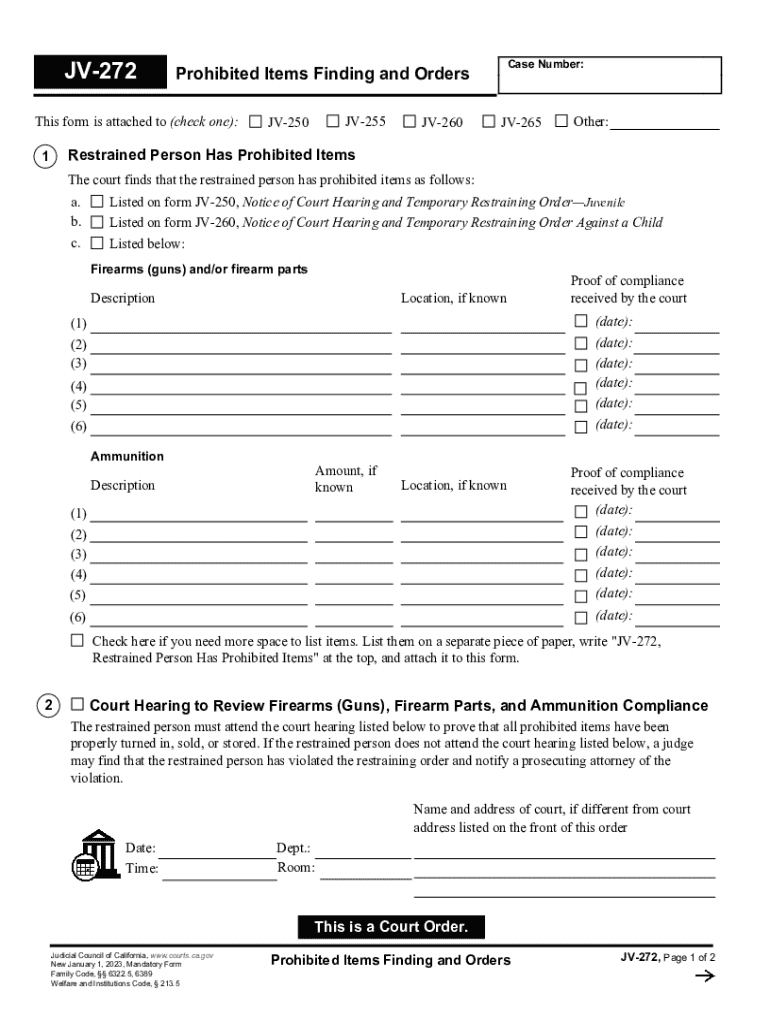
The "JV-272 Prohibited Items Finding and Orders Judicial Council forms" is a legal document used within the judicial system to address findings related to prohibited items, specifically firearms and ammunition, in the possession of a restrained person. This form outlines the obligations of the restrained individual to comply with court orders for surrendering these items. It ensures that the court maintains oversight over compliance with prohibitive mandates and facilitates communication with prosecuting agencies if violations occur.
Core Purpose
- To document findings regarding prohibited items in possession.
- To outline compliance requirements for surrender.
- To provide legal accountability for non-compliance.
Practical Implications
For example, if an individual subject to a restraining order is found in possession of firearms, the JV-272 form acts as an official record, detailing their obligation to surrender these items and setting the stage for potential legal follow-up.
How to Obtain the JV-272 Form
Obtaining the JV-272 form is a straightforward process tailored to ensure accessibility for those involved in relevant legal proceedings.
Acquisition Methods
-
Court Clerk's Office
- Most commonly, the form can be accessed through the clerk’s office at the county courthouse where the case is filed.
- Availability is generally ensured by clerical staff who manage such judicial documents.
-
Online Judicial Council Websites
- Many states offer downloadable access to required judicial forms online.
- Users can find the form under the “Forms” section, typically requiring the selection of the appropriate category.
Convenience Factors
- Online access ensures that individuals can obtain the form without physically visiting a courthouse, making it practical for those unable to travel.
Example
A person seeking compliance with the court's order for someone in possession of prohibited orders can visit their local court's website, download the JV-272 form, and follow the instructions for submission.
Steps to Complete the JV-272 Form
Completing the JV-272 form involves a detailed approach to ensure accuracy and compliance with legal standards.
Filling Process
-
Personal and Case Details
- Enter the full legal names, addresses, and contact information of the parties involved.
- Include the court case number for reference.
-
Description of Prohibited Items
- List all firearms, ammunition, and other relevant items that need to be surrendered.
- Provide details such as serial numbers and descriptions.
-
Compliance Statement
- Affirm whether the individual has attended the required court hearing.
- Document the steps taken to comply with the surrender order.
-
Signature and Filing
- The form must be signed by the respondent and any legal representatives.
- Submit the completed document either in person at the courthouse or via applicable electronic submission methods outlined by the court.
Real-World Scenario
An individual complying with a court ruling may fill out the form detailing the return of a registered firearm to law enforcement, affirming the correct action to avoid legal penalties.
Key Elements of the JV-272 Form
Understanding the core components of the JV-272 form is crucial for ensuring its effective use and legal compliance.
Critical Information Areas
-
Identification
- Accurate identification of the restrained person.
- Clear demarcation of what items are subject to prohibition.
-
Legal Obligations
- A summary of the conditions imposed by the court.
- Specific deadlines for surrendering prohibited items.
-
Compliance Verification
- Sections for verification by law enforcement or the courts.
- An audit trail to track actions taken by the respondent.
Utility of Key Sections
The JV-272 forms’ detailed sections serve to uphold judicial processes, providing evidence of compliance or grounds for further legal action.
Legal Use of the JV-272 Form
In a court setting, the JV-272 form serves a vital legal function in managing prohibitive orders.
Judicial Application
-
Monitoring and Compliance
- Ensures that restrained persons adhere to legal mandates regarding forbidden items.
-
Communication with Law Enforcement
- Facilitates the sharing of information with agencies responsible for enforcing the surrender of these items.
Impact Example
For instance, if a person fails to comply with the firearms surrender requirement, the completed JV-272 form acts as documentation for initiating further legal inquiry or prosecution.
Who Typically Uses the JV-272 Form
Several parties potentially engage with the JV-272 form during its lifecycle.


Key Users
-
Restrained Individuals
- Persons legally ordered to surrender prohibited items.
-
Legal Practitioners
- Attorneys guiding clients through judiciary processes involving prohibited items.
-
Law Enforcement Officers
- Officers tasked with executing and verifying compliance with court orders.
Commons Scenarios
Attorneys typically guide clients on how to accurately document their compliance, while law enforcement verifies the physical surrender of items as outlined by the form instructions.
Important Terms Related to JV-272
Comprehending terminology associated with the JV-272 form ensures all parties involved understand their roles and responsibilities.
Key Terms
-
Restrained Person
- The individual subject to legal prohibitions and court orders concerning possession.
-
Surrender Order
- A judicial directive mandating the transfer of prohibited items to authorities.
-
Compliance Hearing
- A court session that evaluates adherence to ordered terms by the restrained person.
Real-World Understanding
In a case where someone is under a temporary restraining order, familiarity with these terms empowers them to navigate the legal expectations effectively.
Penalties for Non-Compliance
Failure to comply with the terms outlined in the JV-272 form carries significant legal consequences.
Consequential Actions
-
Violation Notification
- The court may inform appropriate prosecuting agencies of non-compliance, prompting further legal action.
-
Legal Repercussions
- Potential charges for contempt of court or similar offenses.
- Possibility of additional fines, extended restraining orders, or other penalties.
Example Outcome
An individual failing to surrender firearms may face prosecution, affecting their legal standing and future ability to possess such items legally.