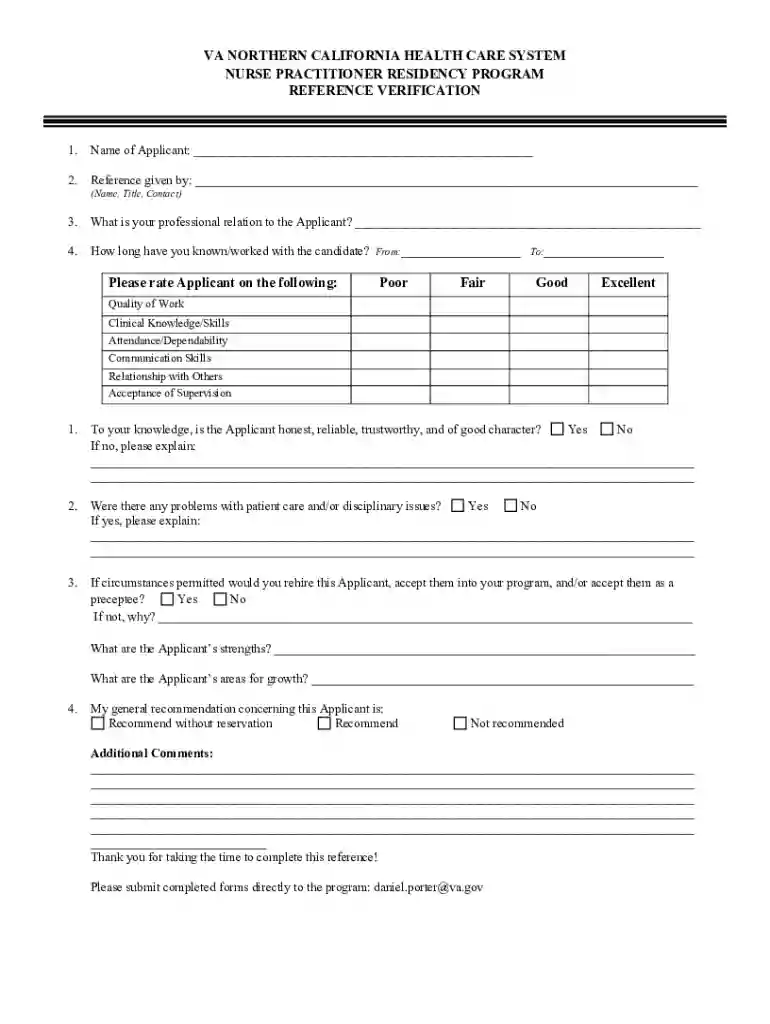
Nurse Practitioner Residency Program Reference Verification 2026

Get Form
Nurse Practitioner Residency Program Reference Verification Preview on Page 1

Here's how it works

01. Edit your form online
Type text, add images, blackout confidential details, add comments, highlights and more.

02. Sign it in a few clicks
Draw your signature, type it, upload its image, or use your mobile device as a signature pad.

03. Share your form with others
Send it via email, link, or fax. You can also download it, export it or print it out.

Definition & Purpose of Nurse Practitioner Residency Program Reference Verification

The Nurse Practitioner Residency Program Reference Verification is a critical document used in the VA Northern California Health Care System. This form serves as a standardized method for assessing an applicant's qualifications and readiness for a residency program. It collects relevant feedback from professional references, providing an unbiased evaluation of competencies across various domains. Each section of the form offers insights into the applicant’s past performance and potential within a clinical setting.

Core Components of the Reference Verification

  • Applicant Information: Captures the applicant's personal details to ensure accurate identification and record-keeping.
  • Reference's Details: Includes the professional relationship to the applicant, contact information, and duration of acquaintance, which contextualizes the reference’s perspective.

Evaluation Criteria

  • Competencies: The form uses a rating scale to assess key attributes such as clinical skills, communication, ethical practice, and adaptability. This objective measure ensures that applicants meet the program's rigorous standards.
  • Character and Integrity: References are asked to comment on the applicant's ethical conduct, reliability, and trustworthiness, which are crucial for patient care roles.

Additional Inquiries

  • Patient Care Issues: Specifically asks if there have been any concerns related to the applicant’s interaction with patients. This is critical for ensuring that only those with proven patient care competencies advance in the selection process.
  • Strengths and Growth Areas: References can provide detailed narratives on the applicant’s areas of strength and potential growth, adding qualitative data to the evaluation mix.
  • Rehire Potential: The form asks whether the reference would consider rehiring the applicant, serving as a strong indicator of past performance from a former employer or supervisor's perspective.

How to Obtain the Nurse Practitioner Residency Program Reference Verification

Accessing the Form

The form can be requested directly through the VA Northern California Health Care System. Typically, this process is initiated by the residency program’s coordinator upon confirmation of an applicant’s entry into the selection cycle.

Supporting Documentation

  • Proof of Identity: Applicants need to provide a valid form of identification to validate their request for the form, ensuring authenticity and data integrity.
  • Contact Information: It is vital to keep contact details updated, as this facilitates seamless communication between the applicant, references, and the residency program.

Steps to Complete the Nurse Practitioner Residency Program Reference Verification

Detailed Instructions for Reference Completion

  1. Read Thoroughly: References should begin by reading the form carefully to understand the rating scale and types of information required.
  2. Provide Contextual Details: Include specific examples to substantiate ratings. Context enhances reliability and the utility of the provided feedback for decision-making.
  3. Rate Competencies Precisely: Use the given scale to evaluate competencies such as clinical decision-making, professionalism, and teamwork.
  4. Answer Comprehensive Questions: Focus on narrative sections to elaborate on the applicant’s strengths, weaknesses, and overall recommendation.
  5. Verify and Submit: After completion, double-check entries for accuracy. Submit the form via the specified email channel to maintain confidentiality and streamline the application process.

Importance of Accurate Completion

An accurately completed form is crucial as it forms a core component of the residency application package. Errors or omissions could result in delays or misinterpretation, potentially affecting the applicant’s candidacy negatively.

Why the Nurse Practitioner Residency Program Reference Verification is Essential

Benefits for Residency Programs

  • Standardization: Provides a consistent framework for evaluating all candidates, ensuring fair and impartial assessment.
  • Informative for Selection Committees: Supplies invaluable insights into the applicant’s professional history and suitability for high-stakes healthcare roles.
  • Risk Mitigation: Helps identify any underlying concerns that could affect patient safety or residency success.

Advantages for Applicants

  • Showcases Strengths: Enables applicants to highlight their competencies as perceived by respected professionals in their past work environments.
  • Supports Career Development: Constructive feedback offers a pathway for applicants to understand areas needing improvement, aiding in their professional growth.

Who Typically Uses the Nurse Practitioner Residency Program Reference Verification

The primary users of the Nurse Practitioner Residency Program Reference Verification include residency program coordinators, selection committees, and prospective nurse practitioner residency candidates.


decoration image ratings of Dochub

Key Users

  • Program Coordinators: Utilize the form to gather comprehensive data on applicants, facilitating further evaluation processes.
  • Selection Committees: Review completed forms to make informed decisions on applicant suitability and fit for the residency environment.
  • Applicants: Use it to enhance their application package, emphasizing their professional accomplishments and receiving constructive feedback for future development.

Important Terms Related to the Nurse Practitioner Residency Program Reference Verification

Terminology Essentials

  • Competencies: Specific skills and attributes evaluated, critical for determining the applicant's readiness for the residency program.
  • Reference: A professional who has worked closely with the applicant, qualified to provide a credible evaluation.
  • Rehire Potential: A term used to gauge the likelihood that the applicant would be considered favorably for future employment based on past performance and behavior.

Frequently Used Concepts

  • Ethical Practice: Involves adherence to professional standards, strongly emphasized in the competency ratings.
  • Collaborative Skills: Assesses the ability to work effectively within healthcare teams, a crucial factor in patient outcomes.
  • Professional Relationship Duration: Considers the length of time the reference has known the applicant, contributing to the credibility and depth of the evaluation.

Each of these components ensures that the Nurse Practitioner Residency Program Reference Verification delivers a comprehensive, detailed picture of an applicant's capabilities and readiness for a rigorous residency program.

be ready to get more

Complete this form in 5 minutes or less

Get form

Got questions?

We have answers to the most popular questions from our customers. If you can't find an answer to your question, please contact us.
Contact us
How Much Does Credentialing Cost: The Total Picture. Adding all these costs, the total initial cost for the credentialing of a nurse practitioner will fall between $2,000 and $4,000, excluding malpractice insurance and professional memberships. This includes: Certification exam: $395-495.
Myth: Once I am licensed, I can practice as an NP. Reality: You must first be credentialed with your employer organization before you can begin working for your employer as an NP.
You will: Graduate from NP school. Sit for your boards (and get a certification when you pass!) Apply for your state license. Then for your NPI number. And possibly apply for your DEA license.
To successfully verify a Nurse Practitioner (NP), you will need the NPs last name and an AANPCB certification number that begins with one of the specific prefixes indicating the type of certification (e.g., A for Adult, AG for Adult-Gerontology). Ensure the NPs certification is active before proceeding.
How Long Can NP Credentialing Take? ScenarioRough Timeline Best-case 60 days Typical 90120 days Worst-case 6+ months Jun 11, 2025

Security and compliance

At DocHub, your data security is our priority. We follow HIPAA, SOC2, GDPR, and other standards, so you can work on your documents with confidence.

Learn more
ccpa2
pci-dss
gdpr-compliance
hipaa
soc-compliance

People also ask

Research has shown that nurse practitioners that complete residency programs are more satisfied with their career, and are more likely to stay working as an NP. They also have higher retention rates in their job and increased confidence as clinicians.

Related links