




01. Edit your form online
Type text, add images, blackout confidential details, add comments, highlights and more.

Type text, add images, blackout confidential details, add comments, highlights and more.

Draw your signature, type it, upload its image, or use your mobile device as a signature pad.

Send it via email, link, or fax. You can also download it, export it or print it out.
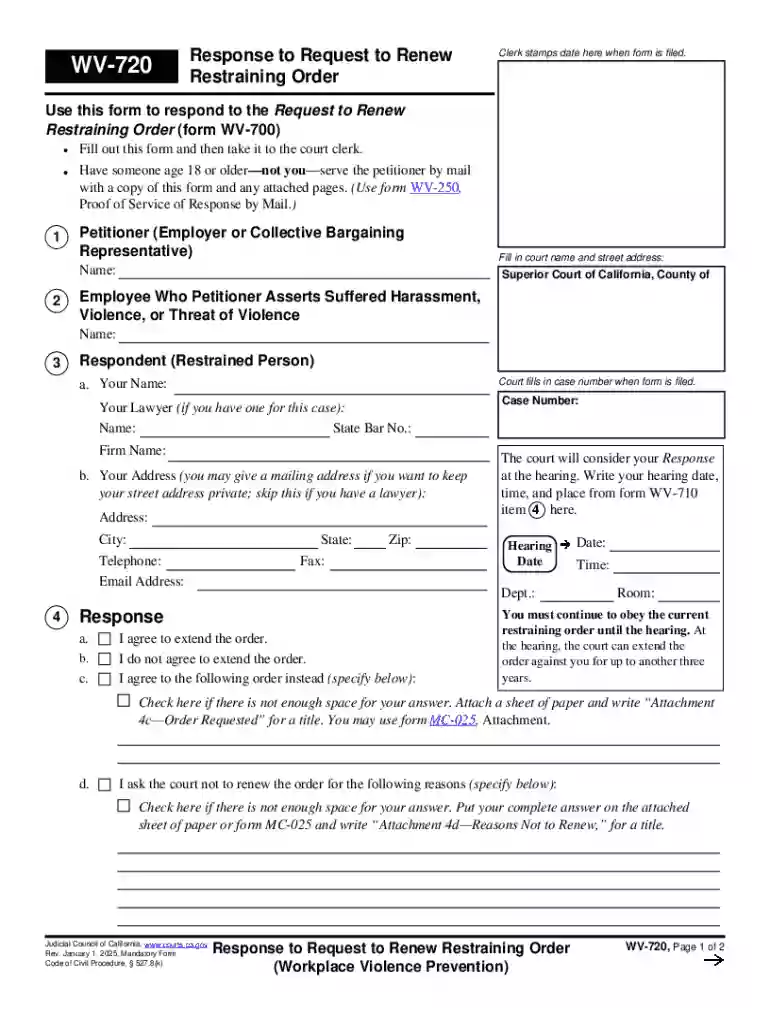
The WV-720 is a legal form used in the state of California specifically for responding to a Request to Renew a Workplace Violence Restraining Order. This document is crucial because it provides the respondent—often an individual accused of workplace violence—the ability to contest or agree with the renewal of the restraining order initially filed against them. The form outlines the steps involved in responding to such requests, requires the respondent to state reasons against the renewal, and demands signatures for submission. It plays a significant role in legal procedures related to workplace violence prevention, giving a voice to those accused and ensuring due process.
When faced with a request to renew a workplace violence restraining order, respondents must carefully use the WV-720 form to communicate their stance. The form is essential for indicating agreement or disagreement with the order's renewal. Here’s how it is typically used:
Completing the WV-720 requires thorough attention to detail to ensure all necessary information is accurately captured. Here’s a step-by-step guide:
The WV-720 form serves a legal purpose, ensuring both parties in a workplace violence case have the opportunity to present their side of the story. Its usage is governed by California law and contributes to a fair legal process. Key legal uses include:
When preparing to complete the WV-720 form, it is important to recognize its key elements:
California has distinctive rules and requirements for dealing with workplace violence restraining orders:
Submitting the WV-720 can be completed through several methods, adhering to state compliance protocols:
Failure to appropriately complete and submit the WV-720 form within the state's legal framework can result in specific penalties:
Understanding how the WV-720 form is applied can be aided by examining real-world scenarios:
These scenarios highlight the form's utility and the necessity for diligent, accurate completion.
We've got more versions of the Wv-720 form. Select the right Wv-720 version from the list and start editing it straight away!
At DocHub, your data security is our priority. We follow HIPAA, SOC2, GDPR, and other standards, so you can work on your documents with confidence.


720 9th Street Sacramento, CA 95814. You may be sent to jail for up to one year, pay a fine of up to $1,000, or both. This is a Court. You must stay at least
Jan 1, 2025 Use this form to respond to the Request to Renew. Restraining Order (form WV-700). Fill out this form and then take it to the court clerk.Read more


