






Definition and Purpose of the Thesis Submission
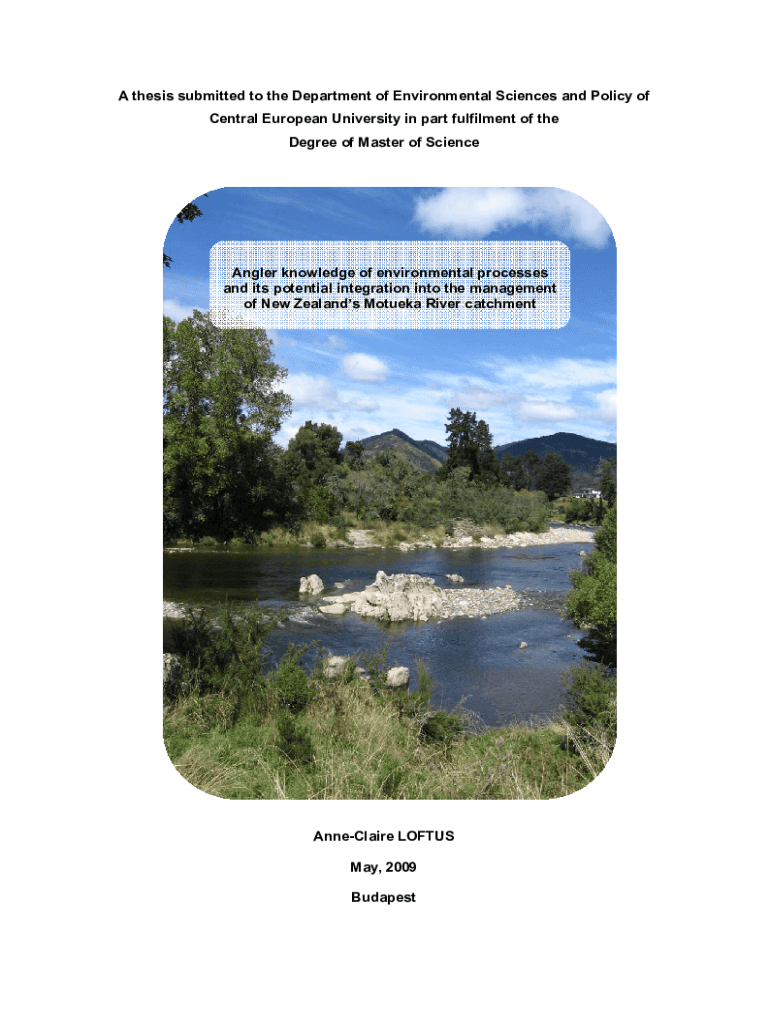
A thesis submitted to the Department of Environmental at Central European University (CEU) is a critical academic document reflecting research conducted in environmental studies. This submission is a culmination of master's or doctoral research, showcasing the candidate's comprehensive understanding of a specific environmental topic. For example, Anne-Claire Loftus's thesis explored anglers' knowledge in New Zealand's Motueka River catchment and how this could aid catchment management.
Steps to Complete the Thesis Submission Process
Completing a thesis at CEU involves several steps. First, students must select a research topic approved by their academic advisor. The next phase is conducting extensive literature reviews, fieldwork, or data collection. After assembling the data, it is analyzed and discussed in the context of existing research. Writing the thesis includes drafting multiple versions for review before final submission. Typically, the submission involves an oral defense where candidates present their findings and answer questions posed by faculty.
Required Documents
- Approved thesis proposal
- Thesis manuscript following the prescribed format
- Appendices containing raw data
- Consent forms for interviews or surveys
- Turnitin plagiarism report
Key Components of the CEU Thesis
A well-formulated thesis includes several crucial elements:
- Title Page: Officially designates the document, including the title, student name, and submission date.
- Abstract: Provides a concise summary of the problem, methodology, findings, and conclusion.
- Acknowledgments: Recognizes individuals and institutions that contributed to the research.
- Literature Review: Offers a comprehensive background and rationale for the study.
- Methodology: Detailed description of the study design and data gathering techniques.
- Findings and Discussion: Presentation and analysis of results, linking them to the research questions and existing literature.
- Conclusion and Recommendations: Summarizes the research outcomes and suggests future research areas.
Importance of Submitting a Thesis to CEU
Submitting a thesis is integral to fulfilling graduation requirements for students at CEU. Beyond academic achievement, it demonstrates critical thinking, problem-solving, and research skills essential in the field of environmental studies. Graduates are often better positioned in the job market, capable of contributing effectively to environmental management and policy-making.
Who Typically Submits This Kind of Thesis
This type of thesis is typically undertaken by graduate students enrolled in the Department of Environmental Sciences. Candidates often have varying educational and professional backgrounds, including biology, geography, or environmental policy. Many students aim to blend academic research with practical environmental challenges, aspiring to careers in academia, governmental agencies, or non-profit organizations focused on environmental conservation.
Legal and Ethical Considerations in Thesis Submission
Legal and ethical considerations include ensuring that all research is conducted ethically and in compliance with institutional guidelines. This encompasses obtaining informed consent from participants and speaking to the Institutional Review Board when necessary. Additionally, intellectual property rights must be respected, and any conflicts of interest should be disclosed.
Variations and Adaptations for Specific Needs
While CEU provides a structured format, adaptations may be required depending on specific research needs. For example, a thesis concentrating on policy analysis might necessitate extensive case studies. Conversely, empirical research would demand rigorous data collection and statistical analysis. Students should customize their thesis approach in consultation with their advisors to suit their research focus and methodologies.