






Definition and Meaning
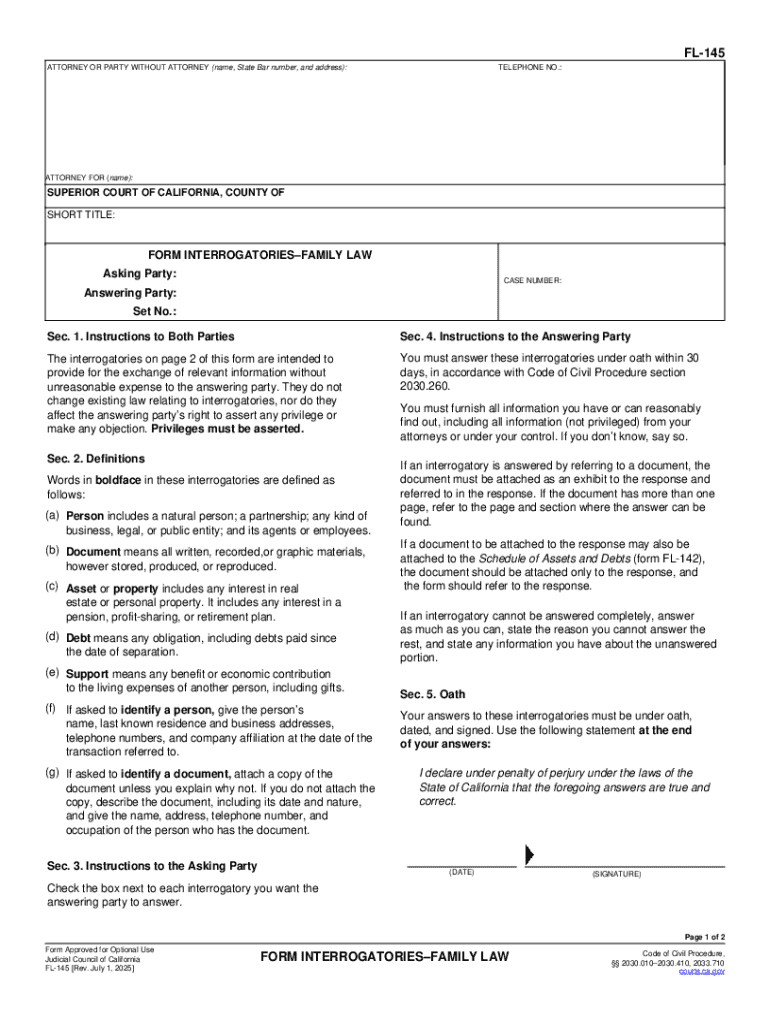
The FL-145 form, also known as "Interrogatories," is utilized in the state of California within family law cases for the formal exchange of information between parties. It serves as a mechanism to collect detailed responses to specific questions posed by one party to another. This process can aid in obtaining pertinent information related to personal history, legal actions, agreements, financial status, including income, assets, and debts. The form ensures transparency and accountability, as responses must be given under oath, adhering to legal statutes and procedural guidelines.
How to Use the FL-145
Using the FL-145 effectively involves a structured approach that starts with identifying the information needed. Parties involved in legal proceedings must carefully draft questions that are precise, relevant to the case, and crafted to elicit detailed responses. Both parties have responsibilities: the party posing the questions must ensure clarity and compliance with court rules, while the responding party is obligated to answer truthfully and completely. It's crucial to familiarize oneself with the procedural requirements for both asking and answering interrogatories to avoid legal pitfalls or sanctions.
How to Obtain the FL-145
The FL-145 form is readily available from several sources for those involved in California family law proceedings. Interested parties can obtain the form from the official California Courts website, where downloadable PDF versions are accessible for print and completion. Additionally, local courthouses may provide physical copies to those who request them in person. Legal professionals and law libraries can also serve as resources for accessing this form, providing further context and guidance on its application and submission.
Steps to Complete the FL-145
Completing the FL-145 form requires attention to detail and a methodical approach. Here is a step-by-step guide:
-
Review Instructions: Begin by reading the instructions thoroughly to understand the requirements for both asking and responding parties.
-
Draft Questions: Formulate clear and concise questions if you are the asking party. Ensure they relate directly to the case and serve a specific purpose.
-
Provide Responses: As the responding party, answer each question accurately. Attach additional sheets if necessary to provide exhaustive accounts.
-
Verification: Include a verification page where answers are sworn under oath. Failure to do so can result in non-compliance penalties.
-
Submission: File the completed form with the court and deliver copies to the opposing party by the deadlines outlined by the court.
Who Typically Uses the FL-145
The FL-145 form is primarily utilized by parties involved in family law cases within California. Legal professionals such as attorneys often assist in preparing, reviewing, and submitting forms on behalf of their clients, ensuring that the information aligns with legal standards. In addition to litigants, judges and court personnel may use the form to facilitate clearer understanding and resolution of a case, particularly when financial or personal disclosures are central to the case outcome.


Important Terms Related to FL-145
Understanding certain key terms is essential when dealing with the FL-145:
- Interrogatories: Written questions requiring answers under oath.
- Oath: A solemn promise regarding truthfulness.
- Disclosure: The act of making new or secret information known.
- Privileges: Legal rights allowing one to withhold information.
- Objections: Formal statements disputing the appropriateness of specific questions.
Familiarity with these terms ensures compliance and aids in the effective handling of the form.
Legal Use of the FL-145
The legal utility of the FL-145 lies in its ability to aid litigation through structured information exchange. Questions and responses are admissible as evidence, shaping outcomes significantly. Attorneys often leverage this form to build cases or defenses around financial disclosures or personal agreements pertinent to support calculations or asset division. Legal strategies may involve both crafting questions and articulating objections to maintain client privilege or dispute inappropriate inquiries, underscoring the form's tactical significance in litigation.
Key Elements of the FL-145
The FL-145 encompasses several key sections which ensure comprehensive data gathering:
-
Identifying Information: Details of the parties involved, including full names and case numbers.
-
Questionnaire: Series of questions addressing various legal and personal matters relevant to the case.
-
Verification: A sworn statement affirming the truthfulness of the answers provided.
-
Instructions: Guidelines for completing and interpreting form sections.
Each element must be approached with care to adhere to legal standards and fulfill the form's purpose effectively.
Filing Deadlines and Important Dates
Adherence to deadlines is crucial when dealing with the FL-145. Courts stipulate timelines within which the form must be completed and submitted. Failure to comply can lead to severe repercussions, including default judgments or sanctions. It's imperative to schedule the preparation and review of interrogatories efficiently, ensuring submission aligns with the court's schedule and allowing time for any necessary corrections or objections. Legal counsel can provide specific guidance tailored to individual case timelines.