







Definition and Meaning
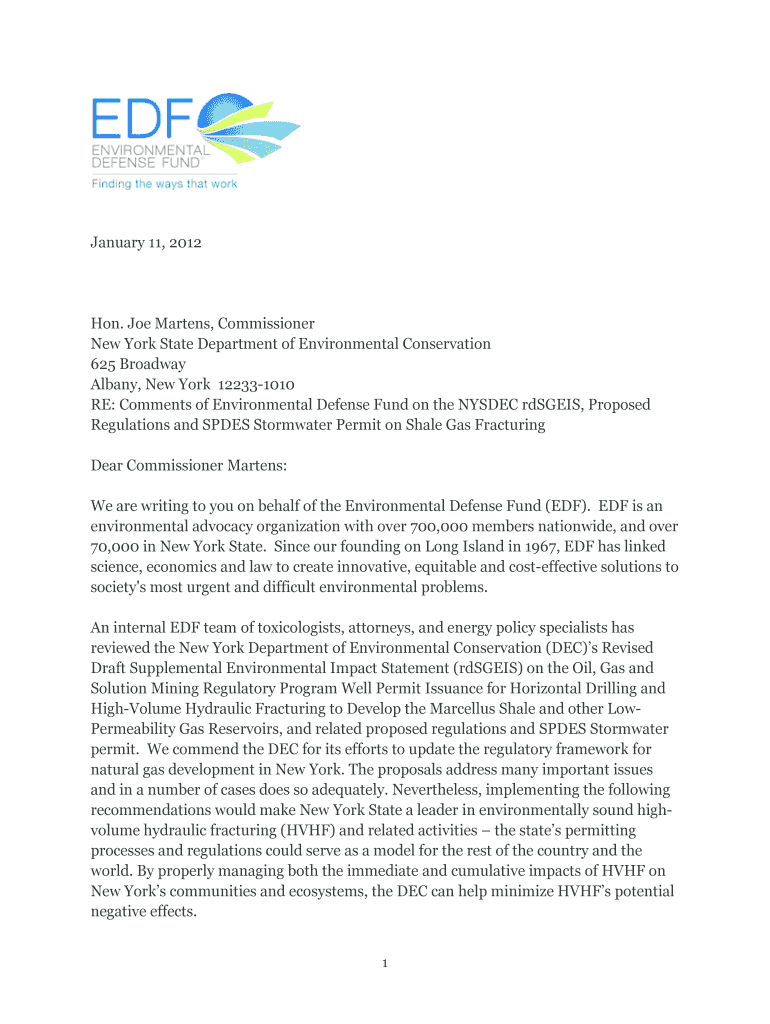
The content referenced from "January 11, 2012 Hon Joe Martens, Commissioner New York State - blogs edf" is likely a communication document from the Environmental Defense Fund (EDF) to Joe Martens, the Commissioner of the New York State Department of Environmental Conservation on that date. It is primarily concerned with providing feedback on proposed hydraulic fracturing regulations. The significance of this document lies in its suggestions for enhancing environmental protections, which include stricter chemical disclosure requirements and improved monitoring of air and water quality.
Key Elements
- Commissioner Joe Martens: The then commissioner receiving the document.
- Hydraulic Fracturing Regulations: The core subject of recommendations and comments.
- Environmental Protections: Areas EDF aimed to strengthen through various strategies.
- Chemical Disclosure: Specific focus on transparency regarding the chemicals used in fracking.
How to Use the January 11, 2012 Document
If you are an environmental policy analyst, this document serves as a reference point for historical regulatory efforts in New York regarding fracking. Review its recommendations to understand past policy critiques and the focus areas EDF prioritized at that time.
Steps to Use
- Review the document's content for precise recommendations on regulatory enhancements.
- Analyze EDF’s suggestions to see alignment or divergence in current regulatory practices.
- Apply insights to advocate for policy amendments or establish baseline regulatory benchmarks.
Obtaining the January 11, 2012 Document
Accessing the document requires navigating relevant agencies and sources that archive regulatory commentary.
- Request through the New York State Department of Environmental Conservation: Given its direct involvement, they may house the archive.
- Check EDF’s publications or blogs as they may publicly share such communications.
- Access legal repositories or public libraries which may archive such documents.
Steps to Complete Related Documentation
Understanding how to contextualize or apply the information within your operations involves several steps.
- Identify the regulatory gaps that EDF highlighted.
- Draft a current version or response to present updated positions or reactive measures.
- Coordinate stakeholder input to ensure multifaceted views are considered in modern applications.
Importance of the January 11, 2012 Document
The document highlights a critical juncture in environmental regulation discourse, showcasing a push for transparency and robust safeguards in hydraulic fracturing.
Benefits
- Advocates for stronger chemical management and public involvement in regulation.
- Offers a historical perspective for gauging regulatory evolution in energy practices.
- Serves as a model for advocating environmental reforms in other jurisdictions.
Who Uses the January 11, 2012 Document
This document is primarily utilized by policymakers, environmental advocates, and legal professionals.
Typical Users
- Policy Analysts: Investigate and advise on environmental regulations.
- Legal Professionals: Reference it in environmental litigation or advocacy.
- Environmentalists: Use it to understand historic advocacy stances and outcomes.
Important Terms Related to the Document
Certain terms are recurring and pivotal in understanding the document's content.
- Hydraulic Fracturing Regulations: Laws and guidelines governing the extraction process.
- Chemical Disclosure: The act of detailing chemicals used in industrial operations.
- Environmental Defense Fund (EDF): An environmental advocacy group focusing on policies to protect the environment.
Legal Use Considerations
For legal compliance and application, consider the following:
- Analyze the document within the current legal framework to ensure relevance.
- Apply insights from EDF's recommendations in drafting contracts or policy provisions.
- Ensure adherence to current state regulations, using the document as a contextual guide.
Key Takeaways
The January 11, 2012 document symbolizes an essential contribution to the regulatory dialogue surrounding hydraulic fracturing in New York.
Highlights
- EDF’s proactive stance on environmental safeguarding.
- Significance in shaping transparent regulatory frameworks.
- Its role as a precedence-setting document for ongoing policy development.
Understanding and utilizing the information from this document can benefit ongoing environmental regulatory processes, contribute to the development of current legislation, and provide a foundation for advocacy efforts.




