
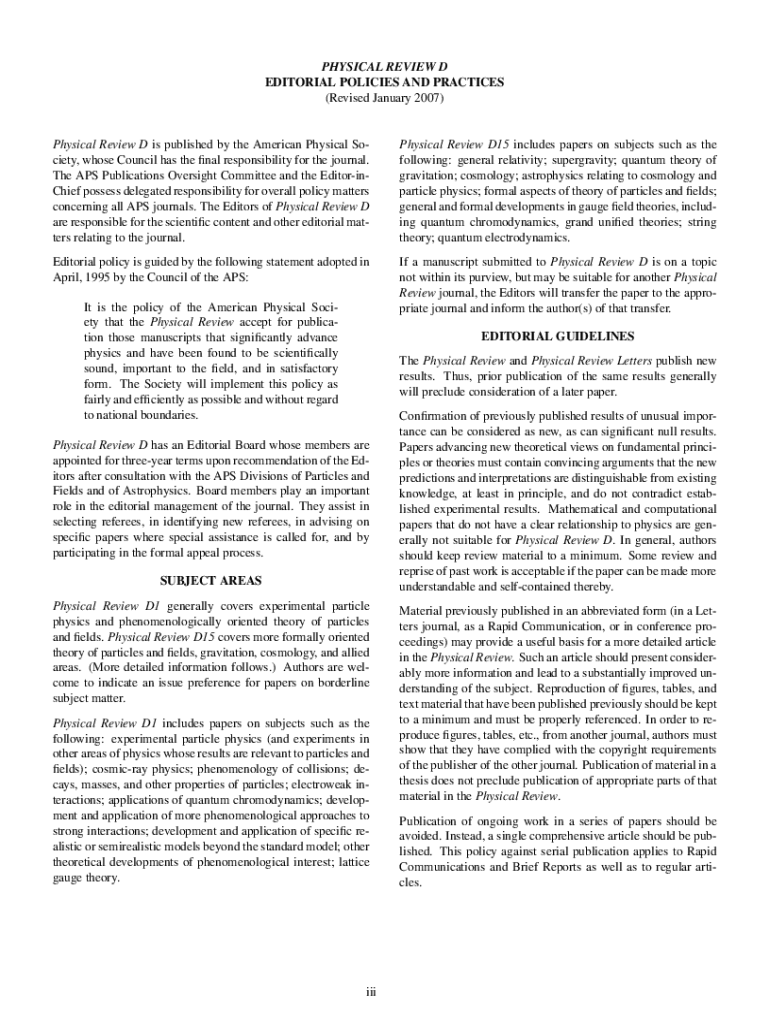







Definition & Significance of Physical Review D
Physical Review D is a prominent scientific journal focused on the fields of high energy physics, gravitation, and cosmology. It is published by the American Physical Society (APS), an authoritative organization that aims to advance and diffuse the knowledge of physics. As a respected publication in the scientific community, Physical Review D ensures high standards in peer review, making it a critical source for researchers seeking well-vetted scientific findings.
Researchers and academics rely on Physical Review D for the latest discoveries in theoretical and experimental physics. The journal serves as an essential platform for scientists to publish their work, gaining visibility and recognition among peers. Its rigorous review process ensures that only scientifically sound and relevant studies are published, furthering scientific progress in its specialized areas.
Editorial and Review Process
The editorial and review process at Physical Review D is meticulous, emphasizing the importance of both originality and scientific rigor. Manuscripts submitted undergo a thorough peer-review process, where subject experts evaluate the content for accuracy, significance, and novelty. The American Physical Society’s Council bears the ultimate responsibility for published content, adhering to strict ethical guidelines and editorial practices.
The peer review process involves multiple steps and feedback rounds. Initially, editors screen submissions for relevance and quality. Accepted papers move to qualified referees who provide detailed evaluations. Authors may be asked to revise their manuscripts based on referee comments, ensuring clarity and scientific integrity. This iterative process culminates in the publication of robust and impactful scientific work.
How to Submit a Manuscript
Authors interested in submitting to Physical Review D should follow a structured process to ensure their work meets APS standards. Initial steps include preparing the manuscript according to the journal’s submission guidelines, ensuring proper formatting, citation, and clear presentation of ideas.
-
Manuscript Preparation: Authors must adhere to the publication's format, including section headings, figure placement, and referencing style. Comprehensive instructions are available on the APS website.
-
Originality and Citations: Submissions must be original, with accurate citations to prior work. Authors should clearly state the novelty and contribution of their research.
-
Online Submission System: Manuscripts are submitted through the APS online portal. Authors create an account, upload their work, and provide relevant information such as author details and suggested reviewers.
-
Review and Feedback: Post-submission, authors receive feedback from referees. Clear and actionable feedback helps authors refine their papers for ultimate acceptance.
-
Finalization: Following corrections and final approval from the editorial board, the accepted manuscript is scheduled for publication.
Key Elements of Physical Review D
Physical Review D encompasses several key areas of research, categorized broadly under theoretical and experimental physics. These include topics such as quantum field theory, astrophysics, particle physics, and cosmology. Each submission is expected to contribute significantly to one or more of these fields.
-
Theoretical Physics: Papers in this category delve into abstract concepts and propose new theories or extensions to existing models.
-
Experimental Results: Research detailing groundbreaking experiments or novel methodologies fall under this category, highlighting practical implications in high energy physics.
-
Review Articles: Comprehensive reviews summarizing current knowledge and future directions are occasionally published, offering invaluable insight into complex topics.
-
Methodological Innovations: Submissions offering new methods or tools for analyzing physical phenomena are encouraged and critically evaluated for their potential to advance scientific inquiry.
Role of the American Physical Society
The American Physical Society, as the publisher of Physical Review D, plays a crucial role in maintaining the publication's standards and reach. The APS, through its council, oversees the final responsibility for the journal’s editorial content, ensuring adherence to ethical practices and scientific excellence.
Initiatives and Contributions
-
Educational Outreach: By prioritizing educational initiatives, APS promotes physics as a discipline, fostering the next generation of scientists.
-
Policy Advocacy: APS actively engages in advocacy, influencing science policy to benefit research and education globally.
-
Networking and Collaboration: Through its publications and events, APS facilitates networking among physicists, encouraging collaborative research and knowledge exchange.
These efforts ensure that Physical Review D remains at the forefront of scientific publication, known for its quality and influence within the scientific community.
Legal and Ethical Considerations
Ensuring legal and ethical compliance is a priority for Physical Review D. The journal upholds stringent guidelines to prevent academic misconduct such as plagiarism, data falsification, and authorship disputes. Authors must adhere to copyright regulations, ensuring the proper use of third-party content.
-
Plagiarism: All submissions undergo plagiarism checks to uphold integrity.
-
Authorship and Contribution: Transparent disclosure of each author’s contribution is mandated to ensure appropriate credit.
-
Conflict of Interest: Authors, referees, and editors must declare any potential conflicts to maintain impartiality in the review and publication process.
These measures preserve the journal's credibility, encouraging honest and transparent scientific communication.
Impact on Scientific Research and Community
Physical Review D has a profound impact on both the scientific community and broader scientific research. It serves as a critical resource for cutting-edge findings in high energy physics, influencing ongoing research and fostering scientific dialogue.
-
Citation and Recognition: Articles published in Physical Review D receive high visibility and citations, contributing significantly to an author’s academic reputation and career growth.
-
Interdisciplinary Influence: The journal’s topics often intersect with other fields, facilitating interdisciplinary research and application of physics in diverse areas.
-
Global Reach: By disseminating its findings worldwide, Physical Review D pushes the envelope of international scientific collaboration, promoting discoveries that transcend borders and cultural differences.
The journal’s contributions underpin many breakthroughs, continually pushing the boundaries of what is known in physics.




