Fl-303 S 2026

Get Form
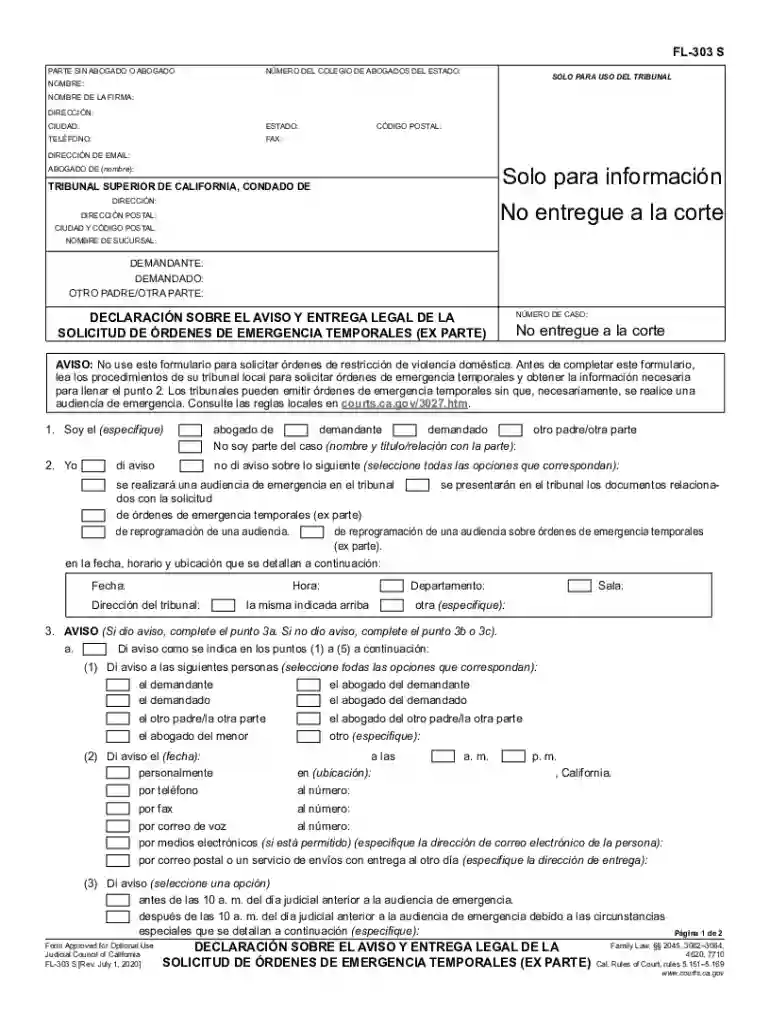
Fl-303 S Preview on Page 1

Here's how it works

01. Edit your form online
Type text, add images, blackout confidential details, add comments, highlights and more.

02. Sign it in a few clicks
Draw your signature, type it, upload its image, or use your mobile device as a signature pad.

03. Share your form with others
Send it via email, link, or fax. You can also download it, export it or print it out.

Definition and Importance of the FL-303 S

The FL-303 S is a legal form used in California family law cases to notify involved parties of a request for temporary emergency orders, also known as ex parte orders. These orders are typically sought in urgent situations where the court's immediate intervention is necessary to address issues such as custody, visitation, or protection from domestic violence. The form provides detailed sections for entering personal and case-related information, making it crucial for ensuring all parties are informed and legal procedures are followed appropriately.

  • Significance: Understanding the FL-303 S is vital as it facilitates timely communication and helps in managing emergency family law matters effectively.
  • Purpose: It acts as a formal notification to the other party, upholding due process rights and ensuring that they have an opportunity to respond to the emergency consideration.

Steps to Complete the FL-303 S

Filing the FL-303 S involves several deliberate steps to ensure accuracy and compliance with legal standards. Here's how you can complete it efficiently:

  1. Fill Out Personal Information: Begin by entering your personal details, including your name, address, and contact information. Ensure these details are current.
  2. Specify Case Information: Clearly state the case number, court location, and the names of all involved parties. This ensures that your document is processed under the correct case.
  3. Detail the Request: Specify the nature of the emergency order you are requesting, including reasons why it is necessary. This section should include any evidence or supporting details that justify the urgency of the order.
  4. Service of Notice: Indicate whether notice has been given to the other parties and, if not, provide reasons for the waiver of such notice. It's important to justify how lack of notice would result in immediate harm or injustice.
  5. Review and Sign: Carefully review all information for completeness and accuracy, then sign and date the form before submission.

Completing the FL-303 S accurately not only ensures legal compliance but also facilitates swift legal proceedings in urgent situations.

Who Typically Uses the FL-303 S

The FL-303 S is commonly used by parties involved in family law disputes within California. It is especially relevant to:

  • Parents: In cases involving child custody or visitation rights where there might be immediate harm to the child if swift court action is not taken.
  • Spouses: During divorce proceedings that require immediate resolution of issues like property disputes or spousal support until a hearing can be scheduled.
  • Legal Guardians: When managing cases that include minors who require immediate protection or intervention from the court.

Understanding the typical users of the FL-303 S helps in appreciating its role in safeguarding the welfare of families in urgent circumstances.


decoration image ratings of Dochub

How to Obtain the FL-303 S

Accessing the FL-303 S can be done through various channels, each designed to provide convenience and accessibility to users:

  • Online: The form is readily available on the official California Courts website where it can be downloaded and printed.
  • Local Courthouse: You can obtain a physical copy directly from the clerk's office at your jurisdiction's family law court. This is often the method preferred by those unfamiliar with digital forms.
  • Legal Aid Organizations: They often provide forms and assistance in completing them for individuals who qualify for aid due to financial constraints or other reasons.

These methods ensure that the form is accessible to a wide audience, enabling them to initiate necessary legal action quickly.

Legal Use of the FL-303 S

The legal framework surrounding the FL-303 S dictates how it should be used within California's family law context:

  • Adherence to Local Rules: Each county might have specific rules regarding the filing and processing of emergency orders, requiring familiarity with local court procedures.
  • Court Approval: As an ex parte request, the form must be reviewed and approved by a judge who determines the necessity of the emergency order.
  • Validity: The FL-303 S is part of establishing a temporary solution; hence, subsequent formal hearings might be required to settle the matters permanently.

This legal context ensures that the FL-303 S serves as a temporary and necessary measure to address urgent family concerns.

Key Elements of the FL-303 S

Understanding the key elements of the FL-303 S assists in proper form completion and filing:

  • Identification of Parties: Accurate details of the petitioner and respondent are a must to avoid delays or misdirected communications.
  • Details of Emergency Order: The specific nature of the relief or order sought, including detailed reasons and supporting evidence.
  • Notification Process: Documenting any notice given to other parties or reasons for not doing so is crucial for maintaining transparency in ex parte actions.

Identifying these elements aids in preparing a comprehensive and legitimate request that the court can aptly consider.

State-Specific Rules for the FL-303 S

California has unique legal requirements that govern the use of the FL-303 S. These rules ensure proper adherence to state laws:

  • Timeframes: Emergency orders are time-sensitive and often have specific deadlines for filing and responses that must be strictly met to avoid automatic denial.
  • Local Practices: Some counties may have additional documentation requirements or forms that must be submitted alongside the FL-303 S.
  • Priority Handling: Given their urgent nature, these forms are often processed at a different pace compared to standard legal documents.

This specification of state rules helps individuals understand the legislative environment within which the FL-303 S is employed, ensuring lawful and timely pursuits in emergency family matters.

Examples of Using the FL-303 S in Real Life

In practice, the FL-303 S is a critical tool for navigating family emergencies in the legal realm:

  • Child Safety: Imagine a scenario where a parent believes their child's safety is at risk due to the other parent's behavior. Filing an FL-303 S can result in temporary custody modifications that protect the child until a formal hearing.
  • Domestic Violence: For survivors of domestic violence, an FL-303 S can be used to request an immediate restraining order, providing safety and security while awaiting court proceedings.
  • Urgency in Spousal Support: When one spouse finds themselves financially strapped due to a pending divorce, the FL-303 S can secure temporary spousal support to maintain living conditions until a final settlement.

Through real-world applications, one can see the vital role of the FL-303 S in managing pressing family law situations effectively.

be ready to get more

Complete this form in 5 minutes or less

Get form

Got questions?

We have answers to the most popular questions from our customers. If you can't find an answer to your question, please contact us.
Contact us
Declaration Regarding Notice and Service of Request for Temporary Emergency (Ex Parte) Orders (FL-303) Tells the court if and how you let the other party know that you are asking the court to make emergency orders in your case.
In the legal process, the FL-335 Proof of Service by Mail form is required when you need to provide evidence that legal documents have been served to the other party by mail. This form is crucial in family law cases, ensuring the opposing party is informed about filings or requests made to the court.
An ex parte order is quick and temporary, given without the accuseds presence. A restraining order, on the other hand, involves a full hearing with both parties. It offers longer-term protection.
Proof of Service by Mail (FL-335) Tells the court that you had the other party served legal papers by mail. Lists the papers that were served and tells when and where the papers were served, as well as who served them.
Insufficient Evidence: If the petition doesnt provide enough evidence to prove that the child is in immediate danger, the judge may deny the ex parte order.

Security and compliance

At DocHub, your data security is our priority. We follow HIPAA, SOC2, GDPR, and other standards, so you can work on your documents with confidence.
Learn more
ccpa2
pci-dss
gdpr-compliance
hipaa
soc-compliance

People also ask

0:11 0:51 After filling out the information box at the top have the person you had served the papers fill outMoreAfter filling out the information box at the top have the person you had served the papers fill out the FL330. On number two write down the persons. Name you served the documents.

Related links