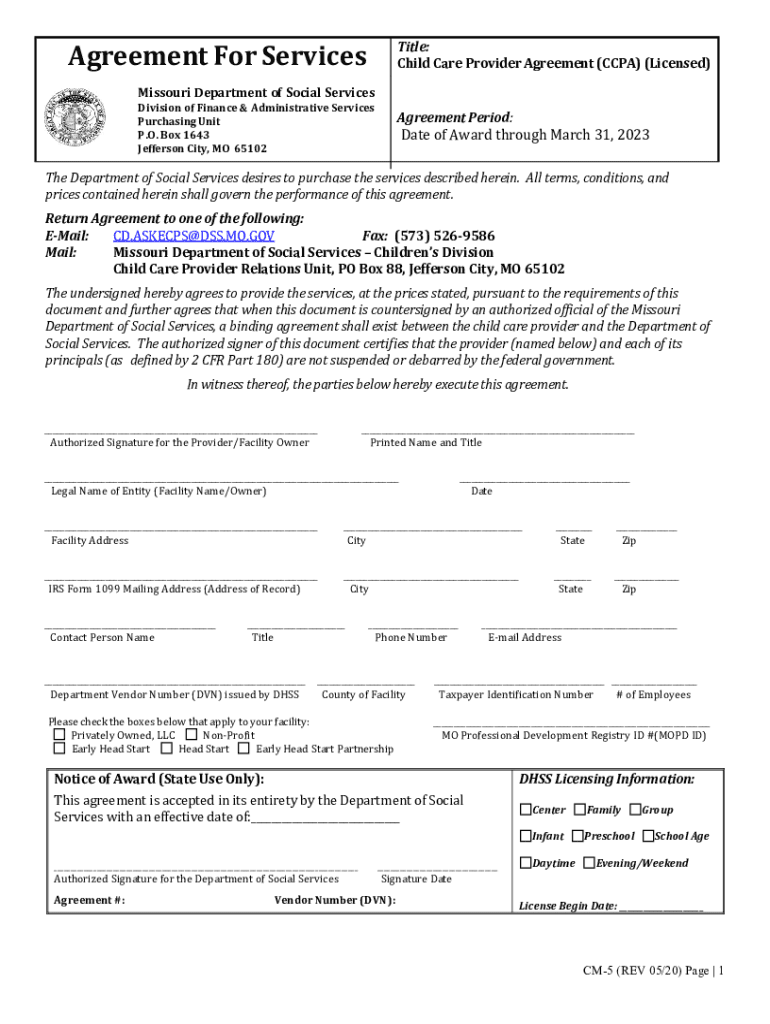







Overview of the Agreement For Services Title: Child Care Provider
The "Agreement For Services Title: Child Care Provider," often known as the Child Care Provider Agreement (CCPA), is a formal document issued by the Missouri Department of Social Services. This agreement sets forth the guidelines and conditions under which licensed child care providers deliver services to authorized clients. It serves as a crucial legal framework ensuring that all parties adhere to federal and state regulations, thereby maintaining a standard of quality and safety in child care services.
Essential Elements of the Child Care Provider Agreement
Understanding the core components of the CCPA is essential for compliance and effective service delivery. Key elements of this document typically include:
- Agreement Period: Specifies the active duration for which the agreement is valid. This period defines when the child care services are to be provided under the outlined terms.
- Performance Requirements: Outlines the expectations and standards that child care providers must meet to fulfill the terms of the agreement. This includes adhering to licensing standards and maintaining high-quality care.
- Service Definitions: Provides clear definitions of what constitutes child care services, detailing activities, responsibilities, and limitations for providers.
- Legal Compliance: Emphasizes the necessity for providers to comply with federal and state laws and regulations, including health, safety, and licensing requirements.
How to Obtain the Child Care Provider Agreement
The acquisition of the Child Care Provider Agreement involves several straightforward steps, primarily managed through state or regional agencies:
- Contact the Missouri Department of Social Services: Begin by reaching out to the relevant department to request access to the agreement.
- Online Access: Many state departments provide digital copies of such agreements on their websites, allowing providers to download and print the document.
- Mail Requests: If a digital option is unavailable, submitting a mail request directly to the department can provide a physical copy of the agreement.
- In-Person Visits: Visiting the department’s offices might also be an option for expedited access to the agreement, where staff can offer guidance on completion.
Completing the Child Care Provider Agreement
The process of completing the CCPA requires careful attention to detail and compliance with legal standards:
- Read Thoroughly: Begin by carefully reading the entire agreement to understand all requirements and conditions outlined.
- Verify Information: Ensure all personal and business information is current and accurate, reflecting the most recent details.
- Signatures: Both parties – the service provider and the authorizing body – must sign the agreement to formalize the contract.
- Submission: Submit the completed agreement according to the instructions provided, typically via mail or a secure online portal.
Use Cases and Practical Examples
The CCPA is used by a variety of stakeholders, each with unique priorities and requirements. Practical examples include:
- Home-Based Child Care Providers: These individuals often use the agreement to establish terms with the state for offering authorized care in their homes.
- Daycare Centers: Larger facilities may rely on the CCPA to ensure compliance with state licensing requirements and funding provisions.
- Special Needs Programs: Programs tailored for children with special needs can use the CCPA to guarantee compliance with additional state-mandated care standards.
Legal Use of the Agreement
Understanding the legal implications of the CCPA is crucial for both compliance and risk management:
- Binding Nature: The CCPA is a legally binding document, meaning that once signed, both parties are obligated to adhere to its terms.
- Regulatory Compliance: The agreement ensures that providers are compliant with state and federal guidelines, reducing the risk of legal disputes.
- Confidentiality Agreements: Providers are often required to maintain confidentiality about client information, a stipulation reinforced by the terms of the CCPA.
State-Specific Rules and Variations
While the CCPA is a standardized document, certain elements might vary based on state-specific regulations:
- Missouri Guidelines: Providers in Missouri must follow state-specific licensing requirements and adhere to particular performance benchmarks, which might differ from those in other states.
- Updates and Amendments: Regular updates to state laws may necessitate amendments to the agreement, requiring providers to stay informed about any changes.
Software Compatibility and Digital Integration
With the increasing digitization of document management, understanding the software compatibility for handling the CCPA is essential:
- Document Management Software: Systems like DocHub are instrumental in managing, editing, and signing digital versions of the CCPA, offering tools to streamline workflows and ensure compliance.
- Integration with Google Workspace: Providers can utilize Google Drive and related services for easy access, storage, and sharing of digital agreement forms, ensuring seamless integration into existing business processes.
Each of these elements provides a detailed understanding of the "Agreement For Services Title: Child Care Provider," offering insights into its acquisition, completion, and significance within the broader context of child care service provision.