Teacher End of the Year Assessment (EOYA) - Vermont Agency of 2026

Get Form
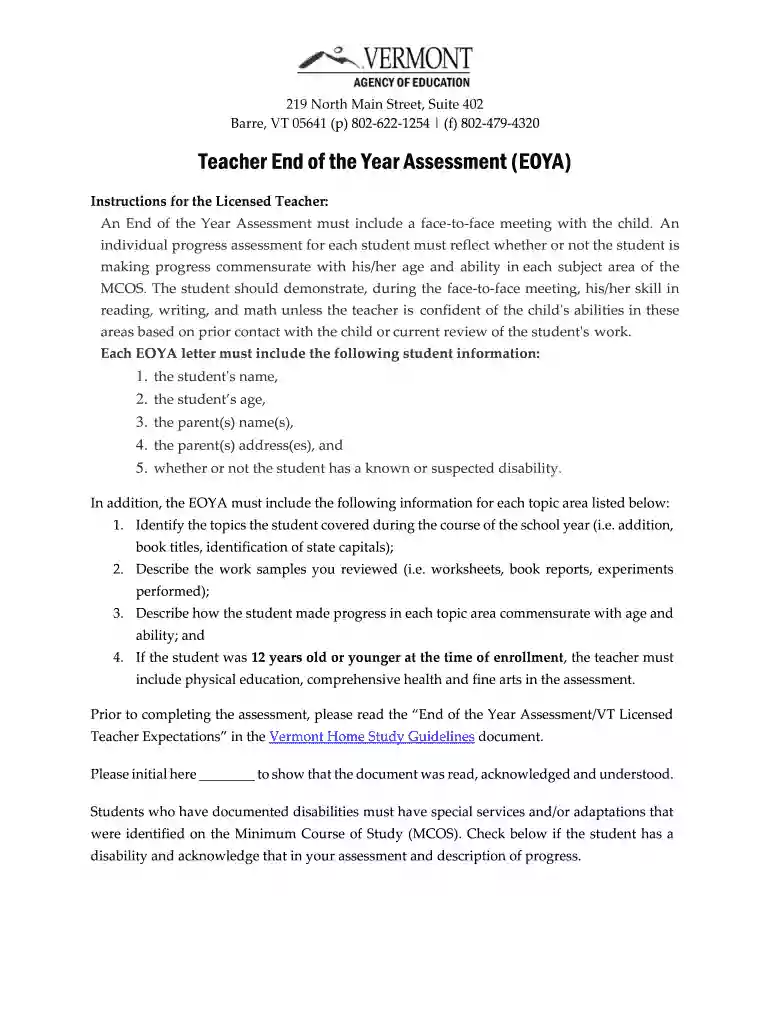
Teacher End of the Year Assessment (EOYA) - Vermont Agency of Preview on Page 1

Here's how it works

01. Edit your form online
Type text, add images, blackout confidential details, add comments, highlights and more.

02. Sign it in a few clicks
Draw your signature, type it, upload its image, or use your mobile device as a signature pad.

03. Share your form with others
Send it via email, link, or fax. You can also download it, export it or print it out.

Definition and Purpose of the Teacher End of the Year Assessment (EOYA)

The Teacher End of the Year Assessment (EOYA) in Vermont is a structured evaluation process designed to assess student progress in various academic areas. This assessment is crucial for capturing detailed insights into each student's learning journey over the school year. Teachers use the EOYA to conduct comprehensive reviews through face-to-face meetings with students, focusing on subjects like reading, writing, math, and potentially physical education and fine arts. This form ensures that educators evaluate not only academic performance but also consider the diverse needs of students, including those with disabilities.

Importance in Educational Assessment

  • Facilitates personalized student evaluations.
  • Promotes accountability in educational outcomes.
  • Provides a holistic view of student progress.

Examples of Use

A middle school teacher may utilize the EOYA to assess a student’s progress in reading comprehension and writing skills, incorporating specific feedback on strengths and areas for improvement.

Steps to Complete the Teacher End of the Year Assessment (EOYA)

Completing the EOYA involves a series of methodical steps to ensure thorough documentation of student performance.

Preparation

  1. Gather Work Samples: Collect and organize work samples that illustrate the student’s progress.
  2. Review Syllabus and Objectives: Revisit the year’s curriculum goals to align the assessment with intent.

Conducting the Assessment

  1. Face-to-Face Meetings: Engage students in discussions covering each subject area to gain qualitative insights.
  2. Document Findings: Record observations and evaluations in the designated sections of the EOYA form.

Finalization

  • Ensure all necessary fields and sections are completed.
  • Review for accuracy and completeness before submission.

Key Elements of the Teacher End of the Year Assessment (EOYA)

The EOYA encompasses several components that aid in the detailed evaluation of student performance throughout the year.

Student Information

  • Personal Details: Name, age, grade level.
  • Subject Areas Covered: List of subjects assessed.

Evaluation Criteria

  • Progress Indicators: Assessment of student achievements against set objectives.
  • Considerations for Disabilities: Modifications or accommodations if applicable.

Examples

A high school math teacher may include specific metrics used to evaluate student capability in algebra, calculating the proficiency growth over the academic year.

Who Typically Uses the Teacher End of the Year Assessment (EOYA)

The EOYA is primarily utilized by teachers in Vermont schools to perform annual student evaluations.


decoration image ratings of Dochub

Educators and Administrators

  • Teachers: Conduct assessments to identify progress and areas needing improvement.
  • School Administrators: Analyze aggregated data to inform school-wide educational strategies.

Use Case Scenario

A special education teacher might focus the EOYA on customized learning goals tailored for students with individual learning plans.

State-Specific Rules for the Teacher End of the Year Assessment (EOYA) in Vermont

The EOYA is regulated by specific guidelines set by the Vermont Agency of Education, ensuring that assessments are consistent and fair across the state.

Key Regulations

  • Mandated Face-to-Face Assessments: Required meetings for accurate student evaluations.
  • Documentation Requirements: Full detail of student progress and areas assessed within the year.

Example of Compliance

An elementary school must submit all EOYA findings by the state's specified deadline, ensuring all assessments are properly documented.

Legal Use and Compliance with the Teacher End of the Year Assessment (EOYA)

Adhering to the legal framework surrounding the EOYA is crucial for its acceptance and validation.

Legal Considerations

  • Data Privacy: Ensure student information is protected according to state education laws.
  • Document Accuracy: Maintain truthful and comprehensive notes for legal compliance.

Edge Cases

In instances where a student has transferred mid-year, the EOYA must account for assessment data from previous schools to present an accurate yearly evaluation.

Examples of Using the Teacher End of the Year Assessment (EOYA)

Real-world application of the EOYA demonstrates its versatility in capturing educational achievements.

Practical Application

  • Situational Adaptations: Adapting the EOYA to cater to online learning environments where face-to-face meetings are replaced by virtual assessments.
  • Case Studies: Schools reporting increased student success rates by following dedicated EOYA processes guiding instructional improvements.

Required Documents for the Teacher End of the Year Assessment (EOYA)

Successful completion of the EOYA depends on gathering and incorporating several crucial documents.

Essential Documentation

  • Student Work Samples: Copies of essays, math tests, art projects.
  • Evaluation Notes: Detailed notes from teacher-student meetings.

Submission Checklist

  1. Ensure all fields in the form are filled.
  2. Attach required documentation supporting the assessment.
  3. Verify accuracy and completeness before submission to the local education authority.

Following these structured guidelines ensures a detailed and effective assessment process, aligning with Vermont's educational standards.

be ready to get more

Complete this form in 5 minutes or less

Get form

Got questions?

We have answers to the most popular questions from our customers. If you can't find an answer to your question, please contact us.
Contact us
Starting your homeschooling journey in Vermont is straightforward when paired with the tools and support offered by Time4Learning. Follow these steps to get started: Submit your notice of intent to the Vermont Agency of Education, including a detailed outline of your intended curriculum.

Security and compliance

At DocHub, your data security is our priority. We follow HIPAA, SOC2, GDPR, and other standards, so you can work on your documents with confidence.
Learn more
ccpa2
pci-dss
gdpr-compliance
hipaa
soc-compliance