
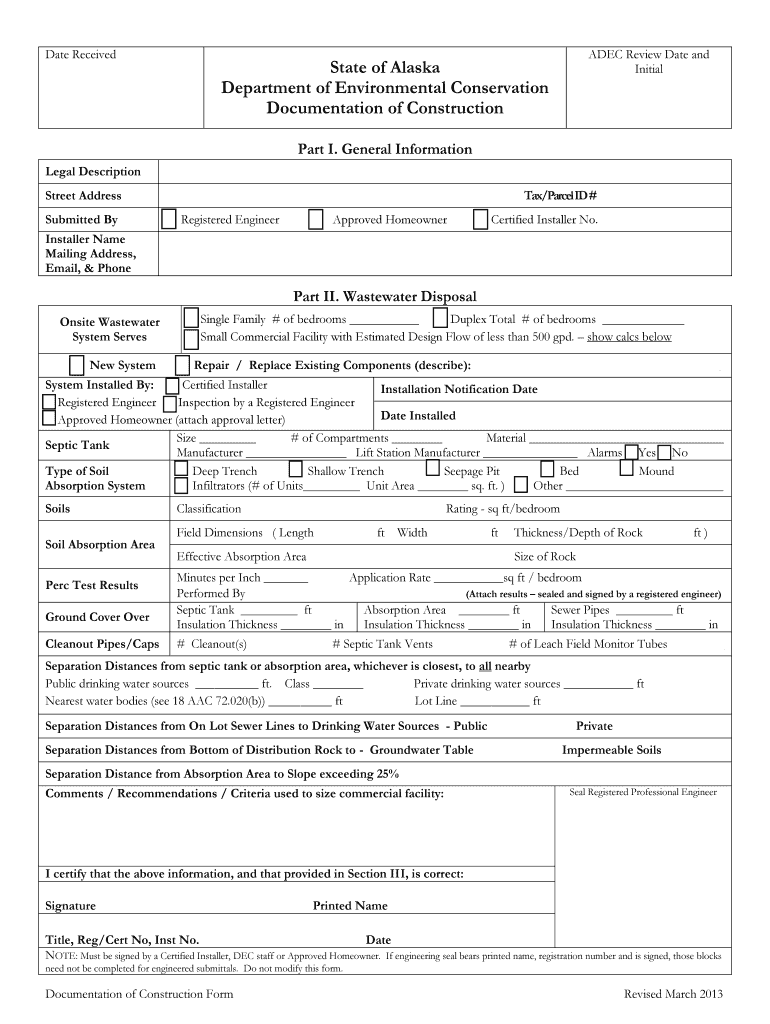







Definition and Purpose of the Documentation of Construction Instructions
The "Documentation of Construction Instructions" serves as a comprehensive guide for individuals undertaking onsite wastewater treatment and disposal system projects in Alaska. It outlines detailed requirements and procedures to ensure these systems are installed correctly, adhering to state regulations. By providing explicit instructions, it facilitates compliance with environmental safety standards and streamlines the communication of necessary protocols to certified installers and approved homeowners.
How to Use the Documentation of Construction Instructions
Utilizing the "Documentation of Construction Instructions" effectively requires a thorough understanding of the guidelines provided. Users should carefully review the document to identify the specific procedures related to their project. The instructions include step-by-step guidance on system installation without needing prior approval from the Alaska Department of Environmental Conservation (ADEC). Users should ensure they gather all necessary documents, such as certified forms, photographs, and soil testing records, which play a crucial role in completing the installation process.
Steps to Complete the Documentation of Construction Instructions
-
Preparation: Begin by assembling the required documents, including engineering documentation and soil testing records. Understanding the scope and extent of the installation project is essential.
-
Submission of Certified Forms: Fill out any mandated forms accurately. These forms should be certified by either an approved homeowner or a certified installer.
-
Photographic Evidence: Capture and submit photographs of the construction site and the installation process as specified in the instructions.
-
Soil Testing and Analysis: Conduct the necessary soil tests and compile these results in an organized manner to accompany your submission.
-
Final Review and Notification: Prior to beginning construction, notify ADEC and review all compiled documentation for completeness and accuracy.
Key Elements of the Documentation of Construction Instructions
-
Submission Requirements: Detail the exact forms and documentation needed to ensure compliance.
-
Photographs and Record-keeping: Emphasize the importance of photographic evidence to verify installation details.
-
Contact Information for Regulatory Bodies: Include essential contact details for ADEC offices to facilitate communication and clarification.
Legal Use of the Documentation of Construction Instructions
The documentation complies with Alaska state regulations, ensuring that all wastewater treatment systems meet the necessary environmental standards. Legal use involves strict adherence to the guidelines provided without deviation unless otherwise authorized by ADEC. Failure to comply can result in penalties or the need for corrective actions.
Who Typically Uses the Documentation of Construction Instructions
This documentation is primarily used by certified installers and approved homeowners engaged in the installation of onsite wastewater systems. It is also a critical resource for regulatory officials from the ADEC who oversee compliance with environmental safety standards. Contractors and engineers involved in environmental and construction disciplines may refer to these instructions for precise project execution.


State-Specific Rules for the Documentation of Construction Instructions
Alaska's requirements for onsite wastewater systems uniquely account for the state's environmental conditions. These rules highlight region-specific considerations such as soil composition and climate, which can impact system performance. Understanding these localized factors is crucial for successful installation.
Examples of Using the Documentation of Construction Instructions
For illustrative purposes, consider a scenario where a homeowner in Anchorage needs to install a new wastewater system. They must adhere to the documentation instructions by ensuring all soil tests and photographs are accurately documented and submitted alongside the necessary forms to ADEC, exemplifying a practical application of the guide in a real-world setting.
Penalties for Non-Compliance
Non-compliance with the documentation requirements may lead to a variety of penalties. These can include fines or the revocation of installation privileges. Ensuring adherence to every detail of the documentation process is vital to avoid these repercussions and to maintain environmental integrity.
Required Documents for Submission
Before beginning installation, gather a complete set of documents, which typically includes:
- Certified forms signed by the installer or homeowner
- Detailed photography of the site and installation process
- Soil testing records and analyses
- Engineering documentation demonstrating compliance with state standards




