






Definition & Purpose of the Special Recreation Permit Application
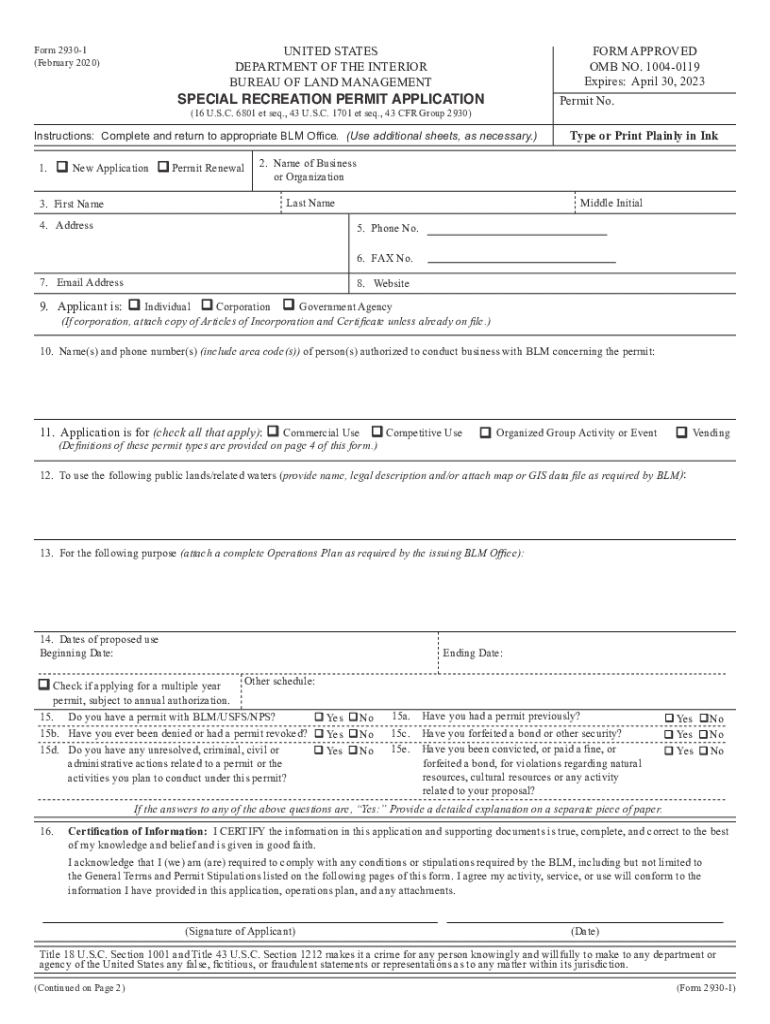
The Special Recreation Permit Application, also known as Form 2930-001, is issued by the U.S. Department of the Interior, specifically through the Bureau of Land Management (BLM). This document is crucial for individuals or organizations seeking permission to conduct commercial, competitive, or organized group activities on public lands. It serves to regulate land use to ensure compliance with legal stipulations and the preservation of natural resources.
Importance of Form 2930-001
- Commercial Activities: Permits are mandatory for commercially-driven activities that generate revenue on public lands, including guided tours or events.
- Competitive Events: Those organizing races, contests, or similar events must apply for this permit to ensure adherence to federal regulations.
- Organized Group Use: Non-commercial groups engaging in recreational activities with significant attendance are required to secure a permit to sustainably manage land use.
How to Use the Special Recreation Permit Application
Submitting the 2930-001 form involves precise and accurate completion to meet the BLM's requirements. Here are detailed instructions to guide you through the process:
Navigating the Application
- Access the Form: Available via the BLM's website or office, you can download or request a physical copy.
- Read Instructions Carefully: Each section provides specific guidelines to accurately convey the required information.
- Complete All Sections: Provide comprehensive details about your organization, the nature of the activity, date, location, and expected participants.
Practical Tips
- Double-check that all fields are filled to prevent processing delays.
- Clarify any uncertainties with BLM representatives to ensure compliance.
Obtaining the Special Recreation Permit Application
The process for acquiring the 2930-001 form is streamlined and accessible:
Steps for Acquisition
- Online Access: Most efficiently done through the official BLM website.
- Physical Locations: Obtain paper forms from BLM field offices if required.
- Submitting a Request: Specify the type of activities planned and provide necessary identification to secure the correct documentation.
Considerations
- Timing is important; initiate the process well ahead of the anticipated event date to accommodate any potential processing delays.
- Confirm the required supporting documents to bolster your application’s success.
Steps to Complete the Special Recreation Permit Application
This comprehensive guide will walk you through each stage of filling out Form 2930-001:
Step-by-Step Instructions
- Contact Information: Enter the applicant's full details, including contact names, addresses, and phone numbers.
- Activity Description: Clearly outline the nature of the event or activity in detail to align with BLM's criteria.
- Site Information: Provide specifics about the public land location, ensuring you have gathered all pertinent geographical details from maps or on-site visits.
Additional Steps
- Attach any necessary insurance documentation confirming liability coverage.
- Review for completeness and accuracy before submission.
Key Players in Using the Special Recreation Permit Application
Understanding who typically engages with Form 2930-001 helps streamline the application process:
Primary Users
- Event Organizers: These individuals or entities seek permits to host events involving multiple participants.
- Commercial Operators: Businesses intending to use public lands for tours, lessons, or experiences.
- Recreational Groups: Non-commercial groups aiming to conduct organized activities without monetary gain.
Collaborative Efforts
- Engage local authorities to ensure regional compliance.
- Consult environmental specialists to anticipate and mitigate ecological impacts.
Legal Use and Compliance of the Special Recreation Permit Application
Adherence to legal frameworks underpins the Special Recreation Permit Application:
Legal Obligations
- Accurately disclose all intended land use activities and abide by BLM regulations.
- Compliance with insurance and liability requirements is mandatory for commercial users.
Enforcement
- BLM maintains stringent checks to enforce compliance, safeguard land resources, and ensure public safety.
- Corrective actions, including penalties or revocation of permits, may be applied for non-compliance.
Examples and Scenarios: Utilizing Form 2930-001
Real-world applications provide context and depth to the use of the Special Recreation Permit Application:
Common Scenarios
- A company arranging guided hiking expeditions on federal lands secures a permit, outlines the itinerary, and includes environmental impact considerations.
- A non-profit organizing an educational camp requires a permit to conduct activities aimed at youth and family education about conservation.
- Competitive events, such as a triathlon spanning several land sites, ensure each location is covered under a single or multiple permits if applicable.
Outcome-driven Evaluation
- Assess successful applications against failed attempts to understand BLM expectations and improve future submissions.
State-Specific Considerations for the Special Recreation Permit Application
Distinctive regulations across states influence the preparation of the permit application:
State-by-State Variations
- Local Regulations: Each state may introduce additional restrictions or guidelines catering to specific ecological or recreational needs.
- Regional Offices: Differences exist in administrative processes and support resources available to applicants.
Best Practices
- Research all pertinent state laws ahead of submission.
- Leverage consultation services offered by local BLM offices for region-specific guidance.
By understanding the detailed aspects of the Special Recreation Permit Application, applicants are better equipped to navigate the requirements and secure the necessary permissions for public land use.