






Definition and Purpose of National Environmental Services Center Documents
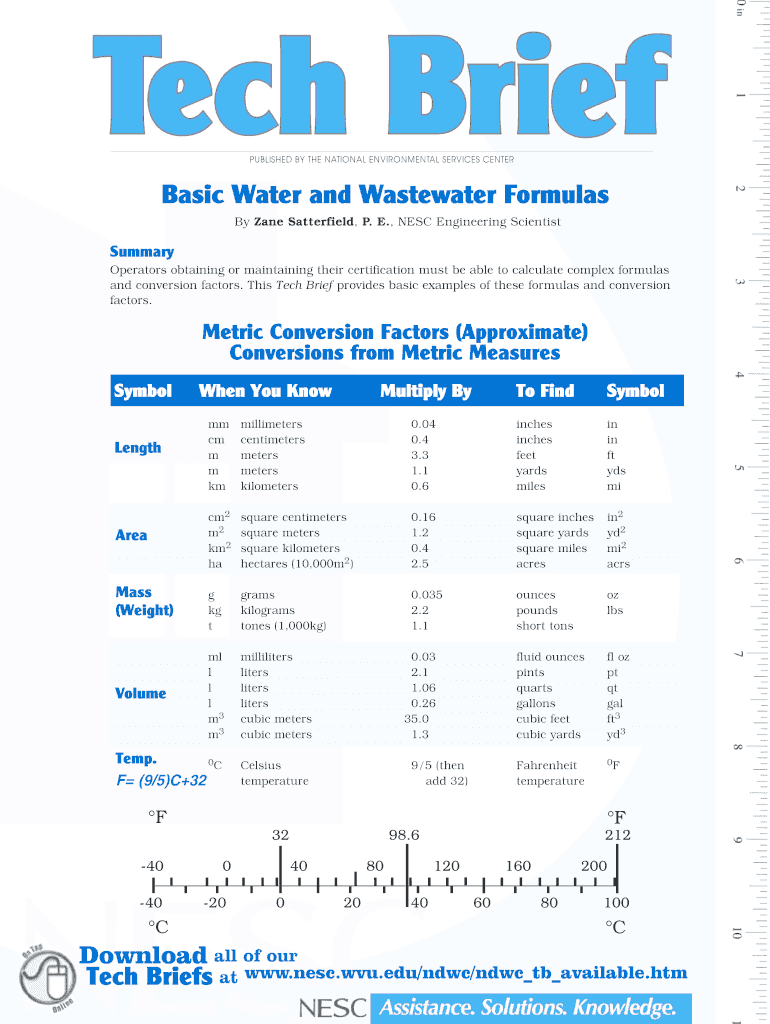
The documents published by the National Environmental Services Center (NESC) serve a critical role for professionals involved in environmental management, particularly water and wastewater operations. These resources equip practitioners with the necessary formulas, conversion factors, and methodologies essential for their daily operations and certification processes. By providing precise calculations for various shapes and intricate problems related to water treatment processes, these documents facilitate the technical proficiency required in this field.
How to Use NESC Publications for Certification
To effectively utilize NESC publications, professionals should first familiarize themselves with the document's structure and sections. Begin by identifying the specific formulas and conversion factors relevant to your current needs. These resources are typically organized to address common operational issues, allowing users to quickly find solutions to technical problems. Practitioners should keep the document on hand as a reference tool when performing calculations or when sitting for certification exams.
Steps to Complete a Certification Using NESC Resources
- Identify the Required Certification: Determine which certifications you need for your profession.
- Access the Appropriate NESC Document: Obtain the relevant NESC publication to support your learning and practical application.
- Study Core Sections: Focus on metric conversion factors, basic geometry, and process-related problems included in the publication.
- Apply Knowledge in Real Scenarios: Utilize the document’s examples and practice problems to enhance your understanding of water treatment processes.
- Prepare for Exams: Use the document as a study aid to reinforce essential knowledge prior to taking certification assessments.
Why NESC Publications Are Essential for Water and Wastewater Operators
NESC publications form an indispensable part of the toolkit for water and wastewater operators aiming to enhance their technical capabilities and maintain certification standards. These documents provide structured knowledge that supports environmental management and compliance with industry regulations. By offering systematic guidelines for calculations, they help professionals improve operational efficiency, leading to better management of environmental resources.
Key Elements of NESC Documents
- Metric Conversion Factors: Essential for standardizing measurements and ensuring consistency in calculations.
- Basic Geometrical Calculations: Guiding operators in determining area, volume, and other spatial dimensions necessary for process management.
- Water Treatment Sample Problems: Offering practical scenarios that simulate real-world challenges in water treatment, aiding operators in problem-solving.
Who Typically Uses NESC Publications
The primary users of NESC documents are water and wastewater professionals, engineers, and environmental scientists. These individuals rely on the accuracy and comprehensiveness of these resources for both operational execution and certification studies. The documents serve as critical tools in educational settings and can be used for training new professionals entering the environmental services industry.
Legal and Compliance Considerations
Ensuring compliance with legal requirements is crucial in the environmental services field. NESC publications are instrumental in helping professionals align their practices with relevant regulations. By thoroughly understanding these documents, users can better ensure that their operations meet both local and national standards, reducing the risk of penalties for non-compliance.
Examples of Practical Use Cases
Consider a water treatment facility operator tasked with managing daily water quality assessments. By using NESC publications, the operator can accurately calculate the necessary doses of treatment chemicals and predict the outcomes of different treatment scenarios. Another example is a practitioner studying for a state certification exam who uses the standards and procedures outlined in the documents to prepare effectively.
Compatibility and Integration with Digital Platforms
NESC documents, while traditionally available in paper format, have evolved to be compatible with modern digital platforms. Operators can access these resources online, integrating them with document management tools like DocHub to annotate and manage essential sections digitally. This transition to digital enhances accessibility and ensures professionals have immediate access to critical information, irrespective of their location.