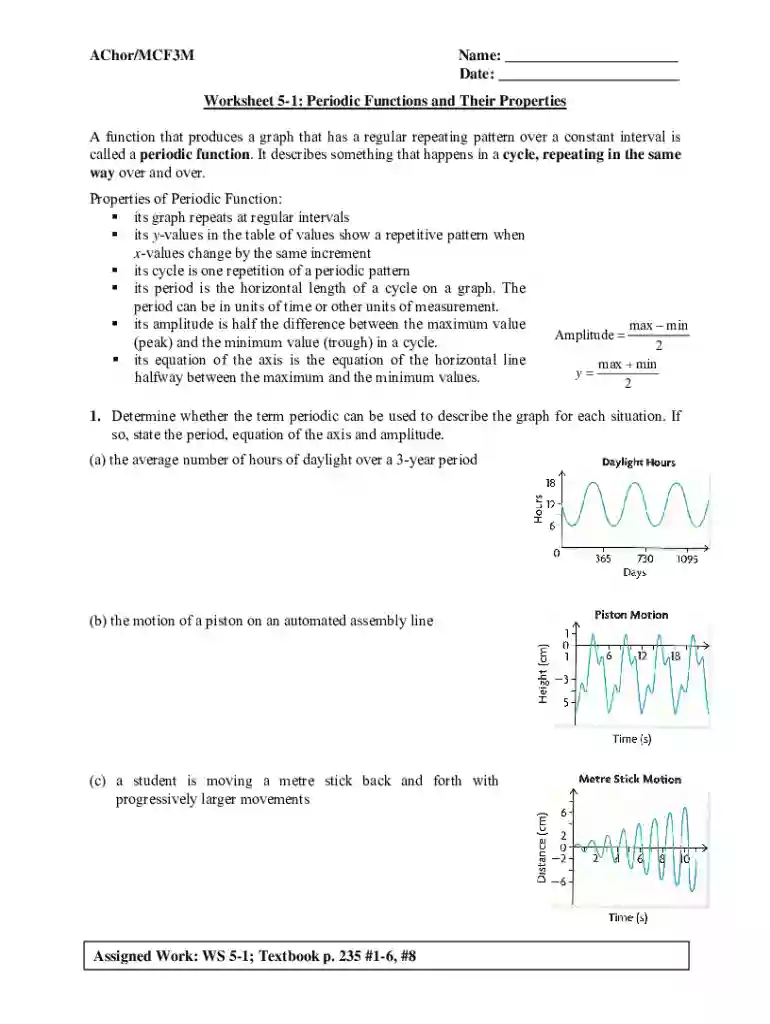
Definition & Purpose of Worksheet 5-1: Periodic Functions and Their Properties
The "Worksheet 5-1: Periodic Functions and Their Properties" serves as an educational tool designed to help students and educators explore the characteristics and applications of periodic functions. These functions are mathematical entities characterized by repeating patterns, defined periods, amplitudes, and equations of axes. Understanding periodic functions is crucial in various fields, such as engineering, physics, and economics, where cyclical behavior is observed. This worksheet facilitates the analysis of such functions by providing structured exercises and practical examples.
Key Elements of the Worksheet
The worksheet includes several critical elements to aid learners in comprehending periodic functions. These elements are:
- Repetition and Cycle: The worksheet details how periodic functions repeat at regular intervals, known as periods, and offers examples to illustrate these cycles.
- Amplitude Analysis: It covers the concept of amplitude, which measures the extent of variation in the function's values and is crucial for understanding the function's range.
- Equations of Axes: Learners are guided to derive and understand the equations that represent the central axis of the function, around which the oscillations occur.
- Graphical Interpretation: The worksheet provides graphical representations of periodic functions, allowing students to visualize and interpret data in terms of periodicity.
How to Use the Worksheet
To effectively utilize the "Worksheet 5-1: Periodic Functions and Their Properties," follow these steps:
- Review Basic Concepts: Begin by ensuring a solid understanding of key mathematical terms such as period, amplitude, and cycle.
- Analyze Provided Examples: Work through the examples related to manufacturing processes and natural gas consumption in Ontario to see real-world applications of periodic functions.
- Solve Exercises: Tackle the exercises designed to reinforce the theoretical knowledge by applying it to scenarios depicted in the worksheet.
- Graph Interpretation: Use the graphs to identify the period and amplitude of given functions, honing visualization and interpretation skills.
Steps to Complete the Worksheet
- Read Instructions Carefully: Start by reading any preliminary instructions at the top of the worksheet to understand the context and objectives.
- Examine Graphs and Data: Carefully examine any graphs and accompanying data provided within the worksheet.
- Calculate Period and Amplitude: Use mathematical formulas to calculate the period and amplitude of the functions you are analyzing.
- Respond to Questions: Answer any questions on the worksheet that relate to the graphs and data, ensuring thorough and accurate responses.
- Review and Revise: Go over your work to verify calculations and answers, making corrections where necessary to ensure accuracy.
- Seek Feedback: If possible, have a teacher or peer review your work to gain constructive feedback and further understanding.
Important Terms Related to the Worksheet
Comprehending certain terms is vital when using the worksheet:
- Period: The interval at which a function's values repeat in a cyclical manner.
- Amplitude: The maximum extent of a vibration or oscillation, measured from the position of equilibrium.
- Cycle: A repeated sequence of operations or events.
- Axis: A fixed reference line for the measurement of coordinates.
Practical Examples of Periodic Functions
The worksheet includes practical examples to contextualize the theory and facilitate deep understanding. These examples may involve:
- Manufacturing Patterns: Analysis of production cycles in industrial settings, demonstrating periodic elements.
- Energy Consumption: Examination of data such as natural gas usage in Ontario, illustrating periodic consumption patterns due to seasonal changes.
Software Compatibility and Digital Tools
The worksheet can be completed using digital tools that offer advantages over traditional methods:
- DocHub: A platform that simplifies editing, sending, and signing documents online.
- Graphing Calculators and Software: Useful for creating visual representations of periodic functions and solving related mathematical problems.
- Spreadsheet Applications: Such as Microsoft Excel or Google Sheets, which can facilitate data handling and graph creation for analyzing periodic functions.
Examples of Using the Worksheet in Real-world Scenarios
The worksheet enables exploration of real-world contexts where periodic functions are evident:
- Seasonal Sales Analysis: Businesses can use periodic functions to predict sales trends and inventory needs throughout the year.
- Weather Modeling: Meteorologists use periodic functions to understand and forecast seasonal weather patterns.
- Sound Waves: Engineers analyze sound waves in terms of periodic functions to understand acoustics and frequency.
By deeply engaging with these various aspects of periodic functions, users can enrich their mathematical knowledge and apply these concepts in diverse practical contexts.