




01. Edit your aviation risk assessment template online
Type text, add images, blackout confidential details, add comments, highlights and more.

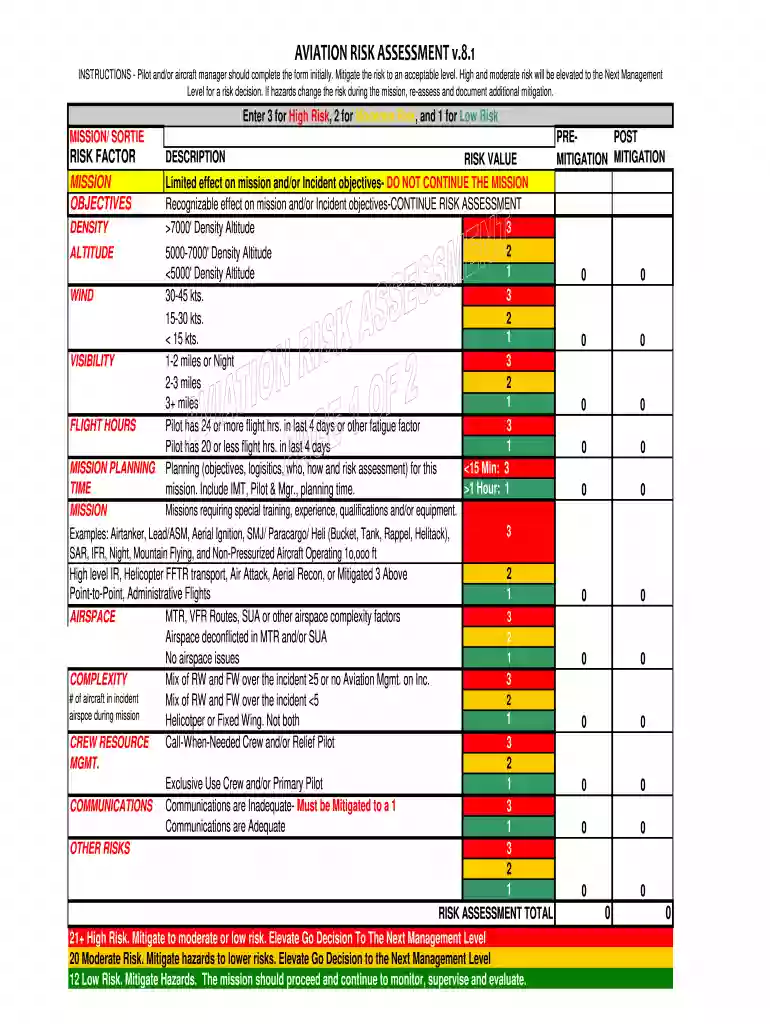
Type text, add images, blackout confidential details, add comments, highlights and more.

Draw your signature, type it, upload its image, or use your mobile device as a signature pad.

Send aviation risk assessment example via email, link, or fax. You can also download it, export it or print it out.
An aviation risk assessment worksheet serves as a crucial tool for identifying, analyzing, and mitigating risks associated with aviation operations. This document enables pilots, aviation managers, and safety personnel to systematically evaluate various risk factors influencing flight safety. The worksheet encompasses multiple components that help categorize risks into high, moderate, and low levels, promoting ongoing safety evaluations throughout different aviation missions.
Utilizing this worksheet helps ensure compliance with Federal Aviation Administration (FAA) regulations and guidelines, thereby enhancing overall aviation safety protocols.
Completing an aviation risk assessment worksheet involves several systematic steps:
Gather Relevant Information: Compile details about the flight operation, including route, weather conditions, and aircraft specifications. Accurate data collection provides a reliable foundation for risk assessment.
Identify Hazards: Evaluate potential hazards related to the operation. This can involve brainstorming sessions with crew members or referencing previous flight incidents to identify recurring risks.
Assess Risks: Use a structured analysis, such as the FAA risk assessment matrix, to determine the probability and severity of identified risks. Each risk should be rated based on likelihood and impact.
Develop Mitigation Strategies: Create a list of strategies aimed at lowering the risk levels. These can include altering flight routes, increasing maintenance checks, or ensuring additional crew training sessions.
Implement and Review: Once strategies are established, implement them and continually monitor their effectiveness. Use feedback and incident reports to revise the risk assessment as necessary.
This structured approach emphasizes the importance of proactive risk management in aviation, ensuring that all aspects of flight safety are considered.
Detailed case studies illustrate how aviation risk assessments are applied in practice:
Example: Mountainous Terrain Operations Aviation operations in mountainous regions face unique challenges. A worksheet might highlight risks associated with changing weather conditions, terrain altitude, and aircraft performance capabilities. Assessment may indicate a higher risk level, prompting recommendations for alternate flight routes or additional pilot training in mountainous navigation.
Example: Adverse Weather Conditions A worksheet filled out for a flight scheduled during a thunderstorm would prompt a detailed review of wind velocities and visibility. This analysis might lead aviation managers to delay the flight until conditions improve to reduce danger to the crew and passengers.
These real-world instances underscore the practical application of the aviation risk assessment worksheet in decision-making and operational planning.
The FAA risk assessment matrix is an essential tool integrated into the aviation risk assessment worksheet. This matrix categorizes risks based on their probability of occurrence and the severity of their potential impact.
Determine Probability Levels: Classify risks into categories such as unlikely, possible, likely, and highly likely. This classification gives users context regarding how often a risk might confront the operation.
Assess Severity Levels: Severity should be assessed with reference to consequences, ranging from minimal injuries to loss of life or significant financial implications.
Matrix Intersection: The intersection of probability and severity levels produces a risk rating, influencing operational decisions and prioritizations for mitigation strategies.
Utilizing this matrix ensures thorough evaluations, allowing aviation professionals to recognize and address the most pressing risks in any given operational context.
The aviation risk assessment worksheet fosters an inclusive approach where multiple stakeholders contribute insights regarding potential hazards and mitigation strategies.
Diverse Perspectives: Involving various team members, including ground crew, pilots, and safety officers, ensures a comprehensive identification of risks that one individual may overlook.
Increased Buy-in: When employees participate in the risk assessment process, they are more likely to value its importance and adhere to mitigation strategies implemented as a result.
Enhanced Safety Culture: A collaborative approach creates a culture of safety within the organization, reinforcing a shared commitment to minimizing risks and enhancing overall flight safety.
This teamwork emphasizes the critical nature of input from multiple sources in effective aviation risk management.
Risk management is not a one-time event but an ongoing process. Continuous monitoring and feedback are integral to maintaining safety within aviation environments.
Incident Reporting: Establish systems for reporting incidents and near misses, allowing organizations to adjust the risk assessment worksheet in light of new data and trends.
Regular Reviews: Incorporate periodic reviews of ongoing risk assessments, adapting to changing conditions like new technology, regulatory changes, or updated safety standards.
Training and Education: Ongoing training programs ensure that all personnel stay up-to-date with the latest safety practices and risk management protocols, reinforcing their role in maintaining flight safety.
This cycle of constant assessment and adaptation is vital for effective risk management in aviation.
Compliance with aviation regulations, such as those set forth by the FAA, is crucial when conducting risk assessments and deploying risk management strategies.
Understanding Regulations: Familiarize yourself with relevant guidelines and regulations regarding aviation safety to ensure assessments align with Federal standards.
Documentation: Maintain thorough documentation of risk assessments, mitigation strategies, and training initiatives to provide evidence of compliance during audits or inspections.
Penalties for Non-Compliance: Be aware of possible penalties for failing to adhere to aviation regulations, which can include fines or legal repercussions, enhancing the impetus for proactive risk management.
Fostering a culture of compliance through regular training and clear communication about regulations can aid in reducing legal risks associated with aviation operations.
At DocHub, your data security is our priority. We follow HIPAA, SOC2, GDPR, and other standards, so you can work on your documents with confidence.
Nov 9, 2015 DEPs Environmental Assessment Form (EAF) pursuant to their regulations. A conceptual mitigation plan, discussion of Erosion and SedimentRead more
Consider delaying flight until conditions improve and risk is reduced. Requires UAS Program. Chair signoff. Conditions present much higher than normal risk.Read more
Oct 28, 2024 A FRAT facilitates proactive hazard recognition, is user-friendly, and provides a visual representation of risk levels. It serves as anRead more


