01. Edit your form online
Type text, add images, blackout confidential details, add comments, highlights and more.

Type text, add images, blackout confidential details, add comments, highlights and more.

Draw your signature, type it, upload its image, or use your mobile device as a signature pad.

Send it via email, link, or fax. You can also download it, export it or print it out.
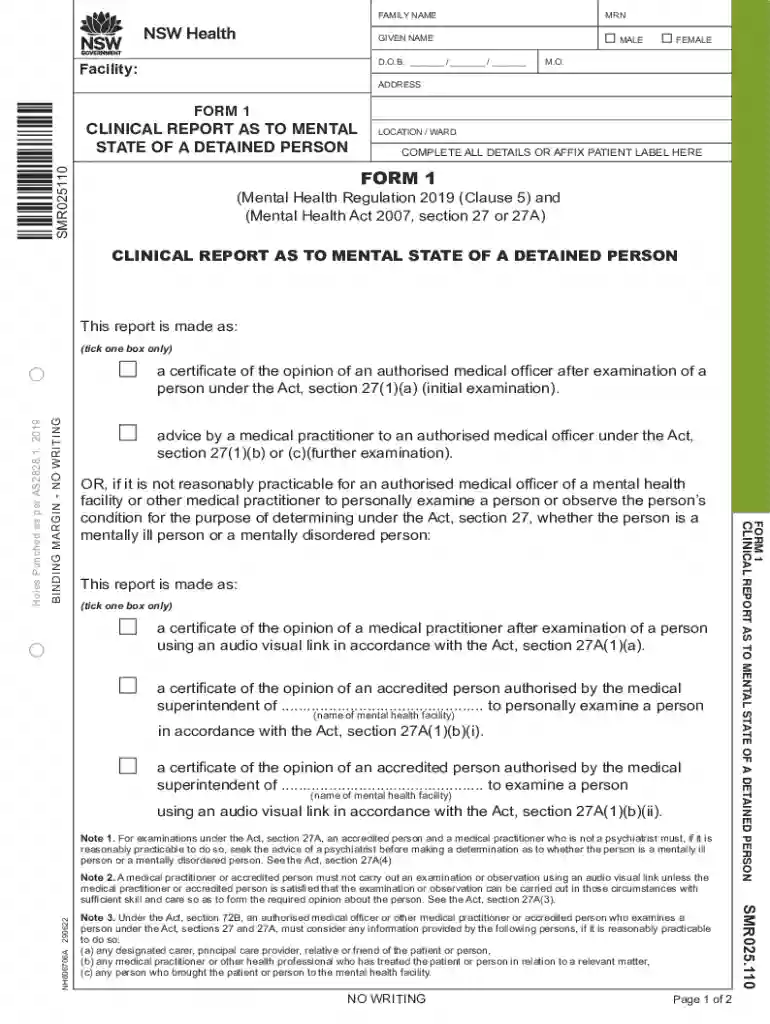
Form 1 is a clinical report form used for evaluating the mental state of a person detained under the Mental Health Act. It is integral to the mental health assessment process and typically includes sections for recording patient identification, examination details, and the opinion of a medical practitioner regarding the individual’s mental condition. The purpose of Form 1 is to ascertain whether the individual is suffering from a mental illness or disorder, which can impact the necessity for their detainment for treatment and evaluation.
Patient Identification: Clearly record the patient's full name, date of birth, and identification number. This ensures that the form corresponds to the correct individual.
Details of Examination:
Medical Opinion:
Legal Compliance: Ensure that all sections of the form are completed in accordance with applicable legal standards. Non-compliance can result in the invalidation of the assessment.
Form 1 is primarily utilized by medical practitioners and mental health professionals involved in the assessment and treatment of individuals under the Mental Health Act. It is an essential tool for professionals, such as psychiatrists, psychologists, and psychiatric nurses, particularly when involved in legal situations where an individual’s mental state is in question. Additionally, legal entities, such as law enforcement officers or attorneys, may reference the form during legal proceedings related to the detained individual’s mental health evaluation.


Form 1 must adhere to specific legal requirements prescribed under the Mental Health Act, ensuring it is used lawfully within its intended scope. Its legal purposes include facilitating the involuntary admission of individuals in need of psychiatric evaluation and treatment when they cannot consent to such actions due to their mental state. The proper completion and submission of Form 1 can result in the lawful detainment of a patient for further mental health services, underscoring its importance in legal contexts.
Different states may have variations in the implementation of Form 1, reflecting local legislation regarding mental health practices. Some jurisdictions may have additional requirements, such as specific phrasing or departmental reporting guidelines. Professionals using Form 1 must be familiar with their state’s specific rules and must ensure the form meets these requirements to be valid.
Failure to properly complete or submit Form 1 in accordance with statutory requirements can result in legal repercussions, including the invalidation of the mental health assessment and potential penalties for the issuing medical professional. This could include professional disciplinary actions or the reverse of detainment orders, highlighting the importance of accuracy and legal compliance in completing this form.
Understanding the comprehensive nature and requirements of Form 1 is critical for ensuring accurate assessments and compliance with mental health legislation, ultimately aiding in the effective treatment and management of individuals under care.
We've got more versions of the Form 1 form. Select the right Form 1 version from the list and start editing it straight away!
At DocHub, your data security is our priority. We follow HIPAA, SOC2, GDPR, and other standards, so you can work on your documents with confidence.