






Definition and Meaning
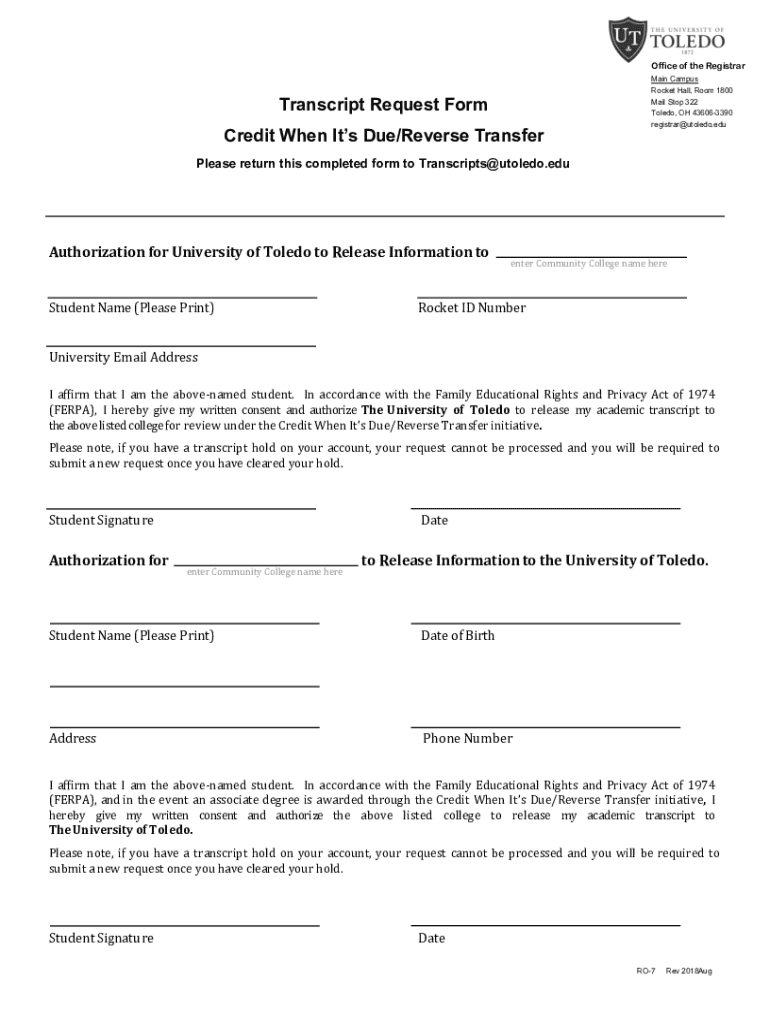
The Reverse Transfer Agreement Transcript Request Form E is a key document used within the Credit When It’s Due initiative. This initiative facilitates the award of associate degrees to students who have transferred to a four-year institution before completing the requirements for a degree at a community college. The form authorizes the release of a student's academic transcripts from a four-year university to a community college, thereby recognizing credits earned and supporting the attainment of an associate degree post-transfer.
How to Use the Reverse Transfer Agreement Transcript Request Form E
The form serves a crucial function in the reverse transfer process, acting as an authorization for the release of academic records. Students should carefully read each section to provide accurate information and ensure compliance. Generally, the steps involve:
- Filling in Personal Information: Students must enter their full name, student ID, and contact details.
- Institution Details: Identify both the four-year university currently attended and the community college.
- Consent for Transcript Release: Grant permission under the Family Educational Rights and Privacy Act (FERPA) for releasing transcripts.
- Signature and Date: Sign the form to validate the request and provide the date of submission.
Steps to Complete the Reverse Transfer Agreement Transcript Request Form E
Completing the form requires attention to detail to facilitate a smooth transfer process. It includes:
- Acquire the Form: Obtain a copy of the form from the university’s Office of the Registrar.
- Provide Student Information: Begin by entering personal details and student ID.
- Detail Both Institutions: Fill in the names and addresses of the current university and the targeted community college.
- Consent Acknowledgement: Read and sign the section granting consent for transcript release under FERPA.
- Submission: Check for any additional instructions regarding the submission process, such as via mail or in-person at the registrar's office.
Key Elements of the Reverse Transfer Agreement Transcript Request Form E
The form includes several key sections that must be completed:
- Student Information: Captures personal data necessary for identifying the student.
- Registrar Details: The student's current university and prospective community college are detailed here.
- FERPA Consent: A section that legally allows the release of academic records.
- Signature Section: Validates the form with the student’s consent and date of authorization. These elements collectively facilitate the accurate transfer of credits for degree completion.
Legal Use of the Reverse Transfer Agreement Transcript Request Form E
The document must comply with FERPA regulations, ensuring that the student’s consent for transcript release is legally binding. Its use is strictly within the scope of facilitating the reverse transfer process and must be handled with confidentiality and accuracy by educational institutions involved.
Examples of Using the Reverse Transfer Agreement Transcript Request Form E
Consider scenarios where a student transferred to a university from a community college without completing an associate degree. By using this form, the student's current credits can be retroactively applied to fulfill degree requirements at the original community college, thereby earning a credential that recognizes educational progress and enhances academic qualifications.
Important Terms Related to the Reverse Transfer Agreement Transcript Request Form E
- Reverse Transfer: The process of transferring credits from a university back to a community college for degree completion.
- FERPA: Family Educational Rights and Privacy Act, a federal law protecting the privacy of student education records.
- Transcript Release: The permission granted by a student to share academic records between institutions.
Who Typically Uses the Reverse Transfer Agreement Transcript Request Form E
This form is primarily used by students who have transferred to a four-year institution but seek to receive an associate degree by transferring credits back to a community college. It is a valuable tool for those who entered a university before completing such a degree, enabling them to broaden their academic credentials and opportunities through recognition of previously acquired credits.