




01. Edit your acte vente navire pdf online
Type text, add images, blackout confidential details, add comments, highlights and more.

Type text, add images, blackout confidential details, add comments, highlights and more.

Draw your signature, type it, upload its image, or use your mobile device as a signature pad.

Send it via email, link, or fax. You can also download it, export it or print it out.
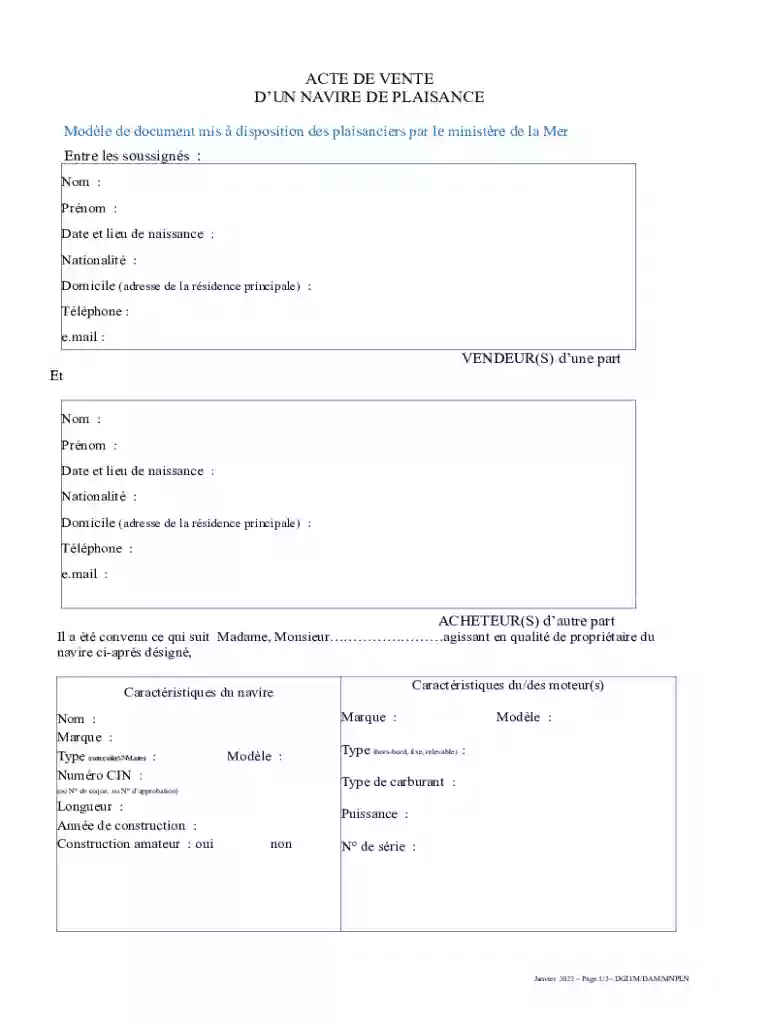
The "acte de vente d'un navire de plaisance" refers to a sales agreement specifically designed for the transaction of a pleasure boat. This legal document outlines the terms of sale between the seller and the buyer, including the vessel's characteristics and the necessary steps to transfer ownership. As a crucial component in maritime transactions, the document provides a clear framework for both parties, ensuring there is a mutual understanding of the boat's condition and that no hidden debts or claims are tied to it.
When engaging in the sale or purchase of a pleasure boat, the act de vente d’un navire de plaisance serves as a critical tool to formalize the transaction. To use it effectively, both parties must fill out their respective information accurately and comprehensively. This includes the seller's and buyer's details, the agreed upon sale price, and any specific conditions attached to the sale. Ensuring every section of the document is completed reduces the risk of misunderstandings and serves as a legally binding contract enforceable by law.
Gather required information: Collect details such as the boat's registration number, make, model, and year, as well as the personal identification of both buyer and seller.
Fill out the form: Begin by entering the buyer and seller information, followed by the vessel's details and sale price.
Agree on sale conditions: Both parties should discuss and agree upon any sale conditions, including warranties or inspection results.
Sign the document: Both the seller and buyer should sign the document in the designated areas. Witnesses may be required depending on jurisdiction.
Submit the form: Follow the necessary steps for registration, as specified by local authorities, to transfer official ownership.
Using this document ensures that the sale of a pleasure boat is legally recognized and enforceable. It provides a formal record of transaction terms, protecting both the buyer and seller. Importantly, it helps prevent disputes arising from missed agreements or surprise claims, and it aids in the transparent transfer of ownership.
The document holds substantial legal weight as it adheres to regulations established by maritime law. In the United States, it is often required for registering the change of ownership in state maritime databases. This legal status emphasizes the necessity to complete the form accurately, as incorrect or incomplete information could invalidate the transaction or lead to legal ramifications.
Consider the scenario where a private owner sells a used boat through an online marketplace. Both parties would use the acte de vente d'un navire de plaisance to detail the transaction, ensuring all details such as the date of sale, condition of the vessel, and agreed price are documented. This is pivotal when registering the new ownership with the maritime authorities to ensure a smooth transfer process.
The completed form can be submitted through various methods depending on the local regulatory requirements. Many jurisdictions allow for online submissions, which streamline the process and reduce the need for physical documentation. Alternatively, individuals may mail the form or deliver it in-person to the relevant maritime registry. It is advisable to confirm the submission method with local entities to ensure compliance.
In the United States, the form is generally provided by the local Department of Motor Vehicles (DMV) or similar maritime authority. These departments oversee the registration and titling of watercraft within their respective states, ensuring all legal requirements are met during the process of ownership transfer.
We've got more versions of the acte vente navire pdf form. Select the right acte vente navire pdf version from the list and start editing it straight away!
| Versions | Form popularity | Fillable & printable |
|---|---|---|
| 2025 | 4.2 Satisfied (24 Votes) | |
| 2024 | 4.5 Satisfied (41 Votes) | |
| 2024 | 4.9 Satisfied (54 Votes) | |
| 2023 | 4.2 Satisfied (32 Votes) | |
| 2023 | 4.5 Satisfied (44 Votes) | |
| 2023 | 4.4 Satisfied (30 Votes) | |
| 2023 | 4.4 Satisfied (57 Votes) | |
| 2022 | 4.2 Satisfied (25 Votes) | |
| 2022 | 4.7 Satisfied (48 Votes) | |
| 2022 | 4.5 Satisfied (21 Votes) | |
| 2022 | 4.8 Satisfied (60 Votes) | |
| 2022 | 4.2 Satisfied (45 Votes) | |
| 2022 | 4.9 Satisfied (35 Votes) | |
| 2022 | 4.1 Satisfied (48 Votes) | |
| 2022 | 4.9 Satisfied (31 Votes) |
At DocHub, your data security is our priority. We follow HIPAA, SOC2, GDPR, and other standards, so you can work on your documents with confidence.


