







Definition & Meaning
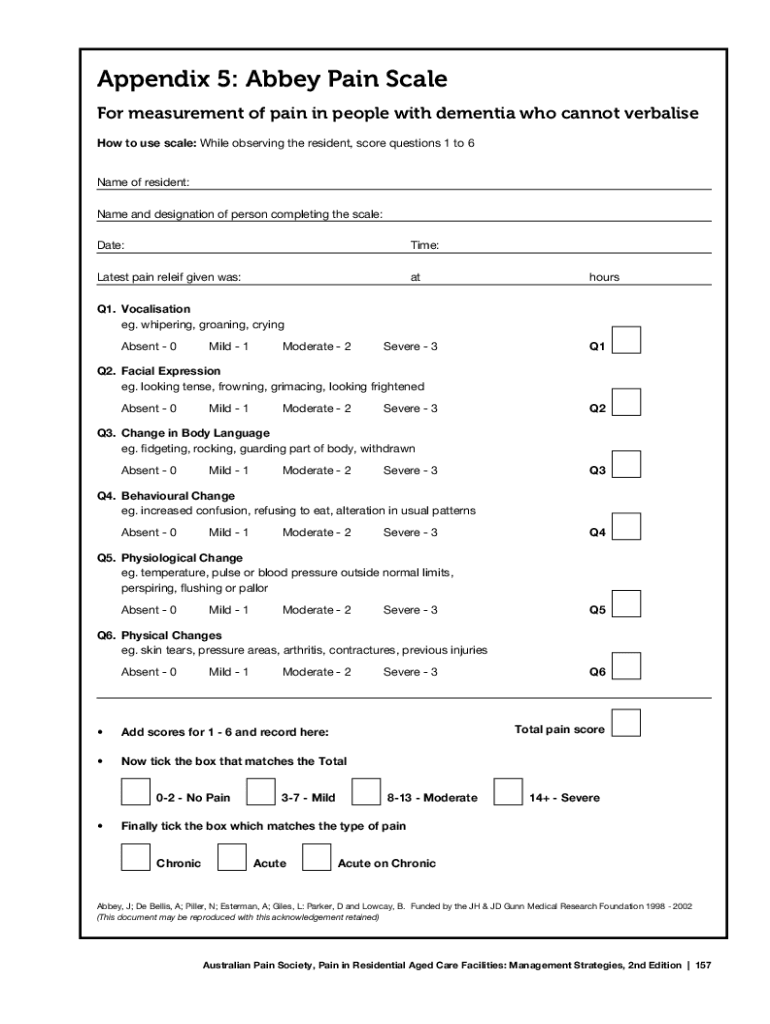
The APSPain-in-RACF-2176ppFull-Proof21AUG18 is a specialized form designed to assess and manage pain in residents within residential aged care facilities (RACFs). This document plays a critical role in ensuring that individuals who are unable to verbally communicate their pain, often due to dementia or other cognitive impairments, receive appropriate pain management. By evaluating a variety of indicators, caregivers can make informed decisions about interventions.
Core Components
- Vocalization: Monitors sounds indicative of discomfort, such as moaning or groaning.
- Facial Expression: Evaluates non-verbal cues like grimacing or frowning.
- Body Language: Assesses movements that may indicate pain, such as tension or rigidity.
- Behavioral Changes: Observes shifts in behavior that may signal distress.
- Physiological Changes: Identifies physical symptoms, including increased heart rate or sweating.
- Physical Changes: Focuses on observable signs like swelling or bruising.
These components provide a comprehensive approach to identifying pain in individuals who cannot communicate it directly.
How to Use the APSPain-in-RACF-2176ppFull-Proof21AUG18
Using the APSPain-in-RACF-2176ppFull-Proof21AUG18 involves a systematic observation and scoring process to evaluate pain levels in residents. Caregivers follow these steps:
- Conduct Observations: Watch residents during normal activities and care routines to capture potential pain indicators.
- Score Each Indicator: Use a standardized scale to rate each component, ensuring consistent and objective assessment.
- Compile Scores: Sum individual scores to determine overall pain levels and severity.
- Formulate Response: Develop pain management strategies based on the scores to address identified issues effectively.
Throughout the process, collaboration with healthcare professionals ensures accuracy and appropriateness of interventions.
Steps to Complete the APSPain-in-RACF-2176ppFull-Proof21AUG18
Completing this form requires attention to detail and methodical execution:
- Initial Evaluation: Carefully read through instructions and guidelines.
- Resident Assessment: Begin with a baseline observation without intervention to identify normal patterns and deviations.
- Indicator Scoring: Assign scores based on the criteria for each category, with higher scores indicating greater pain levels.
- Review Results: Compare scores against established benchmarks to determine necessary interventions.
- Implement and Document Interventions: Record actions taken and follow-up plans for each resident assessed.
Documentation serves as a legal record and ensures continuity of care.
Why Use the APSPain-in-RACF-2176ppFull-Proof21AUG18
This form is crucial in managing pain in aged care facilities because it:
- Facilitates Communication: Provides a structured approach to understanding non-verbal pain indicators.
- Enhances Care Quality: Ensures that all staff use a consistent method for identifying and responding to pain.
- Improves Patient Outcomes: Enables timely interventions, reducing suffering and improving quality of life for residents.
- Supports Regulatory Compliance: Helps facilities meet legal requirements for pain management in care settings.
Using this form underscores a commitment to resident-centered care.
Important Terms Related to APSPain-in-RACF-2176ppFull-Proof21AUG18
Understanding these terms helps in accurately completing the form:
- Pain Indicator: Observable signs that suggest a person may be experiencing pain.
- Baseline Observation: Initial assessment phase to establish typical behavior patterns.
- Benchmark Scores: Pre-determined values used to gauge pain severity.
- Intervention Plan: Strategies developed to address identified pain issues.
- Continuity of Care: Process of ensuring all staff are informed and consistent in executing care plans.
Consistent terminology usage enhances the effectiveness of the form's application.
Key Elements of the APSPain-in-RACF-2176ppFull-Proof21AUG18
Key elements of the form include:
- Structured Scoring System: Objectively measures pain indicators.
- Detailed Observational Guidelines: Provides robust methods for detecting and interpreting pain-related behaviors.
- Response Strategies: Offers frameworks for tailoring interventions to individual needs.
These elements make the form an essential tool for delivering effective pain management.
State-Specific Rules for the APSPain-in-RACF-2176ppFull-Proof21AUG18
Certain state regulations may affect the use and submission of the form:
- Documentation Requirements: Varying rules on how assessments must be recorded and stored.
- Training Requirements: States may mandate specific training for personnel using the form.
- Submission Protocols: Guidance on submitting forms for legal compliance or auditing purposes.
Understanding state-specific rules ensures compliance and optimizes facility operations.
Examples of Using the APSPain-in-RACF-2176ppFull-Proof21AUG18
Consider these scenarios:
- Case 1: A resident with advanced dementia shows increased restlessness. Using the form, the caregiver identifies a pattern correlating with specific daily activities, leading to an effective pain management plan.
- Case 2: Following a hip surgery, a resident unable to communicate verbally is evaluated. The form scores highlight acute pain during certain movements, prompting medication review and physical therapy options.
These examples illustrate how the form translates observations into actionable care enhancements.




