




01. Edit your form online
Type text, add images, blackout confidential details, add comments, highlights and more.

Type text, add images, blackout confidential details, add comments, highlights and more.

Draw your signature, type it, upload its image, or use your mobile device as a signature pad.

Send it via email, link, or fax. You can also download it, export it or print it out.
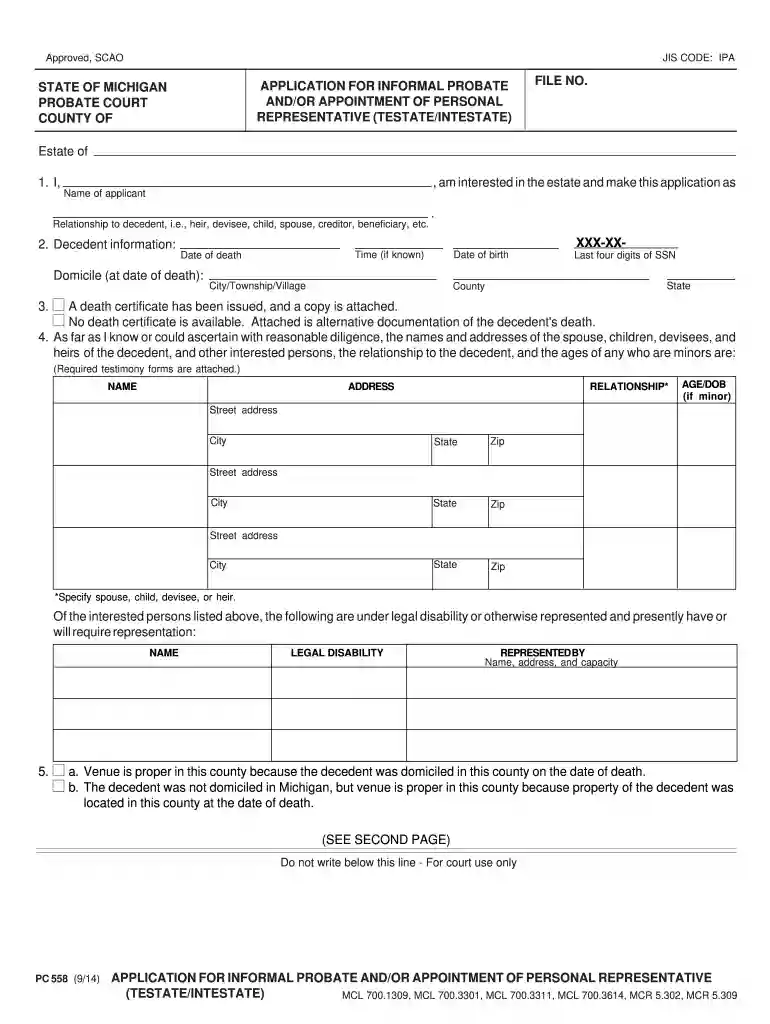
The Michigan application probate is a legal document used in the state of Michigan to initiate the informal probate process or the appointment of a personal representative for a decedent's estate. The form serves to gather crucial information about the deceased individual, including details of their death, their relationships to interested parties, and the existence of any testamentary documents such as wills or codicils. Additionally, the application is a tool for the applicant to provide evidence of the decedent's death, nominate a personal representative, and indicate if a bond is necessary.
Understanding these terms is crucial for anyone involved in the probate process to ensure clear communication and proper handling of estate matters.
Gather Required Information: Accumulate all necessary details regarding the decedent, including their full name, date of birth, date of death, and Social Security number. Information about the decedent's family and interested parties is also essential.
Prepare Evidence of Death: Collect documents such as a death certificate to confirm the decedent’s passing.
Nominate a Personal Representative: Determine who will act as the personal representative to manage the estate. This nomination must be in alignment with any existing wills or testaments.
Complete the Form Sections: Fill out the form with all required information, ensuring accuracy and completeness.
Indicate Bond Requirements: Specify if a bond is required for the personal representative, which is often the case when extensive asset management is needed.
Review and Submit: Carefully review all sections for accuracy before submitting the form as per the required method—mail, online, or in-person.
Michigan has specific regulations guiding the application process for probate. The state law provides options for informal probate proceedings, which are generally quicker and less formal than formal probate. Michigan law allows for both online submission and filing via mail or in-person at the appropriate probate court. It's critical to follow these rules accurately to prevent delays in the processing of an estate.
Typically, applicants will need to present:
Once submitted, the timing for approval can vary depending on the completeness and accuracy of the information provided. Informal petitions generally take a shorter time, often between a few weeks to a couple of months, if there are no contests or complications.
The Michigan application probate must be used in accordance with Michigan's probate laws to ensure legality and compliance. Using this document correctly facilitates the orderly distribution of the decedent's assets, satisfaction of debts, and overall estate management, without needlessly prolonging the probate process through legal challenges or oversight.
We've got more versions of the michigan application probate form. Select the right michigan application probate version from the list and start editing it straight away!
At DocHub, your data security is our priority. We follow HIPAA, SOC2, GDPR, and other standards, so you can work on your documents with confidence.
This appeal is from a probate court proceeding which does not require a complete transcript. [MCR 7.210(B)(1)(b).] e. A motion has been filed in the lowerRead more
STATE OF MICHIGAN. PROBATE COURT. COUNTY. APPLICATION FOR INFORMAL PROBATE. AND/OR APPOINTMENT OF PERSONAL. REPRESENTATIVE (TESTATE/INTESTATE). CASE NO. andRead more
What is Probate? 4. When is Probate Required? 4. Types of Probate Administration. 5. Small Estates. 5. Regular Estates. 6. Responsibilities Following Death.Read more


