







Definition & Meaning
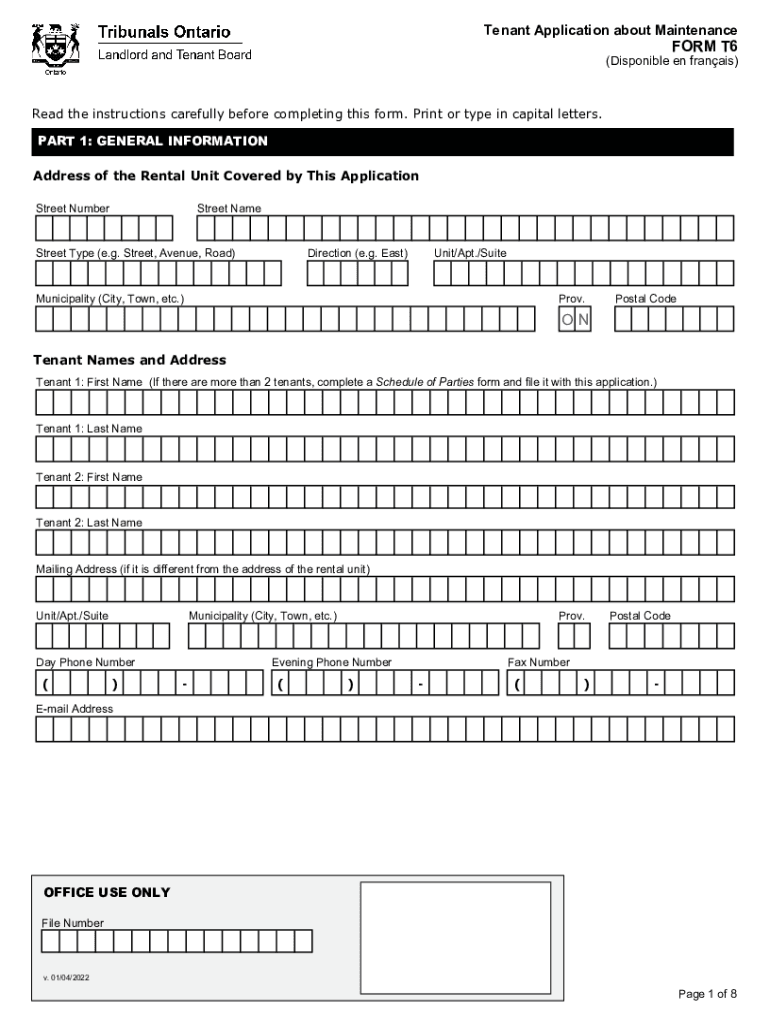
The T6 Form, known as the Tenant Application for Maintenance Issues, allows tenants to formally request intervention regarding any maintenance concerns that their landlord has failed to address. This form enables tenants to bring their issues before the Landlord and Tenant Board, ensuring compliance with health and safety standards in their rental unit. By outlining these concerns in a standardized format, the T6 Form serves as a crucial tool for tenants seeking legal resolution in maintaining habitable living conditions.
Steps to Complete the T6 Form
-
Personal and Property Information: Begin by providing detailed information about yourself and the rental property. This section requires your name, contact information, and precise details of the rental unit, including the address and specific location within a larger building if applicable.
-
Landlord Details: Clearly outline the landlord's information, such as name, contact details, and any management company involved. This ensures that all parties are accurately identified in the application process.
-
Description of Issues: Elaborate on the specific maintenance issues you face. Describe each problem in detail, including any attempts made to communicate these issues to the landlord prior to filing the form.
-
Desired Outcomes: State what you wish the Landlord and Tenant Board to order the landlord to do. This could involve repairs, compensation, or other measures needed to address the deficiencies.
-
Supporting Documentation: Attach any evidence supporting your case, such as photographs, communication logs, or reports from inspections. These documents provide tangible proof of the issues and any negligent responses from the landlord.
-
Signatures and Declarations: Complete the form by adding signatures where necessary, confirming the accuracy of the information provided, and acknowledging the legal obligations tied to submitting this form.
Legal Use of the T6 Form
The T6 Form operates within a legal framework designed to uphold tenants' rights under U.S. law, particularly focusing on habitability standards. When filed, it triggers a legal review by the Landlord and Tenant Board, which assesses the tenant's claims against the landlord's obligations. This process is governed by state-specific statutes, offering tenants legal recourse to compel landlords to fulfill their maintenance duties.
Important Terms Related to the T6 Form
- Habitability Standards: Legal requirements ensuring rental properties are livable, safe, and sanitary.
- Landlord and Tenant Board: A legal body that adjudicates disputes between landlords and tenants.
- Maintenance Issues: Concerns about repairs or conditions that may threaten the safety or health of tenants.
Who Typically Uses the T6 Form
Tenants who experience unresolved maintenance issues commonly use the T6 Form. These may include renters living in apartment complexes or single-family homes where the landlord has failed to make necessary repairs. The form is especially relevant for tenants in urban settings where rental agreements frequently stipulate specific landlord responsibilities for property upkeep.


Key Elements of the T6 Form
- Identification Information: Names, addresses, and contact details of both tenant and landlord.
- Detailed Issue Reporting: Comprehensive account of the maintenance problems experienced.
- Remedy Requests: Clear statement of the corrective actions sought by the tenant.
- Evidence Compilation: Inclusion of documents that substantiate the tenant's claims.
Who Issues the Form
The T6 Form is issued by the Landlord and Tenant Board within each U.S. state. This entity is responsible for handling disputes and ensuring both parties adhere to local housing laws and regulations.
Examples of Using the T6 Form
Consider a tenant who notices mold growth due to persistent leaks in their rental unit. After repeated requests for repairs are ignored, the tenant files a T6 Form to prompt a formal review by the Landlord and Tenant Board. Another example involves a tenant confronting inadequate heating during winter; they file the form to legally enforce the landlord's responsibility to provide functional heating systems.
Form Submission Methods (Online / Mail / In-Person)
- Online Submission: Many states offer digital channels for submitting the T6 Form, providing quick and efficient processing.
- Mail: Physical forms can be mailed to the Landlord and Tenant Board, ensuring inclusion of all necessary documents.
- In-Person: Direct submission at a designated board office, allowing for verification of form completeness.
State-Specific Rules for the T6 Form
Each state may have specific regulations concerning the T6 Form, including variations in how maintenance issues are defined or prioritized. For example, some states might stipulate quicker resolution times for certain safety-related complaints. Understanding these differences is vital for accurately navigating the submission process and maximizing its effectiveness in various jurisdictions.


