
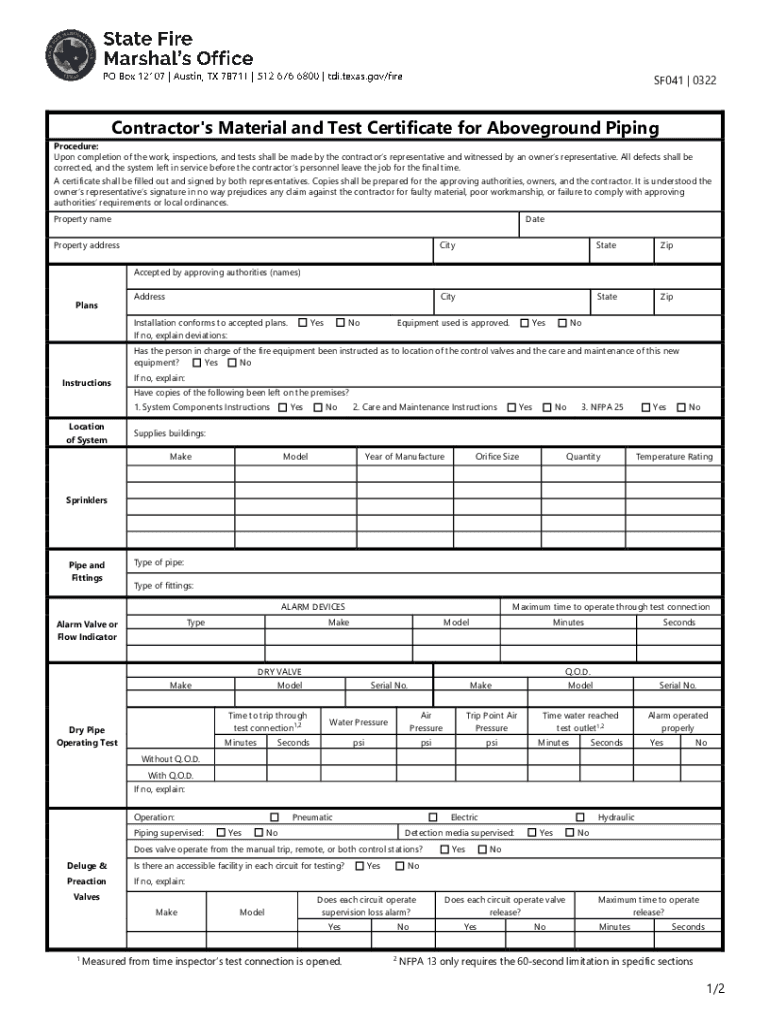







Definition and Meaning of NFPA 13 Above Ground Piping Certificate Application
The NFPA 13 Above Ground Piping Certificate Application serves as a formal request for the certification of aboveground piping systems. Governed by the National Fire Protection Association standard, this application ensures compliance with safety regulations and requirements. By submitting this document, contractors seek to verify that their installation meets established safety standards, minimizing risk and enhancing public safety.
Core Functions
- Compliance Verification: Ensures that installations adhere to NFPA 13 standards.
- Safety Confirmation: Validates the safe installation of piping systems.
- Standardization: Provides a uniform framework for certification processes.
How to Use the NFPA 13 Above Ground Piping Certificate Application
Understanding the usage of the NFPA 13 Above Ground Piping Certificate Application is crucial for contractors and inspectors. The form acts as an official communication medium between contractors and regulatory bodies.
Step-by-Step Usage Guide
- Access and Review: Obtain the form from the designated agency or online resources. Familiarize yourself with all required fields and instructions.
- Complete the Form: Fill out mandatory sections with accurate information about the project, including installation details and contractor credentials.
- Signature Requirement: Secure signatures from authorized personnel to validate the document.
- Submission: Submit the completed form through the designated channels, either online, via mail, or in person.
Practical Scenario
For a contractor installing piping in a commercial building, the application assures the building’s compliance and safety standards, facilitating final project approval by local authorities.
Key Elements of the NFPA 13 Above Ground Piping Certificate Application
Understanding the key components is essential for correctly filling out the NFPA 13 application.
Principal Elements
- Project Identification: Requires precise project details, including location and scope.
- Installer Information: Needs details about the contractor responsible for the installation.
- Inspection Data: Documents inspection events and outcomes, ensuring compliance.
- Compliance Checkmarks: Includes boxes for confirming adherence to NFPA standards.
Example: Completed Installation Entry
In a form field, a contractor would detail the materials used, specific compliance checks, and alignment with NFPA 13 standards. Ensuring that each element reflects true and comprehensive project data is vital for approval.
Steps to Complete the NFPA 13 Above Ground Piping Certificate Application
Completing the NFPA 13 application involves a structured process that demands meticulous attention to detail, ensuring no omissions that could delay processing.
Comprehensive Completion Steps
- Gather Required Information: Obtain comprehensive project data, including materials used, compliance tests performed, and inspector details.
- Fill Out Mandatory Fields: Ensure each section, such as project ID and installation details, is filled accurately.
- Verify for Accuracy: Double-check all entries to prevent errors that could result in non-compliance notices.
- Secure Required Approvals: Obtain necessary signatures from authorized personnel, such as project managers and safety inspectors.
- Submit the Application: Follow the submission method suited to the project’s regulatory requirements.
Practical Tip
Use a checklist to ensure all sections are completed before submission, reducing the risk of rejection due to incomplete information.
Legal Use of the NFPA 13 Above Ground Piping Certificate Application
The legal implications of using the NFPA 13 Above Ground Piping Certificate Application extend beyond routine compliance, influencing contract validity and operational safety.
Legal Considerations
- Validation of Work: Serves as a legal confirmation of compliance with NFPA standards.
- Dispute Resolution: Offers documentation in case of disputes regarding installation safety.
- Contractual Compliance: Verifies that terms respecting safety and standards were upheld.
Example Scenario
A contractor faced with allegations of improper installation can use the completed certificate as part of their legal defense, demonstrating adherence to all required safety measures and standards.
Who Typically Uses the NFPA 13 Above Ground Piping Certificate Application
Understanding who utilizes the NFPA 13 certificate application clarifies its broad impact within construction and safety certification domains.


Common Users
- Contractors: Primary users who initiate the application process post-installation.
- Safety Inspectors: Utilize certified forms to validate adherence to fire safety protocols.
- Regulatory Bodies: Assess completed applications to ensure installations meet legal safety standards.

Usage Example
A contractor working on a large-scale development will routinely engage with the form to certify safe installation of fire-protection components, ensuring compliance from the project's inception to completion.
Important Terms Related to NFPA 13 Above Ground Piping Certificate Application
Grasping essential terms associated with the application can ease understanding and streamline the process.
Key Terminologies
- Certification: The formal confirmation that the installation complies with NFPA 13 standards.
- NFPA 13 Standards: A comprehensive set of guidelines governing the design and installation of fire sprinkler systems.
- Compliance: The adherence to safety and technical standards set forth by NFPA and local regulations.
Term in Focus
"NFPA 13 Standards" encapsulates the critical requirements and is frequently referenced throughout the application to ensure installations align with these guidelines.
State-Specific Rules for the NFPA 13 Above Ground Piping Certificate Application
Given the NFPA 13 form's application across various states, understanding state-specific rules can enhance the effectiveness of submissions.
State Variations
- Local Amendments: Certain states may have additional regulations or requirements.
- Submission Methods: States may differ in accepted submission formats—electronic versus paper.
- Approval Protocols: Some jurisdictions require additional local authority approvals.
Real-World Application
In California, for instance, there may be additional seismic compliance considerations, reflecting both the state's building regulations and geological conditions.
Required Documents for the NFPA 13 Above Ground Piping Certificate Application
Ensuring all necessary documentation accompanies the NFPA 13 application is crucial for a seamless certification process.
Essential Documents
- Installation Plans: Detailed technical drawings of the installed piping system.
- Inspection Reports: Documentation from safety inspections affirming system compliance.
- Material Specifications: Lists of materials and components used in the installation, demonstrating adherence to standards.
Document Checklist
Creating a comprehensive checklist of all required documents can aid in minimizing the risk of omissions that could result in certification delays or rejections.




