




01. Edit your 2014 homeland security cg5330 telework form trial online
Type text, add images, blackout confidential details, add comments, highlights and more.

Type text, add images, blackout confidential details, add comments, highlights and more.

Draw your signature, type it, upload its image, or use your mobile device as a signature pad.

Send 2014 dhs cg5330 telework form trial via email, link, or fax. You can also download it, export it or print it out.
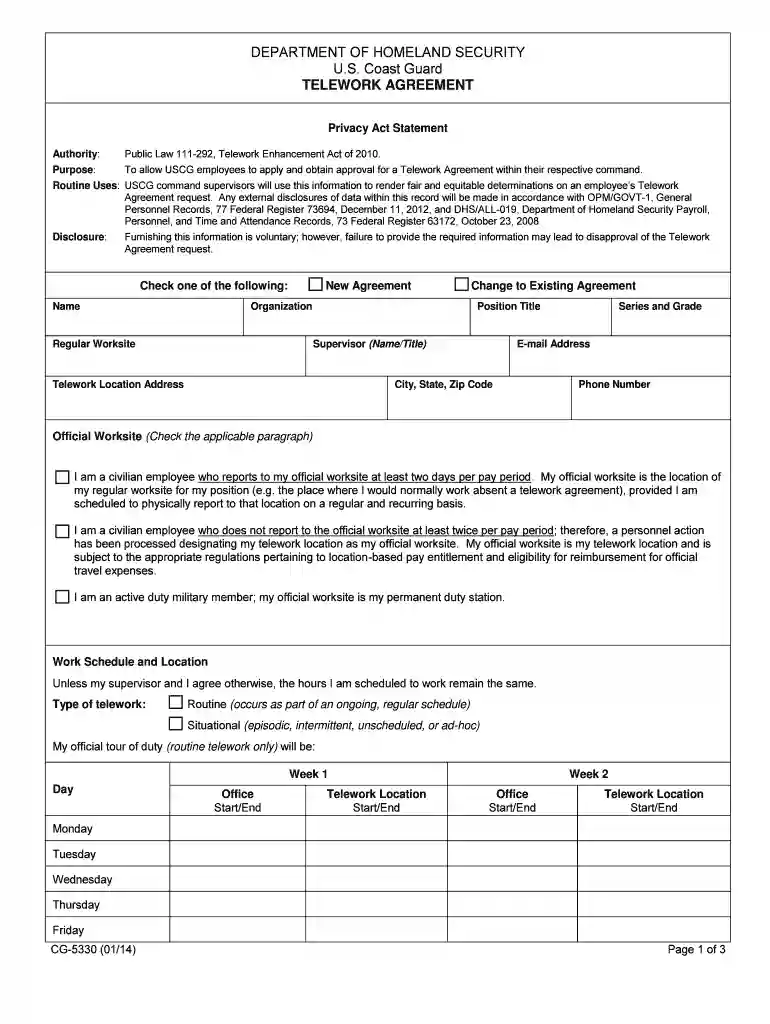
The CG-5330 form is a Telework Agreement utilized by the U.S. Coast Guard. It spells out the terms and conditions under which employees can apply for and participate in telework. This form is integral to outlining the responsibilities of both the employee and supervisor when an employee works remotely. The agreement ensures clear communication of expectations, safeguarding productivity while employees operate outside traditional office settings. It includes provisions for privacy and data security, emphasizing the importance of these domains in remote work.
The CG-5330 form is designed to be straightforward to fill out, with clear sections delineating various topics. It typically requires the employee to detail their work schedule, the specific tasks they'll be performing remotely, and how they plan to secure sensitive information. Supervisors are also required to provide their input, which might include performance metrics and communication protocols the employee must adhere to. Completing the form thoroughly ensures that both parties are aligned on what constitutes successful telework engagement.
Completing the CG-5330 involves a series of structured steps to ensure compliance with Coast Guard telework policies. Each step involves careful consideration of workplace dynamics and security protocols.
This form comprises several crucial components that participants need to complete accurately for a successful remote work arrangement:
Employees filing the CG-5330 form should prepare the following documents to ensure a seamless approval process:
Gathering these documents in advance helps streamline the application process, mitigating delays.
The legal implications of the CG-5330 form involve adherence to telework policies and regulations, ensuring standardized remote work practices within the U.S. Coast Guard. Employees and supervisors must comprehend the legal framework that the form provides, safeguarding both parties in the telework agreement. Non-compliance can lead to termination or disciplinary actions. Both the employee and the supervisor should ensure all terms are carefully read and understood before signing.
Navigating the CG-5330 form requires understanding of several key terms:
Understanding these terms ensures that participants can accurately complete and adhere to their telework agreements.
While the CG-5330 form can be completed as a physical document, many now opt for digital versions using platforms compatible with both desktop and mobile devices. Forms can be worked on with popular software like Adobe Acrobat Reader and LibreOffice, which allow for digital completion and shared use. Given its format, the CG-5330 can also be uploaded to cloud-based services for easy access and collaborative input. Ensuring digital software compatibility helps streamline sharing and editing between employees and supervisors.
The primary users of the CG-5330 form are U.S. Coast Guard personnel eligible for telework. This form is commonly utilized by administrative staff, IT specialists, and other employees whose job functions are conducive to remote work. Supervisors and management teams are also integral users, as they are charged with approving telework applications and setting performance expectations for remote workers. By structuring telework through formal agreements like the CG-5330, the Coast Guard ensures operational efficiency and regulatory compliance.


We've got more versions of the 2014 homeland security cg5330 telework form trial form. Select the right 2014 homeland security cg5330 telework form trial version from the list and start editing it straight away!
Yes, electronically drawing your signature is appropriate, but only if you use a tool that complies with industry regulations and policies. Try DocHub, which guarantees eSignature validity under ESIGN and UETA requirements. All you need to approve your 2014 homeland security cg5330 telework agreement free electronically is an account with DocHub and an internet connection. When you open your document in our editor, click Sign and select the Draw option.
Document editing with DocHub is equally convenient on desktop and mobile devices. You just need an internet browser to edit your 2014 5330 telework agreement form trial on Android. Open our website and sign in to access the tools you require. Add your document and introduce your intended modifications. After that, you can keep your form in your document storage or send it out immediately.
At DocHub, your data security is our priority. We follow HIPAA, SOC2, GDPR, and other standards, so you can work on your documents with confidence.
To establish and maintain, discontinue, change, or transfer ownership of a private aid to navigation, you must apply to the Commander of the Coast GuardRead more
Extended Product Type. AQ225-CG. Product ID. 2TCZ132006R5330. EAN. 6941195438657. Catalog Description. Socket - MingZhi. Long Description.


