Type text, add images, blackout confidential details, add comments, highlights and more.

02. Sign it in a few clicks
Draw your signature, type it, upload its image, or use your mobile device as a signature pad.

03. Share your form with others
Send it via email, link, or fax. You can also download it, export it or print it out.

How to use or fill out the jc wicourts with our platform
Ease of Setup
DocHub User Ratings on G2
Ease of Use
DocHub User Ratings on G2
Click ‘Get Form’ to open it in the editor.
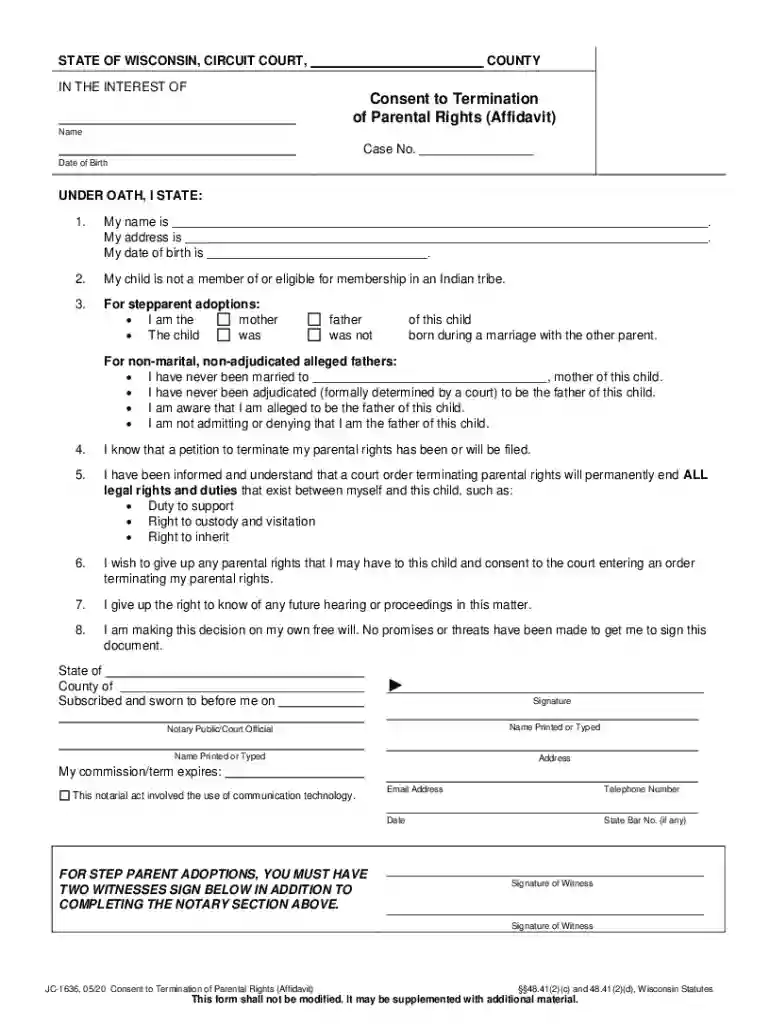
Begin by entering your name, address, and date of birth in the designated fields. Ensure that all information is accurate as it will be used for legal purposes.
Indicate whether your child is a member of or eligible for membership in an Indian tribe by selecting 'Yes' or 'No'.
For stepparent adoptions, specify your relationship to the child by selecting either 'mother' or 'father', and confirm if the child was born during a marriage with the other parent.
If applicable, provide details regarding non-marital, non-adjudicated alleged fathers. Fill out each statement truthfully based on your situation.
Acknowledge that you understand a petition to terminate parental rights has been filed and what this entails legally.
Express your consent to terminate parental rights by checking the appropriate box and signing where indicated.
Complete the notary section at the end of the form, ensuring you have two witnesses sign if required for stepparent adoptions.
Start using our platform today to complete your jc wicourts form online for free!
What is the Article VII of the Wisconsin Constitution?
(1) The supreme court shall have superintending and administrative authority over all courts. (2) The supreme court has appellate jurisdiction over all courts and may hear original actions and proceedings. The supreme court may issue all writs necessary in aid of its jurisdiction.
What is the jurisdiction of the Wisconsin circuit courts?
Article VII of the Wisconsin Constitution, as amended in April 1977, creates the circuit court as a single level, unified trial court with original jurisdiction in all civil and criminal matters within the state.
What is the jurisdiction of the circuit courts in Wisconsin as provided by article VII section 8 of the Wisconsin Constitution?
supervised by a chief judge appointed by the supreme court from the districts circuit judges. A judge usually cannot serve more than three successive two-year terms as chief judge.
What types of cases do circuit courts in Wisconsin handle?
The circuit court is the trial court of general jurisdiction in Wisconsin, having original juris- diction in civil and criminal cases, unless that jurisdiction is assigned to a higher court. The Wisconsin Constitution specifies that there will be judicial circuits with judges elected within those circuits.
How do I look up someones record in Wisconsin?
Criminal History Unit. What criminal history information can be accessed over the Internet? Access to criminal history information can be obtained on the Wisconsin Online Record Check System at .
Related Searches
Wisconsin CCAP search by nameWI CCAP simple searchCCAP LookupCCAP WIWisconsin Circuit Court AccessWisconsin CCAP loginWisconsin public records freeWisconsin criminal records
Related forms
Influence of seed quality of parental forms on sunflower hybrid seed - incda-fundulea
Circuit court; jurisdiction. Section 8. Except as otherwise provided by law, the circuit court shall have original jurisdiction in all matters civil and criminal within this state and such appellate jurisdiction in the circuit as the legislature may prescribe by law.
What type of jurisdiction do the circuit courts have?
In 1789, the United States circuit courts were United States federal courts established in each federal judicial district. These circuit courts exercised both original (first instance) and appellate jurisdiction.
Related links
Off the Record: Transparency Challenges in Judicial
by SMR Cravens 2024 Cited by 3 This Article highlights ways in which matters conducted off the record lead to an array of challenges in the regulation of judicial.
Cookie consent notice
This site uses cookies to enhance site navigation and personalize your experience.
By using this site you agree to our use of cookies as described in our Privacy Notice.
You can modify your selections by visiting our Cookie and Advertising Notice.