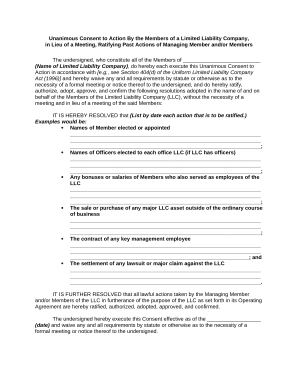
Enhance your file managing with Corporate Governance Forms

Your workflows always benefit when you are able to get all of the forms and documents you may need at your fingertips. DocHub delivers a a huge library of templates to ease your daily pains. Get hold of Corporate Governance Forms category and quickly find your document.

Start working with Corporate Governance Forms in several clicks:

  1. Access Corporate Governance Forms and get the document you need.
  2. Click Get Form to open it in the editor.
  3. Begin changing your form: add more fillable fields, highlight paragraphs, or blackout sensitive facts.
  4. The app saves your modifications automatically, and once you are all set, you can download or share your file with other contributors.

Enjoy seamless file administration with DocHub. Check out our Corporate Governance Forms category and look for your form right now!


Commonly Asked Questions about Corporate Governance Forms

In the broadest sense, governance documents are the officially adopted rules and regulations necessary to govern human interaction. They are essential for the orderly functioning of any large, complex organization such as an institution of higher education.
Governance specialists sum up corporate governance in four words: people, purpose, process, and performance. These four Ps serve as the foundational principles for both the existence and operation of governance.
Governance Documents Articles of Incorporation. Board Code of Conduct. Board Conflicts of Interest Policy. Board Governance Guidelines. Board Meeting Transcripts, Minutes Resolutions. Board Statements of Interest. Summary of Conflicts of Interest and Ethics Practices Review.
For this purpose, the article presents what I consider to be the four most popular approaches to the concept of governance: corporate governance, global governance, good governance, and modern governance.
The concept of governance can be applied to social, political or economic entities (groups of individuals engaged in some purposeful activity) such as a state and its government (public administration), a governed territory, a society, a community, a social group (like a tribe or a family), a formal or informal
Corporate governance refers to the framework of policies and guidelines that inform a companys conduct, decision-making and practice. This infrastructure is built upon four key principles: accountability, transparency, fairness and responsibility.
At its core, corporate governance refers to the system of rules, practices, and processes that direct and control a company. Senior management, including the executive chairman and CEO, must ensure each department follows established processes and maintains high standards while performing corporate governance.
From this follows the classification of forms of government ing to which people have the authority to rule: either one person (an autocracy, such as monarchy), a select group of people (an aristocracy), or the people as a whole (a democracy, such as a republic).