Idph project submission form hospitals 2026

Get Form
idph project submission form hospitals Preview on Page 1

Here's how it works

01. Edit your form online
Type text, add images, blackout confidential details, add comments, highlights and more.
02. Sign it in a few clicks
Draw your signature, type it, upload its image, or use your mobile device as a signature pad.
03. Share your form with others
Send it via email, link, or fax. You can also download it, export it or print it out.

How to use or fill out idph project submission form hospitals with our platform

Form edit decoration
9.5
Ease of Setup
DocHub User Ratings on G2
9.0
Ease of Use
DocHub User Ratings on G2
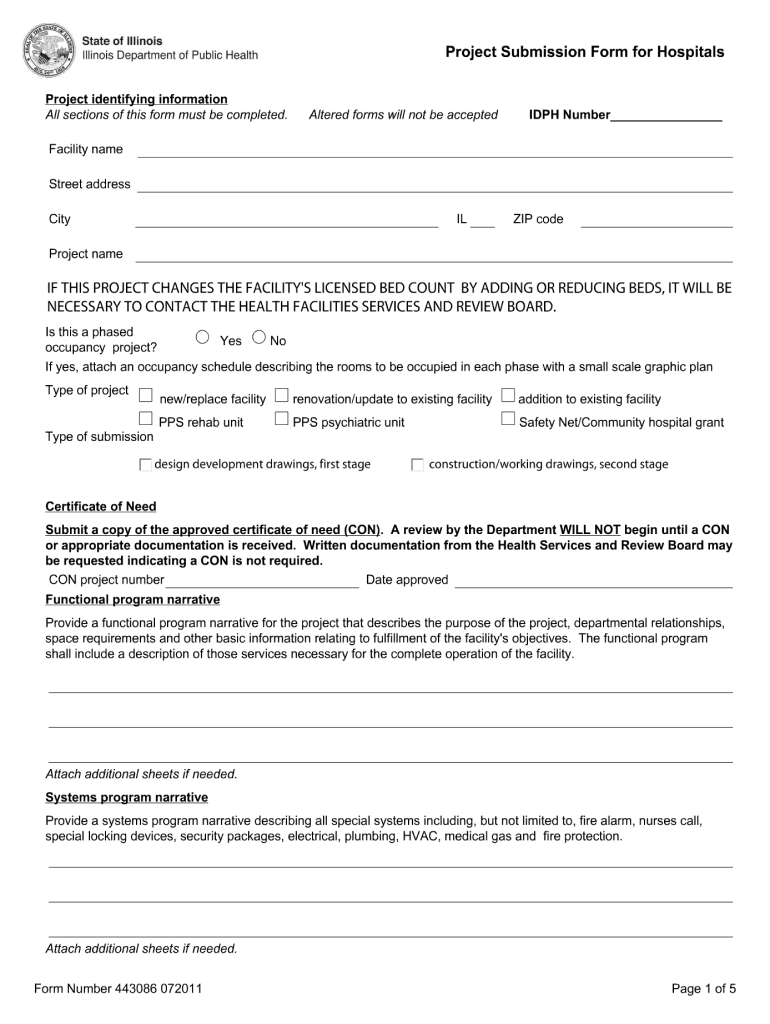
  1. Click ‘Get Form’ to open the idph project submission form in the editor.
  2. Begin by filling out the Project Identifying Information section. Enter your IDPH Number, Facility Name, Street Address, City, State (IL), and ZIP Code.
  3. In the Project Name field, provide a clear title for your project. If applicable, indicate whether this is a phased occupancy project and attach an occupancy schedule if necessary.
  4. Select the Type of Project from the options provided: new/replace facility, addition to existing facility, or others as listed.
  5. Complete the Estimated Project Cost section by detailing costs for site preparation, demolition, construction contracts, and fixed capital equipment. Ensure all calculations are accurate.
  6. Provide narratives for both Functional Program and Systems Program sections. Describe the purpose of your project and any special systems involved.
  7. Fill in Contact Information at the end of the form with details of facility representatives and relevant contractors.

Start using our platform today to streamline your document editing and submission process for free!

See more idph project submission form hospitals versions

We've got more versions of the idph project submission form hospitals form. Select the right idph project submission form hospitals version from the list and start editing it straight away!
Versions Form popularity Fillable & printable
2017 4.8 Satisfied (101 Votes)
2011 4.4 Satisfied (69 Votes)
be ready to get more

Complete this form in 5 minutes or less

Get form

Got questions?

We have answers to the most popular questions from our customers. If you can't find an answer to your question, please contact us.
Contact us
Most people declare bankruptcy due to medical costs, rather than for any other reason. Undoubtedly, having health insurance can play an indispensable role in helping people maintain their financial security. If you end up at the hospital without health insurance, doctors are required to treat you no matter what.
Community health centers are nonprofit health clinics that offer low cost or free care. Often, fees are set on an income-based sliding scale, and staff will work with you to determine your costs.
1:14 2:46 More. So to sum it up private hospitals must treat you in an emergency. Even if you dont haveMoreMore. So to sum it up private hospitals must treat you in an emergency. Even if you dont have insurance thanks to EMA. But for non-emergency. Care they are not obligated to provide free treatment.
(a) The purpose of this Act is to provide for the better protection of the public health through the development, establishment, and enforcement of standards (1) for the care of individuals in hospitals, (2) for the construction, maintenance, and operation of hospitals which, in light of advancing knowledge, will
Being uninsured doesnt mean youre out of luck during an emergency. You have the right to care if you meet the federal guidelines of what counts as an emergency.

Security and compliance

At DocHub, your data security is our priority. We follow HIPAA, SOC2, GDPR, and other standards, so you can work on your documents with confidence.

Learn more
ccpa2
pci-dss
gdpr-compliance
hipaa
soc-compliance
be ready to get more

Complete this form in 5 minutes or less

Get form

People also ask

Under EMTALA, private hospitals that receive public funds through Medicare must provide emergency care to patients in need, regardless of their ability to pay. Now, hospitals are also legally prohibited from releasing a patient to another facility or refusing additional treatment until the patient is stable.

Related links