
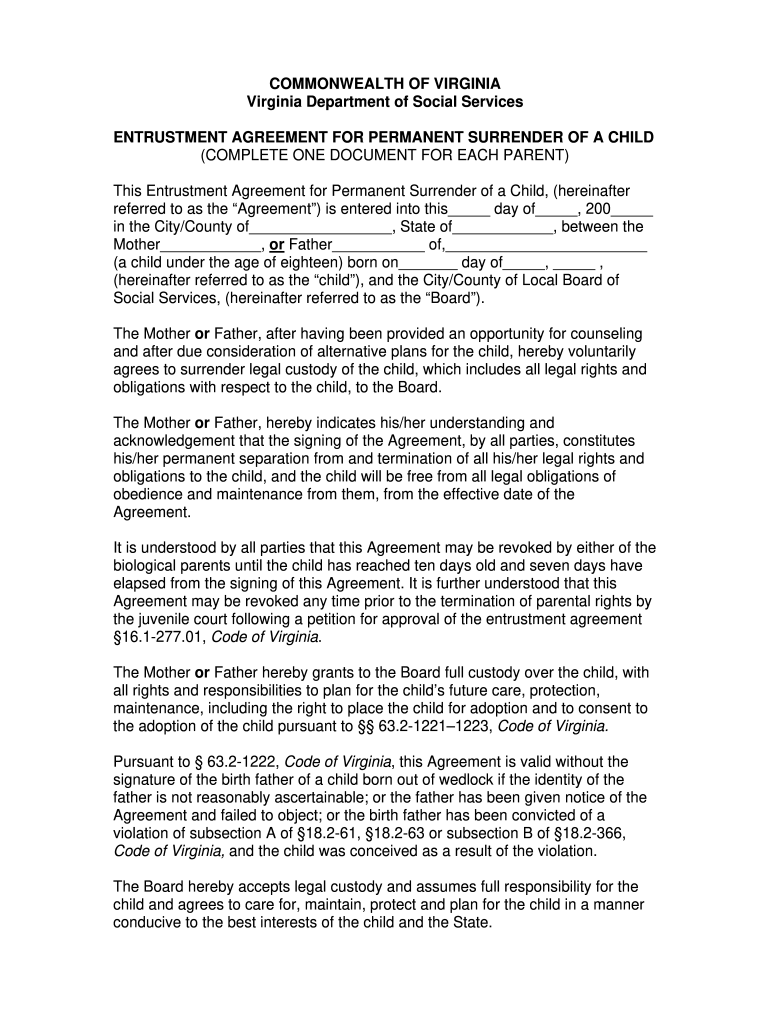







Definition and Meaning of an Entrustment Agreement
An entrustment agreement is a legal contract that outlines the voluntary transfer of custody and care responsibilities for a child from a parent to a designated authority, typically a local Board of Social Services. This agreement is essential in situations where a parent cannot provide the necessary care for their child due to various circumstances such as financial difficulties or personal issues. The document specifies the rights and responsibilities assumed by the receiving party, detailing the arrangements regarding the child's welfare, care, and potential adoption planning.
Key aspects of this agreement include:
- Custodial Rights Transfer: The parent relinquishes certain parental rights and responsibilities, which are allocated to the designated authority for the child's benefit.
- Right to Revoke: The agreement often includes provisions that permit a parent to reclaim custody under specific conditions, ensuring a level of control remains with the parent.
- Temporary vs. Permanent: Depending on its terms, the agreement can be either temporary, allowing for future reunification, or permanent, leading to adoption processes.
How to Use the Entrustment Agreement Sample
Using an entrustment agreement sample is straightforward but requires careful attention to detail. The sample serves as a template that individuals can customize based on their unique circumstances. The following steps outline how to effectively use an entrustment agreement sample:
- Review the Sample: Carefully read through the agreement to understand its components and structure. Familiarize yourself with the relevant terminology and your rights as a parent.
- Customize the Document: Fill in specific details such as names, dates, and the circumstances regarding the custody arrangement. Ensure that all information reflects your situation accurately.
- Include Relevant Terms: Add any necessary clauses that pertain to your situation, such as conditions for revocation of the agreement or stipulations regarding the child's care and education.
- Consult a Legal Professional: Before finalizing the agreement, consider having it reviewed by a legal expert to ensure compliance with local laws and protection of your rights.
- Sign and Date: Once completed, both parties must sign and date the agreement to make it legally binding.
Steps to Complete the Entrustment Agreement Sample
Completing an entrustment agreement sample involves several key steps to ensure clarity and legal validity. This process necessitates attention to detail and adherence to relevant legal requirements:
- Identify Parties Involved: Clearly state the names and contact information of both the parent(s) and the receiving authority, such as a local Board of Social Services.
- Define Custodial Arrangement: Specify the nature of custody being transferred, including whether it is temporary or permanent and the reasons for the entrustment.
- Outline Rights and Responsibilities: List the specific rights transferred, including decision-making authority regarding the child's education, health care, and residence.
- Include Conditions for Revocation: State the conditions under which the parent may revoke the agreement, such as improvement in their circumstances or changes in care needs.
- Ensure Legal Compliance: Authenticate the agreement by adhering to local statutory requirements, ensuring that it is witnessed, notarized, or filed appropriately as necessary.
Important Terms Related to the Entrustment Agreement Sample
Understanding the terminology associated with an entrustment agreement is crucial for navigating this legal landscape. Here are some essential terms:
- Legal Custody: The right and responsibility to make decisions regarding a child’s welfare, including education and healthcare.
- Temporary Custody: An arrangement where custody is given for a limited period, usually with the possibility of reunification.
- Permanent Surrender: A legal process where a parent voluntarily relinquishes all parental rights, typically leading to adoption.
- Revocation: The act of officially canceling the entrustment agreement, allowing the parent to regain custody.
- Caregiver: The individual or entity granted the authority to care for the child under the terms of the agreement.
Familiarizing yourself with these terms can help clarify the document's intentions and implications and aid in the successful navigation of custody matters.
Key Elements of the Entrustment Agreement Sample
The effectiveness of an entrustment agreement sample lies in its clarity and specificity. Important elements to include are:
- Parties Involved: Clearly identify the parent(s) and the legal custodian, ensuring that their rights and responsibilities are explicitly stated.
- Description of Entrustment: Include a detailed description of the custodial arrangement, its duration, and the conditions under which it operates.
- Rights and Responsibilities: List the rights assumed by the receiving authority, such as the ability to make healthcare and educational decisions.
- Reinstatement Conditions: Clearly outline any conditions or procedures for the parent to reclaim custody if desired.
- Signatures: Ensure that all parties involved sign and date the document to enforce the agreement legally.
Incorporating these elements ensures that the entrustment agreement effectively serves its purposes while protecting the involved parties' rights.
State-Specific Rules for the Entrustment Agreement Sample
Each state may have different laws regarding entrustment agreements, impacting their enforceability and requirements. It is essential to consult specific state regulations, as these may dictate:
- Filing Procedures: Some states may require the agreement to be filed with a court or a specific agency to be considered valid.
- Required Forms: Certain jurisdictions might have standardized forms or additional documents that need to accompany the entrustment agreement.
- Legal Representation: In some states, having legal counsel present during the signing may be mandated to ensure parties fully understand the implications of the agreement.
- Waiting Periods: There may be mandatory waiting periods before the agreement can take effect, allowing for any necessary reconsideration.
Familiarizing yourself with these state-specific nuances is essential to avoid potential legal issues and ensure compliance with local laws.
Examples of Using the Entrustment Agreement Sample
Real-world applications of an entrustment agreement can help illustrate its importance and functionality. Here are several scenarios:
- Temporary Withdrawal: A parent undergoing rehabilitation for substance abuse may enter an entrustment agreement to temporarily transfer custody of their child to a relative or a designated agency while they focus on recovery.
- Financial Hardship: In situations where a single parent faces financial challenges, they may opt for an entrustment agreement, allowing a trusted friend or family member to care for their child until they regain financial stability.
- Incarceration: A parent facing incarceration may use an entrustment agreement to ensure that their child is cared for by a relative, while also maintaining the right to revoke the agreement once they are released.
These examples demonstrate the versatility and relevance of entrustment agreements across various personal circumstances, emphasizing the importance of clear communication and legally binding arrangements.


