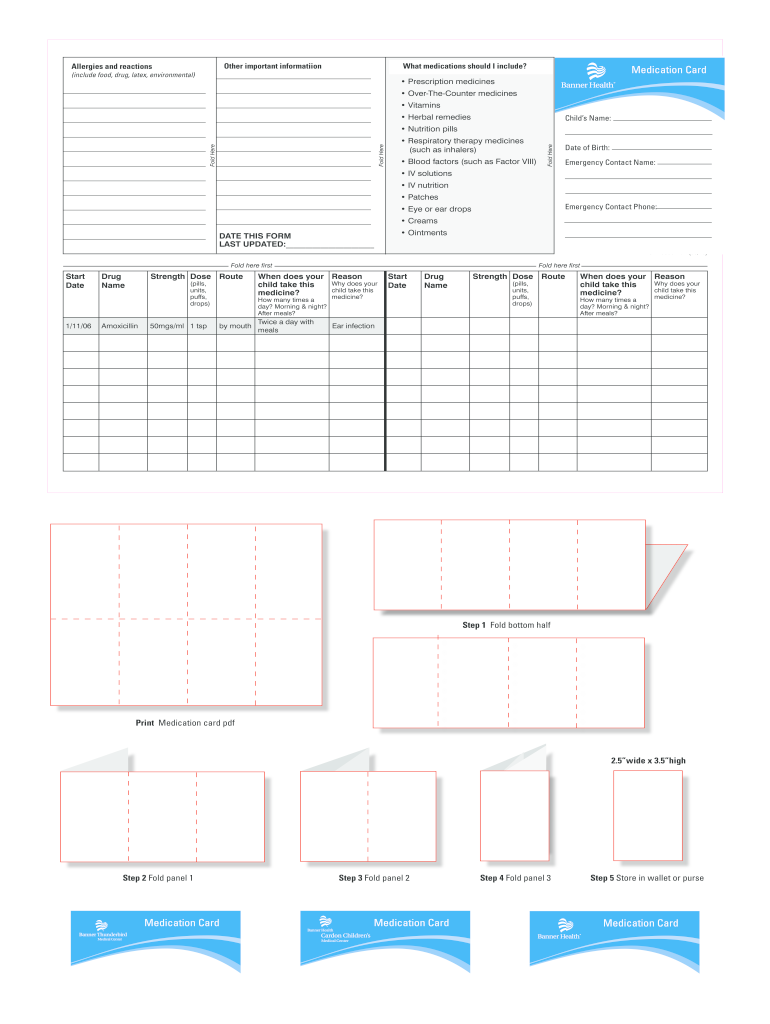
Med card template 2026

Get Form
medication wallet card pdf Preview on Page 1

Here's how it works

01. Edit your medication wallet card pdf online
Type text, add images, blackout confidential details, add comments, highlights and more.
02. Sign it in a few clicks
Draw your signature, type it, upload its image, or use your mobile device as a signature pad.
03. Share your form with others
Send printable medication card for wallet via email, link, or fax. You can also download it, export it or print it out.

How to use or fill out med card template with our platform

Form edit decoration
9.5
Ease of Setup
DocHub User Ratings on G2
9.0
Ease of Use
DocHub User Ratings on G2
  1. Click ‘Get Form’ to open the med card template in the editor.
  2. Begin by entering your child's name and date of birth in the designated fields. This information is crucial for identifying the medication card.
  3. In the 'Allergies and Reactions' section, list any known allergies, including food, drug, latex, or environmental factors. This ensures safety when administering medications.
  4. Proceed to the 'What Medications Should I Include?' section. Here, specify all relevant medications such as prescription medicines, over-the-counter drugs, vitamins, and herbal remedies.
  5. Fill out the medication details including drug name, strength, dose, route of administration (e.g., by mouth), and frequency of intake. Be thorough to avoid any confusion.
  6. Finally, review all entered information for accuracy before saving or printing your completed med card. Ensure it fits well within your wallet dimensions.

Start using our platform today to create your personalized med card for free!

be ready to get more

Complete this form in 5 minutes or less

Get form

Got questions?

We have answers to the most popular questions from our customers. If you can't find an answer to your question, please contact us.
Contact us
Active Stack Pharmacology Flash Cards cover content including: Generic and brand/trade name. Therapeutic use. Side-adverse effects. Interventions. Patient instructions. Administration considerations. Contraindications. Precautions.
If you are making cards for several patients in a clinic, you might want to include their name, address, phone number, medical record number, and the name and phone number of the clinic distributing the cards, or the doctor or pharmacists name and phone number.
Be certain to include the date that you created or updated the card. Fill in information about each medicine. Enter the name of each medicine and the amount of medicine in each pill (e.g., 20 mg) in the left hand column. Each row should have one medicine.
For a pharmacist to dispense a controlled substance, the prescription must include specific information to be considered valid: Date of issue. Patients name and address. Patients date of birth. Clinician name, address, DEA number. Drug name. Drug strength. Dosage form. Quantity prescribed.
Pharmacies typically need a pharmacy benefits card to process a prescription for medication, which contains an RxGroup, RxPCN, and RxBIN number in addition to the Member ID number. Rx is another way to refer to a prescription. Medical cards usually only have a Member ID number.

Security and compliance

At DocHub, your data security is our priority. We follow HIPAA, SOC2, GDPR, and other standards, so you can work on your documents with confidence.

Learn more
ccpa2
pci-dss
gdpr-compliance
hipaa
soc-compliance

People also ask

Dipiro - Pharmacology: A Pathophysiologic Approach Koda-Kimble and Youngs Applied Therapeutics: The Clinical Use of Drugs The Sanford Guide to Antimicrobial Therapy - published yearly Trissel - Handbook on Injectable Drugs Goodman Gilmans Manual of Pharmacology and Therapeutics
Study Guides Flashcards That Stick Built to boost memory, reinforce core concepts, and go wherever you do.

wallet size medication list template