
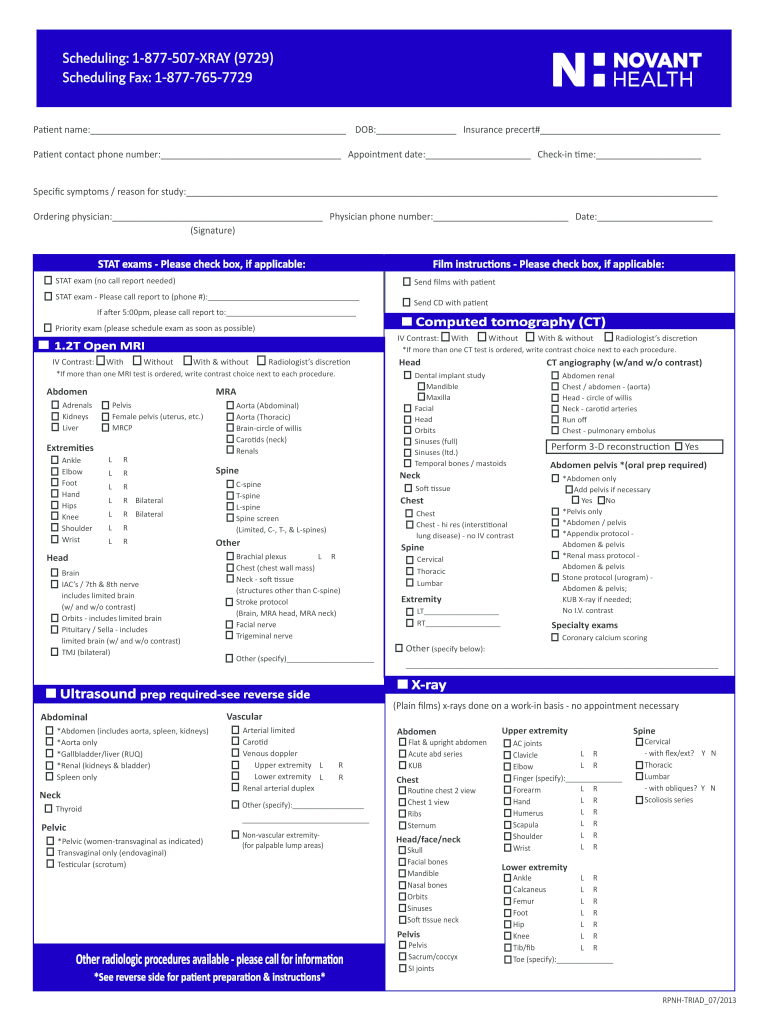







Definition and Meaning of the Novant Health Imaging Triad Requisition Form
The Novant Health Imaging Triad Requisition Form is a crucial document used to facilitate medical imaging appointments within the Novant Health network in the Triad region of North Carolina. This form is standardized to ensure that healthcare providers can efficiently schedule imaging services, which include a variety of diagnostic tests such as X-rays, CT scans, MRIs, and ultrasounds.
The form captures essential patient information, specifics regarding the imaging procedures requested, and details about the ordering physician. Properly completed requisition forms help streamline communication between medical professionals and imaging departments, ensuring that patients receive timely and appropriate care.
Importance of the Requisition Form
- Patient Identification: Contains vital information about the patient’s demographics, ensuring that the imaging services are associated with the correct individual.
- Physician Reference: Establishes a link between the patient and the ordering physician, which is critical for follow-up and additional care.
- Imaging Details: Specifies the type of imaging required and any preparatory guidelines, which enhances the efficiency of the imaging process.
How to Use the Novant Health Imaging Triad Requisition Form
Using the Novant Health Imaging Triad Requisition Form involves a series of straightforward steps designed to assure accurate submissions. Proper usage ensures that both the healthcare provider and the patient benefit from a smooth imaging scheduling process.
- Access the Form: Obtain a copy of the requisition form from authorized sources such as Novant Health facilities or online resources affiliated with Novant Health.
- Fill Out Patient Information: Ensure that the patient's name, date of birth, and insurance information are clearly specified. This information is essential for billing and medical records.
- Provide Imaging Details: Indicate the specific imaging tests required, along with any additional comments or instructions pertinent to the procedure.
- Order Physician's Information: Include details about the ordering physician, such as their name, contact information, and specialty. This assists in clarifying any medical inquiries that may arise.
- Submission: The completed requisition form can then be submitted electronically or physically to the designated imaging center for processing.
Key Considerations for Effective Usage
- Ensure all information is accurate to prevent scheduling errors.
- Follow any additional instructions provided alongside the form, particularly those relating to patient preparation for specific imaging tests.
- Prior to submission, review the form for completeness to ensure all required fields are filled out.
Steps to Complete the Novant Health Imaging Triad Requisition Form
Completing the Novant Health Imaging Triad Requisition Form requires attention to detail and an understanding of the specific requirements for each imaging service. Below are the recommended steps to ensure a successful completion.
-
Gather Information:
- Collect necessary patient details, including personal and demographic data.
- Ensure that the ordering physician has consented and provided necessary information.
-
Patient Section:
- Fill in all sections such as name, date of birth, and insurance details. Accurate patient identification is crucial for processing.
-
Procedure Selection:
- Clearly mark the imaging procedure(s) required. If unsure, consult with the ordering physician for clarification on specific imaging tests needed.
-
Additional Notes:
- Use the comments section to provide any specific instructions or concerns the imaging facility should be aware of, such as allergies or previous imaging records.
-
Double-Check:
- Review all entries for accuracy and completeness. Errors can lead to delays or incorrect imaging.
-
Submission:
- Ensure that the completed form is submitted to the right imaging department via the preferred method (in-person, online, or fax).
Tips for Completing the Form
- Use legible handwriting if completing a paper form.
- Consider electronic submission where possible for quicker processing.
- Keep a copy of the submitted form for future reference.
Important Terms Related to the Novant Health Imaging Triad Requisition Form
Familiarity with key terms associated with the Novant Health Imaging Triad Requisition Form enhances the user's understanding of the document and the procedures it supports. Awareness of these terms can aid in effective communication with healthcare professionals and ensure that all parties involved are aligned.
- Requisition: A formal request for medical services or tests.
- Imaging Procedures: Diagnostic tests such as MRIs, CT scans, ultrasounds, and X-rays designed to visualize internal body structures.
- Ordering Physician: The medical professional who requests the imaging tests, responsible for interpreting the results and guiding patient care.
- Patient Preparation: Specific instructions that patients must follow prior to imaging, which may include fasting or restricting certain medications.
- HIPAA Compliance: Regulations that protect patient privacy during the handling and sharing of medical information.
Contextual Usage of Terms
Understanding these terms is essential. For example, knowing the difference between an MRI and a CT scan can influence patient preparation and scheduling. Ensuring that the physician's information is accurately recorded affects communication, particularly when follow-up care is needed based on imaging results.
Examples of Using the Novant Health Imaging Triad Requisition Form
The Novant Health Imaging Triad Requisition Form is used in various scenarios within the healthcare system, specifically tailored for different imaging needs. Here are some examples of how this form can be employed effectively in practice.
-
Routine Screening: A physician may request a routine breast MRI for a patient with a family history of breast cancer. The requisition form would capture the patient's information and explicitly state the procedure, ensuring timely scheduling.
-
Follow-Up Imaging: After a patient has undergone a CT scan, the physician may determine that a follow-up ultrasound is necessary. The requisition form can be used again to facilitate this additional procedure, citing previous imaging results for reference.
-
Surgical Planning: In cases where imaging is required before surgery, such as a pre-operative MRI for orthopedic evaluation, the form ensures that all necessary data is provided to facilitate seamless coordination among medical teams.
Real-World Application
In a multidisciplinary healthcare setting, the requisition form acts as a communication bridge between differing specialties, enabling smooth transitions for patient care. For instance, if a patient is referred from a primary care physician to a specialist, the latter can easily access imaging needs documented via the requisition form, streamlining the diagnostic process.




