






Definition and Meaning of the Certificate Origin FXF Form Sample
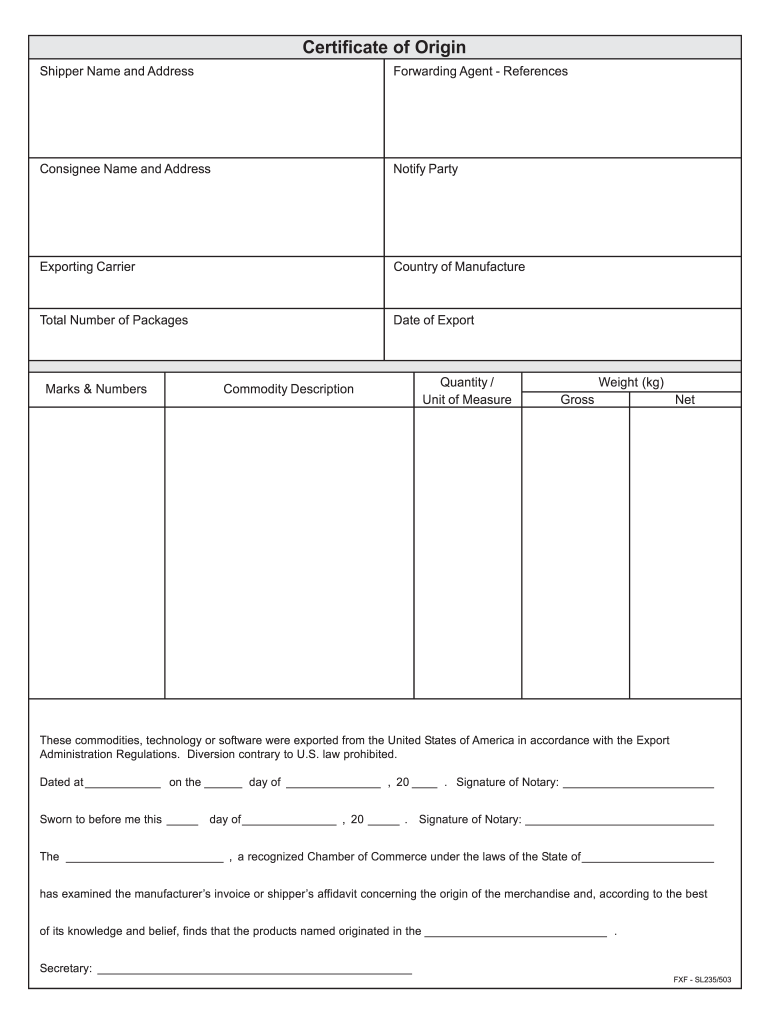
The certificate origin FXF form is an essential document used in international trade to verify and confirm the country of origin of goods being exported. This form is particularly important for exporters and importers as it demonstrates compliance with trade regulations and helps to secure preferential tariff treatment under various trade agreements. The certificate includes crucial information such as details of the shipper and consignee, a description of the goods, and a declaration affirming the origin of the commodities. By ensuring that products qualify under specific rules of origin, businesses can take advantage of reduced duties and tariffs when trading between the United States and other countries, especially in light of agreements like USMCA.
Importance of Origin Certification
This certification plays a vital role in facilitating smoother customs clearance processes. Customs authorities often require this documentation to prevent fraudulent activities such as mislabeling goods, which can affect market dynamics and economic integrity. Moreover, providing accurate certificates can help maintain brand reputation and foster trust between trading partners.
Steps to Complete the Certificate Origin FXF Form Sample
Filling out the certificate origin FXF form requires meticulous attention to detail to ensure compliance with both domestic and international trade regulations. The following steps outline how to complete the document accurately.
-
Identify the Document: Ensure you have the correct version of the certificate origin FXF form. Obtain the latest template as industry regulations may change.
-
Complete Shipper Information:
- Enter the name, address, and contact details of the shipper.
- Clearly provide identification numbers if applicable.
-
Fill in Consignee Details:
- Include the consignee's name, address, and contact information.
- Ensure that these details match those on the shipping documentation.
-
Describe the Goods:
- Provide a precise description of the goods being exported. Include quantities, unit measurements, and Harmonized System codes when applicable.
-
Declare Origin:
- Sign and date the declaration stating the goods are of US origin, and provide necessary notary signatures if required.
- Review eligibility under trade agreement guidelines, such as the USMCA, to confirm the legitimacy of the origin claim.
-
Review and Finalize:
- Double-check all entries for accuracy and completeness. Ensure that any required supplemental documentation is attached before submission.
-
Submit the Document:
- Determine the method of submission, either electronically or via traditional mail, depending on the importer's requirements.
-
Keep Records:
- Retain copies of the completed certificate and any correspondence related to the form for future reference and compliance audits.
Who Typically Uses the Certificate Origin FXF Form Sample?
The certificate origin FXF form is predominantly used by businesses involved in international trade. Key users include:
-
Exporters: Companies that send goods abroad need to provide proof of origin to avail themselves of trade benefits and comply with regulations.
-
Importers: Businesses receiving goods from other countries must obtain certificates to ensure compliance with local laws and to benefit from reduced tariffs.
-
Freight Forwarders: These individuals or companies manage shipping logistics for exporters and importers, often assisting in the preparation of necessary documentation.
-
Customs Brokers: Professionals who facilitate the clearance of goods through customs may assist clients in obtaining and filing the certificate to comply with regulations.
-
Manufacturers: Companies producing goods for export must issue certificates to affirm compliance with origin rules, especially when benefiting from trade agreements.
Each of these stakeholders plays a crucial role in ensuring that the certificate origin FXF form is completed accurately and submitted correctly to avoid delays and penalties.


Legal Use of the Certificate Origin FXF Form Sample
The certificate origin FXF form must adhere to various legal standards governing international trade. Understanding these legal requirements is essential for both compliance and risk management.
Compliance with Trade Laws
-
USMCA Compliance: Under the United States-Mexico-Canada Agreement (USMCA), exporters must ensure that their products meet specific criteria to qualify for reduced tariffs. The certificate serves as proof that goods meet the requisite origin standards specified in the agreement.
-
Customs Regulations: U.S. Customs and Border Protection (CBP) enforces regulations surrounding certificates of origin. Non-compliance can lead to significant penalties, including fines or increased duties.
-
Documentation Requirements: The form must be properly filled out with accurate details to comply with state and federal regulations. Any discrepancies could result in penalties or seizure of goods.
Legal Consequences of Misuse
-
Fines and Penalties: Filing an incorrect certificate can result in fines from customs authorities. Legal actions can also arise from allegations of fraudulent misrepresentation of goods’ origins.
-
Reputation Damages: Non-compliance can severely damage a company’s reputation, leading to lost business opportunities and trust issues with trading partners.
Important Terms Related to the Certificate Origin FXF Form Sample
Understanding key terminology related to the certificate origin FXF form can facilitate better compliance and completion of this critical document. Here are some crucial terms:
-
Certificate of Origin: A document that certifies the country of origin of goods, reflecting compliance with trade agreements and aiding in proper tariff classification.
-
USMCA: An agreement aimed at promoting trade between the United States, Canada, and Mexico, ensuring that businesses can benefit from reduced tariffs when certain origin criteria are met.
-
Harmonized System (HS) Code: An internationally standardized numerical method for classifying traded products which aids in determining tariffs and import/export regulations.
-
Notarization: The process of certifying a document’s authenticity, often required for the certificate to confirm the validity of the signature.
-
Freight Forwarder: A third-party logistics provider that manages and oversees the shipping process, including the documentation required for transport.
Understanding these terms provides clarity and reduces the risk of errors during the completion and submission of the certificate origin FXF form.
Examples of Using the Certificate Origin FXF Form Sample
Utilizing the certificate origin FXF form sample effectively can streamline the export process and ensure compliance with international regulations. Here are several scenarios demonstrating its practical application.
Scenario One: Exporting Clothing from the U.S. to Canada
A textile manufacturer in California exports a shipment of apparel to a retailer in Toronto. To benefit from USMCA provisions, the manufacturer completes the certificate origin FXF form, declaring that the clothing is wholly produced in the United States. The retailer then uses this document to clear customs efficiently and avoid substantial tariffs on the imported goods.
Scenario Two: Importing Electronics to the U.S.
An American tech company sources components from a partner in Mexico. To ensure compliance and take advantage of lower tariffs under the USMCA, the Mexican supplier issues a certificate origin FXF form, stating that the exported components meet the origin criteria. This form is critical for the tech company to avoid unnecessary duties when importing goods into the U.S.
Scenario Three: Food Products Export to Mexico
A farmer in Texas exports organic produce to a distributor in Mexico. To validate the origin of the agricultural products and adhere to trade standards, the farmer fills out the certificate origin FXF form. This documentation confirms that the produce is cultivated in the U.S., thus allowing the exporter to comply with import regulations while enjoying preferential treatment under trade laws.
These examples highlight the importance of accurately completing and submitting the certificate origin FXF form to facilitate international trade and adhere to legal requirements.