




01. Edit your sf 702 online
Type text, add images, blackout confidential details, add comments, highlights and more.

Type text, add images, blackout confidential details, add comments, highlights and more.

Draw your signature, type it, upload its image, or use your mobile device as a signature pad.

Send sf702 via email, link, or fax. You can also download it, export it or print it out.
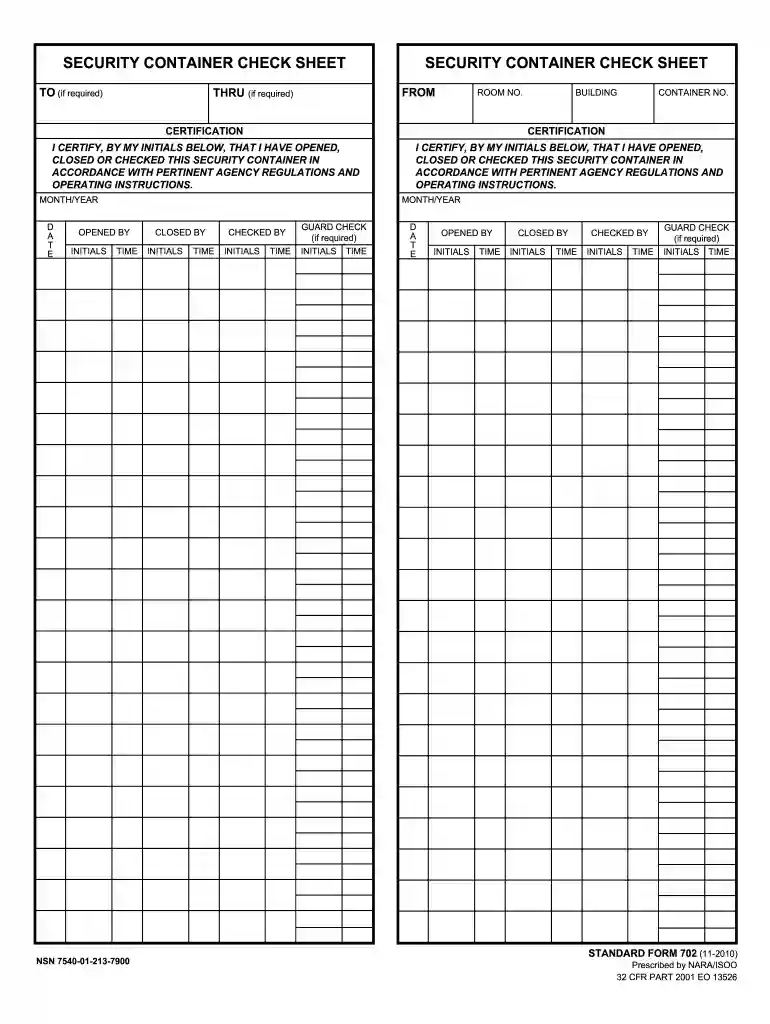
Standard Form 702 (SF 702) is an essential document utilized for certifying the opening, closing, and checking of security containers in compliance with agency regulations. Its primary purpose is to ensure the secure handling and storage of sensitive materials by providing a systematic method for documenting the actions involving these areas.
SF 702 encompasses several critical sections that guide the user through the necessary procedures for securing sensitive material. The key components include:
Security Container Identification: This section requires users to specify the type of security container used, ensuring clarity in tracking the specific container that is being documented.
Dates and Times: Proper timestamping is crucial in maintaining a clear audit trail. This section mandates that users record the date and time of every action taken related to the security container.
Personnel Initials: Each action taken needs to be certified by signing, hence individuals involved in the opening or closing of the container must initial their entries to verify their participation.
To ensure the effective use of Standard Form 702, it is vital to follow specific steps:
Prepare the Form: Ensure that the form is filled out accurately before any container is opened or closed. Identify the security container and date clearly.
Record Actions: Document every action, including opening, closing, and any checks performed. Each event should be logged with the corresponding date, time, and personnel initials.
Review for Completeness: Before finalizing, check that all necessary fields are completed and that all entries are signed by the respective personnel.
Utilizing the SF 702 form is critical for maintaining security protocol as it offers:
Traceability: Effective record-keeping ensures that any discrepancies can trace back to precise personnel actions, fostering accountability.
Compliance: Adhering to the guidelines set forth in the SF 702 is necessary for organizations to remain compliant with federal regulations regarding the handling of classified and sensitive materials.
Organizational Efficiency: The systematic approach of the SF 702 enables organizations to streamline their security processes, reducing the risk of errors in document handling.
While SF 702 is widely recognized, there are other forms with similar functions:
DA Form 702 and AF Form 702: These versions are used by the Army and Air Force, respectively, catering to the specific security protocols of each service branch. Each of these forms mirrors the SF 702 in function but may differ slightly in format or additional instructions specific to their military branch.
Standard Form 702 Rev 1 2020: This is the most updated version of the form and incorporates any changes mandated through the relevant authority updates to security procedures.
The SF 702 serves not only operational purposes but also legal obligations. Adhering to its usage guidelines can mitigate liabilities associated with mismanagement of sensitive materials:
Document Retention: Organizations must retain completed SF 702 forms as part of their compliance documentation for auditing and review processes.
Audit Preparedness: Regular checks and proper file maintenance utilizing the SF 702 ensures that organizations are prepared for potential audits by regulatory bodies.
Standard Form 702 is not just a regulatory requirement; it is a cornerstone of effective security management protocols. By ensuring accurate documentation for every operation involving security containers, organizations can protect their sensitive materials and maintain compliance with federal standards. The consistent and correct usage of SF 702 contributes significantly to operational integrity and accountability within sensitive environments.
We've got more versions of the sf 702 form. Select the right sf 702 version from the list and start editing it straight away!
At DocHub, your data security is our priority. We follow HIPAA, SOC2, GDPR, and other standards, so you can work on your documents with confidence.
Sep 27, 2021 Security Container Check Sheet. Information. Form Number: SF702; Current Revision Date: 01/2020; Authority or Regulation: 32 CFR PART 2001 andRead more
by N Macdonald Cited by 1 Of the several new automatic data process- ing machines operating at the center, the larg- est, most powerful, and one of the newest ma- chines was the IBM 702.Read more


