




What this application covers
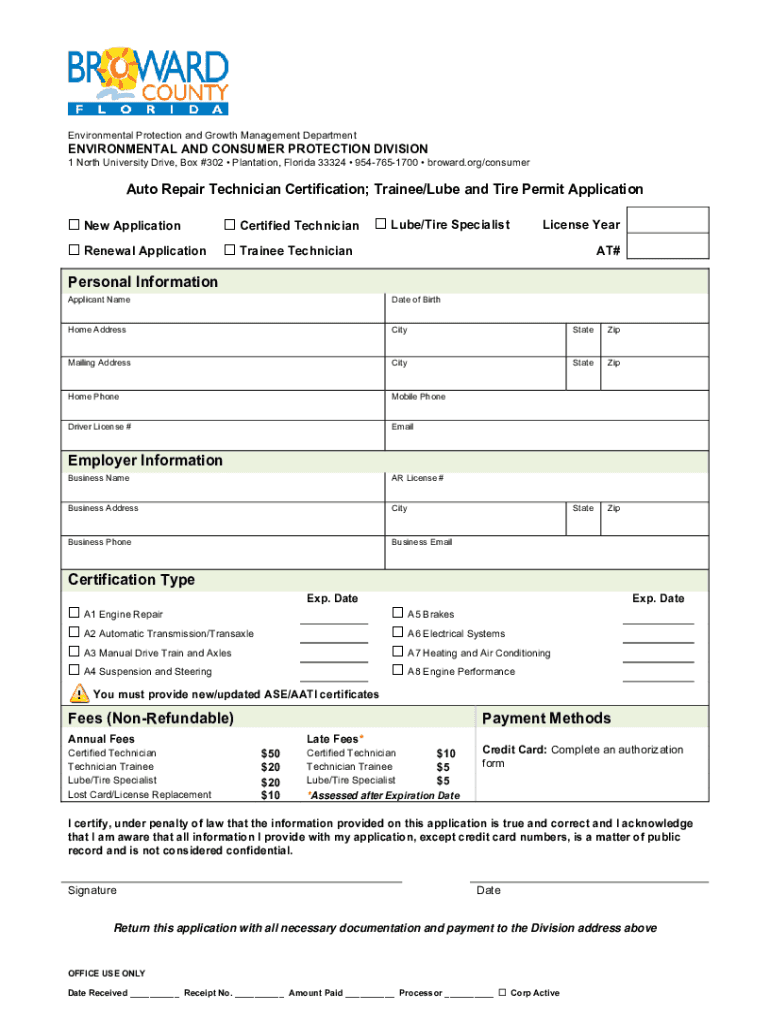
The Auto Repair Technician Certification Application is used to request certification for technicians who work in the auto repair industry under a local consumer protection program, rather than as a general state mechanic license. In Broward County, Florida, this type of application is tied to county-level regulation of auto repair businesses and the technicians who perform repair services for the public.
The form typically helps the reviewing agency identify who the technician is, where they work, what kind of repair work they perform, and whether they meet the local requirements for certification. In practice, the application is part of a broader compliance process that supports consumer protection, shop accountability, and recordkeeping.
This application is usually relevant when a technician is:
- Beginning work at a regulated auto repair business
- Updating a prior certification
- Changing employers or business locations
- Providing documentation for a county inspection or licensing file
In a U.S. context, the form is not generally about federal tax or IRS filing. It is more commonly connected to local regulatory compliance, especially where counties require auto repair personnel to be identified and certified for consumer protection purposes. That makes accuracy important, because the information can affect whether a technician is allowed to perform certain work under the business’s registration or license.
Who usually needs it
The Auto Repair Technician Certification Application is most often used by people who perform repair, diagnostic, or maintenance work in an auto repair setting and whose employer or county rules require technician certification. That can include entry-level technicians, experienced mechanics, diagnostic specialists, and service personnel whose duties fall within the scope of regulated repair activity.
Common users include:
- Technicians employed by independent repair shops
- Employees of dealership service departments, when local rules apply
- Mobile repair personnel, if the business model is covered by the county program
- Shop owners applying on behalf of themselves when they also perform repair work
In some cases, the form may also be used by business operators who need to demonstrate that the technicians working in the shop are properly documented. This is especially important where local consumer protection rules require a listed technician roster or individual certification records.
The application is less likely to be relevant for people who only sell parts, perform clerical work, or handle customer service without actually carrying out repair tasks. It is also different from consumer complaint forms, business tax registrations, or general occupational licenses, so the applicant should confirm that the form matches the work being performed.
Eligibility and qualification factors
Eligibility for an auto repair technician certification application usually depends on the local rules that govern the county or municipality issuing the certification. In Broward County-style programs, the review often focuses on whether the applicant is actually working in the auto repair field and whether the business location is properly registered or recognized.
Typical qualification factors may include:
- Proof of identity
- Current employment with a regulated auto repair business
- Information about prior experience or training
- Any required background or compliance disclosures
- Payment of the applicable fee, if the program requires one
Some programs focus less on formal schooling and more on whether the technician has the practical ability and lawful authorization to work in the trade. Others may ask about certifications such as ASE credentials, trade school training, or prior work history, especially if the county uses those details to classify the technician.
An applicant may have to address edge cases such as:
- A new technician with limited work history
- A technician moving from one shop to another
- An owner who performs repairs personally and also manages the shop
- A technician whose name changed due to marriage or other legal update
If the application asks for qualifications, the most reliable approach is to provide the facts exactly as supported by records, since mismatches between employment history, business records, and the application can slow approval.
Information commonly required
An auto repair technician certification application generally asks for identifying information, work details, and sometimes employer information. The exact fields can vary, but the structure usually supports the agency’s need to connect a person to a place of business and a repair role.
Common information fields include:
- Full legal name
- Home or mailing address
- Phone number and email address
- Date of birth or other identity verification detail
- Employer or shop name
- Shop address and contact information
- Job title or technician classification
Some forms also ask for:
- License or certification numbers, if applicable
- Prior employment history in auto repair
- Proof of training or trade experience
- Signature and date of certification
- Employer acknowledgment or approval section
Where the form includes a declaration, it may require the applicant to certify that the information is true and complete. That section matters because false or incomplete information can affect the certification outcome and may create later compliance problems for both the technician and the shop.
A practical way to think about the required information is in three parts:
- Who the technician is
- Where the technician works
- What authority or qualification supports the request
How to complete the form
Completing the Auto Repair Technician Certification Application usually begins with reading the instructions carefully and confirming whether the form applies to the current business location. Because local rules may differ by county or department, it is important to use the version that matches the jurisdiction and the current filing requirements.
A typical completion process looks like this:
- Enter the technician’s legal name exactly as it appears on identity documents.
- Provide current contact details and a reliable mailing address.
- List the employer, shop name, and physical work location.
- Complete any sections about training, experience, or previous certifications.
- Review any compliance statements or attestation language.
- Sign and date the application in the correct section.
If the form includes fields for attachments, those materials should be organized before submission. Common supporting items may include proof of identity, employment confirmation, or training records. When documents are missing or inconsistent, the reviewing office may reject the application or request clarification.
A frequent issue is the use of abbreviations, nicknames, or outdated addresses. For example, if a technician has moved recently, the application should show the current mailing address, while the business location should remain the actual repair site. Another common issue is leaving employment fields blank when the form clearly expects the current employer, supervisor, or business license information.
Supporting documents and records
Supporting documents help verify the details listed in the application and reduce delays during review. The exact list depends on the local authority, but many applications benefit from clear, current documentation that matches the form entries.
Documents that may be requested include:
- Government-issued photo identification
- Proof of current employment
- Training certificates or trade school records
- ASE or other industry certifications
- Business registration or license information for the employer
- Proof of address, if required by the filing office
The most useful supporting records are those that directly confirm the technician’s identity and work relationship. For example, a pay stub alone may not be enough if it does not identify the employer clearly. Likewise, a training certificate can support experience claims, but it usually does not replace a required business document.
When documents are uploaded or attached, consistency matters. The applicant’s name should match across the application, identification, and employment records whenever possible. If there is a legal name change or an address change, supporting documentation should show that the discrepancy is legitimate and not an error.
It is also helpful to retain copies of everything submitted. That creates a record in case the agency requests a correction, the shop needs to verify technician status later, or a renewal is required and prior information must be referenced.
Submission and processing
Submission methods for this type of application often depend on the county office that issues the certification. Some agencies accept in-person submissions, while others may permit mail delivery or, in limited cases, digital processing. The available method can affect both the speed of review and the ability to correct missing information quickly.
Common submission approaches include:
- In-person filing at the appropriate consumer protection or licensing office
- Mail submission with printed forms and attachments
- Electronic submission, if the agency supports online intake or scanned documents
Processing time may vary based on whether the form is complete, whether attachments are included, and whether the applicant’s employer is already in good standing with the issuing office. A straightforward application with complete documentation is usually easier to review than one with inconsistent or missing details.
There are also practical differences between submission methods:
- In-person filing may allow immediate questions to be addressed
- Mail filing may take longer and requires careful use of the correct address
- Electronic filing may be easier to track, but only if the office accepts it and the files are legible
If the application is part of a local auto repair compliance program, the agency may also review the business’s registration status before issuing the technician certification. That means one person’s application can be affected by the shop’s own licensing or consumer protection history.
Legal and compliance significance
An auto repair technician certification application is more than an administrative form. It can affect whether a person is allowed to perform regulated work under local rules, and it may become part of the business’s compliance file. For that reason, the information provided should be accurate, complete, and consistent with employment and business records.
The legal significance often includes:
- Documenting who is authorized to perform repair work for the business
- Supporting consumer protection oversight
- Creating a record that can be reviewed during inspections or investigations
- Helping the county confirm that the repair operation is properly staffed and disclosed
In some jurisdictions, false statements on a certification application can lead to denial, suspension, revocation, or other enforcement action. If the form includes a signature block with an attestation, that signature usually confirms that the applicant understands the legal effect of the submission.
A technician should also be aware that certification may not be the same as a professional license issued by the state. In Florida, many auto repair requirements are local or business-focused rather than a single statewide technician credential. That distinction matters because a person may be fully qualified to work in the trade but still need to satisfy county-level rules before doing so in a particular location.
Common errors and delays
The most common problems with this application are usually simple, but they can still delay approval. Missing signatures, incomplete employer information, and inconsistent names are among the most frequent causes of review issues.
Common mistakes include:
- Using a nickname instead of the legal name
- Listing an old employer or former shop address
- Leaving required fields blank
- Forgetting to date the application
- Submitting illegible copies of identification or training records
Another frequent issue is assuming the form is self-contained when it actually depends on other business records. If the employer’s registration is expired, if the business address is incorrect, or if the technician’s role is not clearly identified, the filing office may pause the application until the related issue is resolved.
Some applicants also confuse technician certification with:
- A business tax receipt
- A state mechanic license
- A consumer complaint response
- A general employment application
Those are different records with different purposes. Keeping them separate reduces confusion and prevents an incorrect filing from being sent to the agency.
Variations and related forms
Local auto repair certification programs sometimes use more than one version of a form, depending on whether the applicant is new, renewing, changing employers, or updating records. The exact title can also vary slightly from one county or department to another.
Possible variations include:
- New technician application
- Renewal or re-certification form
- Change of employer update
- Replacement or duplicate certificate request
- Shop-level technician roster update
Some businesses maintain internal versions of the same information for compliance tracking, even when the official form belongs to the county. In those cases, the internal document may help organize staff data, but it does not replace the official application.
A related issue is whether the certification is individual or tied to a business location. In some programs, a technician’s approval only has meaning when associated with a specific registered repair shop. If the technician changes employers, a new filing or update may be required.
For people who work in more than one setting, it is especially important to check whether each location needs its own disclosure or whether the certification follows the technician across employers. That rule can change the way the application is completed and maintained.


