




Definition & Meaning
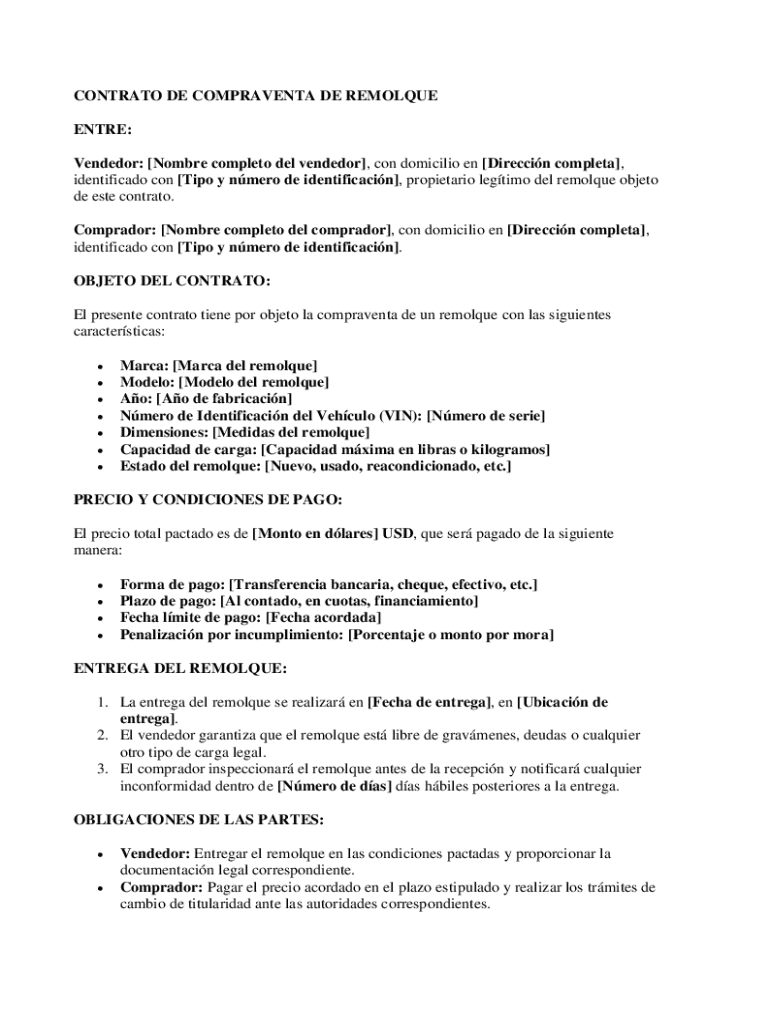
The "Contrato de Compraventa de Remolque," or Trailer Purchase Agreement, is a legal document used to formalize the sale of a trailer between a buyer and a seller. This contract outlines the terms and conditions agreed upon by both parties and serves as a binding agreement protecting their rights. The document includes details like the trailer's specifications, purchase price, payment method, and delivery terms, ensuring clarity and reducing the risk of disputes.
Important Components
- Identification of Parties: Clearly names and provides contact information for both the seller and the buyer.
- Description of Trailer: Detailed specifications including make, model, year, and VIN (Vehicle Identification Number).
- Sale Price: The agreed-upon amount to be paid for the trailer.
- Payment Terms: Payment methods and schedules.
- Warranties: Any guarantees provided by the seller for the trailer.
- Liabilities and Indemnities: Provisions that shield either party from legal liability in the event of specific issues.
- Signatures: Required from both parties to validate the contract.
How to Use the Contrato de Compraventa de Remolque
To utilize this agreement effectively, both parties must understand its clauses and voluntarily consent to its stipulations. The form can be employed in various situations such as private sales or transactions involving dealerships. Parties should negotiate terms to ensure mutual satisfaction before finalizing the contract.
Practical Steps
- Initial Discussion: Parties should agree on basic terms such as price and delivery before drafting the document.
- Drafting the Contract: Use a template or draft the document from scratch, ensuring all essential details are included.
- Review and Negotiate: Each party should carefully review the draft and negotiate any terms that are unclear or disagreeable.
- Finalization and Signing: Once agreed upon, both parties sign the contract to make it legally binding.
Steps to Complete the Contrato de Compraventa de Remolque
Completing the form requires careful attention to detail to ensure that all information is accurate and comprehensive.
Detailed Process
- Gather Information: Collect all necessary data regarding the trailer and parties involved.
- Fill Out the Form: Input details including the buyer and seller’s names, trailer information, and sale terms.
- Review: Both parties should review the form for errors or omissions.
- Amend if Needed: Make necessary adjustments based on the review.
- Sign and Date: Ensure both parties, and any witnesses if required, sign and date the document.
Common Errors to Avoid
- Missing or incorrect VIN numbers.
- Incomplete signatures or dates.
- Vague payment terms.
Key Elements of the Contrato de Compraventa de Remolque
The contract must include fundamental elements that define the obligations and rights of both parties involved in the sale of the trailer.
Core Elements
- Full Descriptions: Ensure the trailer's details are precise to avoid any future disputes.
- Payment Arrangements: Clearly outline how and when payments will be made.
- Transfer of Ownership: Detail the process and timing for transferring ownership and registration.
- Condition of Trailer: Disclosure of the trailer's condition at the time of sale.
Additional Considerations
- Include terms for resolving possible disputes.
- Define any post-sale responsibilities such as maintenance or repair obligations.
Legal Use of the Contrato de Compraventa de Remolque
Adhering to legal standards is crucial for the contract to be enforceable. The document must be constructed and executed in compliance with the law to ensure it holds up in a legal setting.
Compliance Aspects
- State Law Adherence: Ensure the contract meets state-specific requirements where the transaction occurs.
- Clarity: Use clear, unambiguous language to avoid misinterpretation.
- Consent: Both parties must voluntarily agree to the contract terms.
- Legal Capacity: Ensure both individuals have the legal capacity to enter into a contract.
State-Specific Rules for the Contrato de Compraventa de Remolque
Different states may have varying requirements for such agreements. Ensuring that these local laws and rules are adhered to is crucial for the contract's validity.
Variation Examples
- Notary Requirements: Some states mandate notarization of signatures.
- Registration Protocols: Variations in how and where a trailer must be registered post-purchase.
- Tax Implications: Differences in state sales tax rules and requirements.
Who Typically Uses the Contrato de Compraventa de Remolque
This form is utilized by a diverse group of individuals and entities involved in the buying and selling of trailers.

Typical Users
- Private Buyers and Sellers: Individuals engaging in private transactions for personal use.
- Dealerships: Professional sellers who require standardized contracts.
- Business Owners: Companies purchasing trailers for commercial purposes.
Examples of Using the Contrato de Compraventa de Remolque
This clause illustrates real-world applications of the form, providing insight into its practical utility.
Scenario Examples
- Private Sale: An individual selling their personal trailer to another person after a classified advertisement.
- Dealership Transaction: A dealership selling new or used trailers including warranties and service agreements.
- Business Acquisition: A construction company acquiring trailers for operational use, requiring customized terms to suit business needs.
Prioritizing these elements will ensure that users have a comprehensive understanding of the "Contrato de Compraventa de Remolque," enabling efficient and effective documentation of trailer sales.