Child Custody Visitation Agreement Template 2026

Get Form
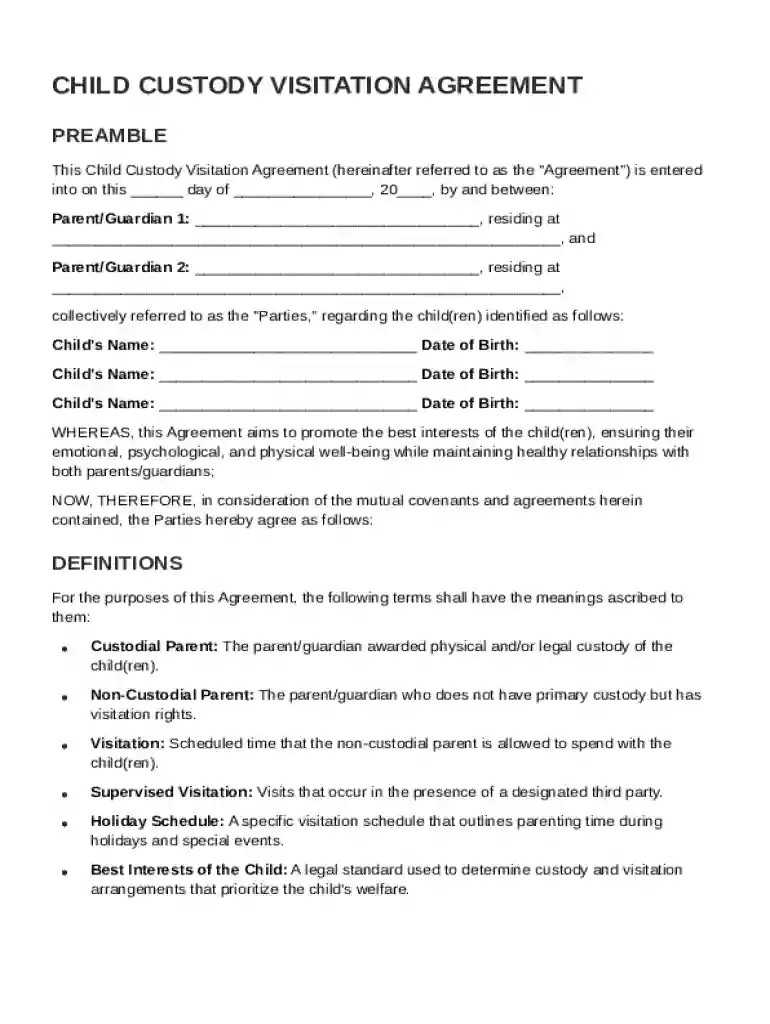
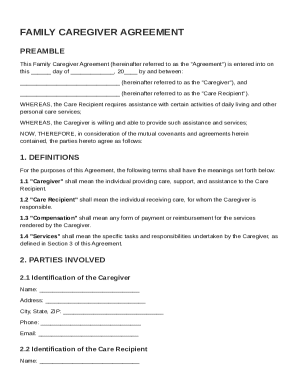
Child Custody Visitation Agreement Template Preview on Page 1

Here's how it works

01. Edit your form online
Type text, add images, blackout confidential details, add comments, highlights and more.

02. Sign it in a few clicks
Draw your signature, type it, upload its image, or use your mobile device as a signature pad.

03. Share your form with others
Send it via email, link, or fax. You can also download it, export it or print it out.

Definition and Meaning of the Child Custody Visitation Agreement Template

The Child Custody Visitation Agreement Template is a standardized document used to outline the terms and conditions relating to custody and visitation rights of children between parents or guardians. It clearly delineates the roles of custodial and non-custodial parents, ensuring clarity on both parties' responsibilities. Importantly, the template serves to protect the best interests of the children involved by promoting stability and structured interaction with both parents. By using a template, parents can ensure that all critical elements of the custody arrangement are documented, reducing potential disagreements or misunderstandings.

How to Use the Child Custody Visitation Agreement Template

Utilizing the Child Custody Visitation Agreement Template effectively involves several key steps. Firstly, both parents need to fill in personal information and details relevant to their family dynamics. Key aspects such as the preferred language, specific visitation schedules, and transportation arrangements must be clearly indicated.

  1. Personal Information: Enter the names and contact details of both parents.
  2. Visitation Schedules: Specify regular and holiday visitation times.
  3. Transportation: Outline who is responsible for transporting the child during visits.
  4. Communication Protocols: Establish guidelines for communication between visits.

It's crucial to review the completed template with a legal professional to ensure it complies with state laws and adequately represents both parties' interests.

Key Elements of the Child Custody Visitation Agreement Template

Several elements are integral to the Child Custody Visitation Agreement Template, each acting as a fundamental building block of the document:

  • Custodial Arrangements: Clearly outline who will hold primary custody and the specific conditions thereof.
  • Visitation Details: Define specific dates, times, and conditions for visitations.
  • Parenting Guidelines: Include rules around discipline, education, and healthcare.
  • Dispute Resolution: Set procedures for how disagreements will be resolved.
  • Acknowledgments: Both parties must sign and date the agreement, acknowledging their understanding and agreement to the terms.

Each section must be accurately completed to ensure the effectiveness and enforceability of the agreement.

Steps to Complete the Child Custody Visitation Agreement Template

Completing the agreement template involves these orderly steps:

  1. Gather Information: Collect personal details, work schedules, and school calendars.
  2. Draft the Agreement: Fill in the required sections using the template structure.
  3. Review Legal Implications: Consult with a family law attorney to determine legal compliance.
  4. Revise as Necessary: Amend the document based on legal advice.
  5. Finalize the Agreement: Both parents should thoroughly review and sign the document, witnessing by a third party if necessary.

Adhering to these steps helps ensure that the agreement is comprehensive and legally sound.

Legal Use of the Child Custody Visitation Agreement Template

In the U.S., each state has its regulations regarding child custody arrangements. Therefore, it's important to customize the template according to state-specific requirements. The agreement must align with the legal standards of the jurisdiction where it will be enforced. This involves consulting with a legal expert familiar with state family laws to ensure the document will hold up in legal settings.

State-Specific Rules for the Child Custody Visitation Agreement Template

State-specific laws play a pivotal role in shaping the terms of custody arrangements. For instance, states like California and New York have distinct stipulations regarding visitation rights and the mediation process. The template should be flexible enough to accommodate these variations, and parents should be prepared to make modifications to comply with state guidelines.

Researching and understanding state-specific legislation is crucial for ensuring the enforceability of your custody arrangement.

Examples of Using the Child Custody Visitation Agreement Template

Practical examples of using this template include situations where:

  • Parents Live in Different States: The agreement must accommodate the travel costs and arrangements unique to such scenarios.
  • Shared Physical Custody: When both parents intend to spend equal time with the children, detailing the split-week schedules becomes crucial.
  • Special Needs Considerations: Tailor the agreement to include necessary accommodations for children requiring additional care or resources.

Examining these scenarios highlights the importance of customization according to unique family dynamics.

Important Terms Related to the Child Custody Visitation Agreement Template

Understanding key terminology is essential when filling out the template:

  • Primary Custody: Refers to the parent with whom the child primarily resides.
  • Joint Custody: Both parents share decision-making responsibilities and custody.
  • Visitation Rights: The legal right awarded to the non-custodial parent to spend time with the child.
  • Mediation: A facilitated negotiation process to resolve disputes constructively.

Familiarity with these terms ensures that parties enter the agreement with a clear understanding of their responsibilities and rights.

Software Compatibility and Digital Use Considerations

When considering digital versus paper versions of the agreement, convenience and accessibility reaffirm the advantages of using platforms like DocHub. With online tools, you can:

  • Edit and Save: Make real-time edits and securely store the document.
  • Share Easily: Send digital forms for e-signatures and comments.
  • Access from Anywhere: Utilize cloud storage for immediate access anytime.

For users deeply integrated within digital environments, platforms like DocHub simplify the completion and management of legal forms such as the Child Custody Visitation Agreement Template.

be ready to get more

Complete this form in 5 minutes or less

Get form

Got questions?

We have answers to the most popular questions from our customers. If you can't find an answer to your question, please contact us.
Contact us
So, most divorcing parents hope for amicable child custody arrangements. The child custody arrangement you settle on will depend on your family. However, joint custody tends to be the most common child custody arrangement.
Emotions: The inability of parents to consistently control their emotions, and avoid emotional decision making, is the most common mistake we see in child custody cases. The reason: it is such an easy mistake to make, and so pervasive in all aspects of the case.
70/30 Parenting Schedule The child spends the week (Monday - Friday) with parent A, and the weekend (Saturday and Sunday) with parent B. The child spends two consecutive weeks (14 days) with parent A and one week (7 days) with parent B.
The following are six common ways for parents to split child custody evenly using a two-week time frame. Splitting Child Custody Every Other Week. Splitting Custody Every Other Week Plus One Overnight. A 3-3-4-4 Custody Schedule. A 2-2-5-5 Child Custody Schedule. A 2-2-3 Custody Schedule. Splitting Custody Every Other Day.
The common perception has historically favored mothers, but recent shifts in family law show that this assumption is no longer universally accurate. Courts today aim to make custody decisions based purely on the childs best interests, balancing various factors regardless of parental gender.

Security and compliance

At DocHub, your data security is our priority. We follow HIPAA, SOC2, GDPR, and other standards, so you can work on your documents with confidence.
Learn more
ccpa2
pci-dss
gdpr-compliance
hipaa
soc-compliance