
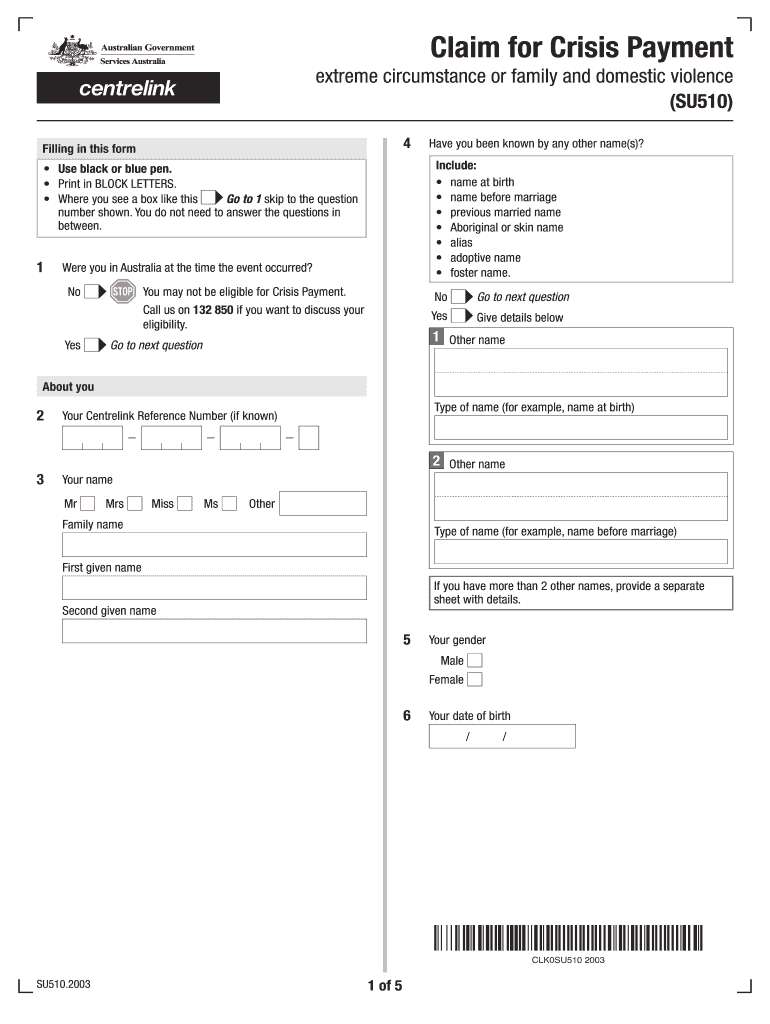







Definition & Meaning
The "Claim for Crisis Payment" is a specialized financial assistance form designed to provide support to individuals experiencing severe and immediate financial hardship due to unforeseen circumstances. This payment aims to offer temporary relief to help individuals cover essential living expenses during times of crisis. It is typically utilized in situations such as natural disasters, extreme personal distress, or instances of domestic violence. The form serves as a formal request for government financial aid catered to those needing urgent monetary intervention.
Real-World Examples
- A family displaced by a hurricane may use the form to secure immediate aid for temporary lodging and essentials.
- Victims of domestic violence seeking refuge might file the form to access necessary funds to secure a safe environment.
Eligibility Criteria
Eligibility for the Claim for Crisis Payment requires applicants to meet specific conditions, primarily centered around the nature and timing of their crisis. To qualify, individuals must demonstrate that they have experienced or will imminently experience a critical event leading to significant financial difficulty. The crisis must be recent, and applicants typically need to prove their inability to meet basic needs without assistance.


Key Eligibility Factors
- Situational Factors: Natural disaster impact, family violence, or other significant traumatic events.
- Timing: Generally, the crisis should have occurred within a set timeframe before the application.
- Financial Hardship: Proof of financial instability, typically illustrated through bank statements or income documentation.
How to Obtain the Claim for Crisis Payment
Acquiring a Claim for Crisis Payment involves accessing the relevant form through government services, which can often be completed online, by mail, or in-person. Prospective applicants should first confirm their eligibility, gather necessary documents, and then submit their application through the preferred channel.
Available Form Submission Methods
- Online: Accessible through designated government portals for fast processing.
- Mail: Traditional form submission, requiring postal services, which may involve longer processing times.
- In-Person: Visiting a government service center for direct assistance and submission.
Steps to Complete the Claim for Crisis Payment
Filing for a Claim for Crisis Payment involves a precise step-by-step approach to accurately complete and submit the form. Here's a typical process:
- Gather Required Documents: Identification, financial records, and documentation of the crisis.
- Access the Form: Obtain the form online, by mail, or in-person from government service offices.
- Complete the Form: Fill out personal details, crisis-specific questions, and financial information.
- Review the Submission: Ensure all sections are completed accurately before submission.
- Submit the Form: Choose between online, mail, or in-person submission based on personal convenience.
Required Documents
Completing a Claim for Crisis Payment necessitates a series of essential documents to verify identity, financial status, and the nature of the crisis. Accurate submission of these documents ensures faster processing of the application.
Documentation Checklist
- Identification: Driver’s license, passport, or state-issued ID.
- Financial Proof: Bank statements, pay stubs, or tax returns.
- Crisis Verification: Police reports in cases of violence, insurance claims post-disasters.
Benefits of Filing a Claim for Crisis Payment
Applying for a Claim for Crisis Payment offers immediate relief in critical situations, providing tangible benefits:
- Financial Relief: Immediate funds to address urgent needs, such as food, shelter, and clothing.
- Safety Assurance: Assistance in securing personal safety and stabilization, particularly in domestic violence cases.
- Support in Regeneration: Initial support that aids the recovery process, enabling individuals to rebuild their lives post-crisis.
Legal Use of the Claim for Crisis Payment
The Claim for Crisis Payment has a legal framework, ensuring that funds are used appropriately and applicants qualify under truthful pretenses. It is essential for applicants to understand these frameworks to maintain legitimacy and avoid penalties.
Key Legal Considerations
- Truthful Representation: Providing accurate crisis information is mandatory.
- Use of Funds: Funds should solely aid in managing crisis-related expenses.
Penalties for Non-Compliance
Failure to comply with the legal stipulations for a Claim for Crisis Payment can lead to penalties. Non-compliance includes falsifying information, misuse of funds, or fraudulent application processes.
Potential Consequences
- Refund Requirement: Repayment of the aid received due to misuse.
- Legal Action: Subject to prosecution if fraud is detected.
- Ineligibility for Future Aid: Risk of being barred from future government assistance programs.




